


























Views
Downloads

Essential Antonym Match Worksheet | Grade 1 ELA
Paste this activity's link or code into your existing LMS (Google Classroom, Canvas, Teams, Schoology, Moodle, etc.).
Students can open and work on the activity right away, with no student login required.
You'll still be able to track student progress and results from your teacher account.
This printable antonym worksheet helps first-grade students master word opposites through a multi-sensory approach. By engaging with word banks, sentence completion, and creative illustration, learners develop a robust understanding of lexical relationships. Students will transition from basic recognition to active application, building the foundational vocabulary skills necessary for reading comprehension and expressive writing.
At a Glance
- Grade: 1 · Subject: English Language Arts
- Standard:
CCSS.ELA-LITERACY.L.1.5— Demonstrate understanding of word relationships and nuances in word meanings- Skill Focus: Antonyms (Opposite Meanings)
- Format: 3 pages · 16 problems · Answer key included · PDF
- Best For: First-grade vocabulary building and independent practice
- Time: 20–30 minutes
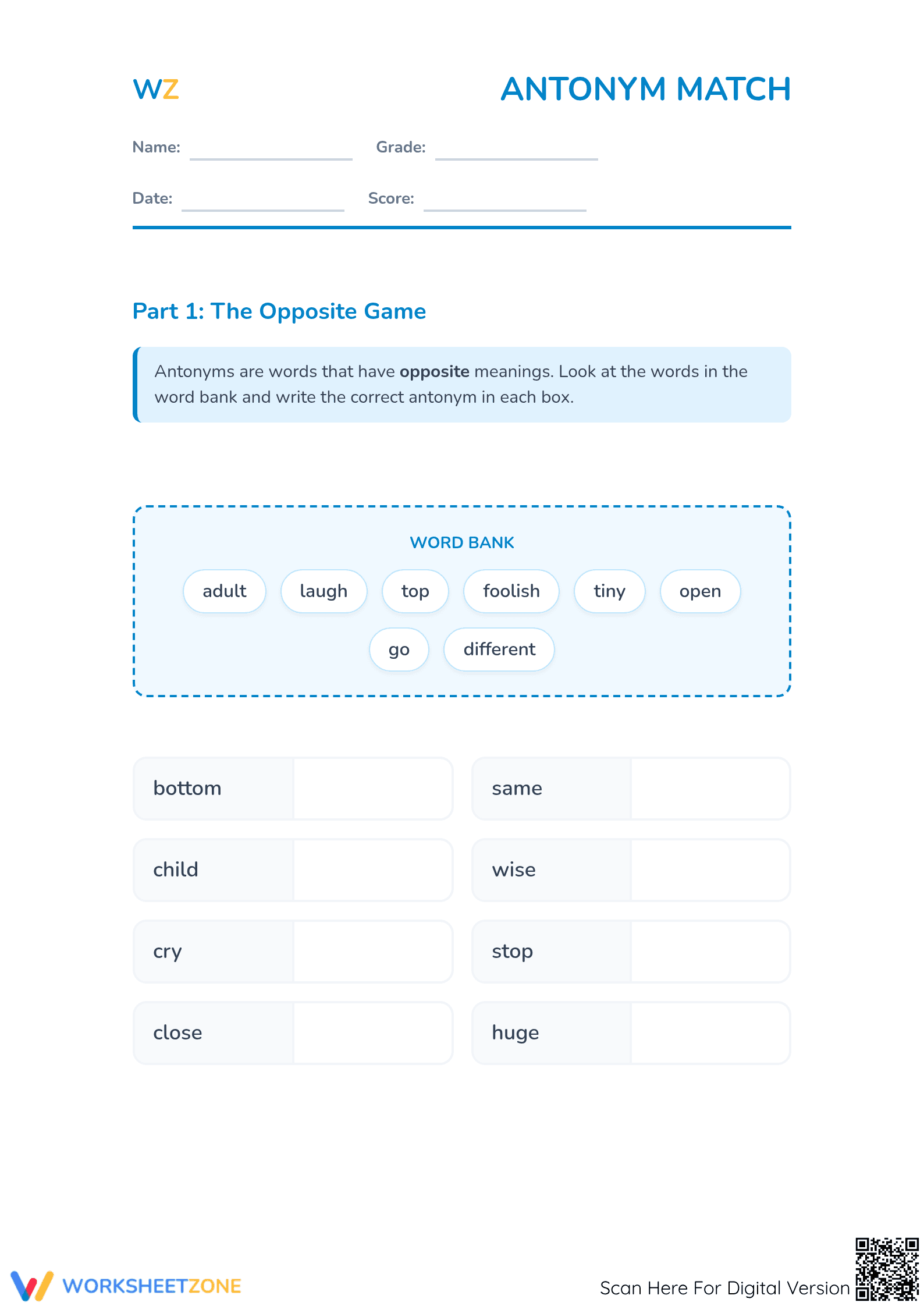
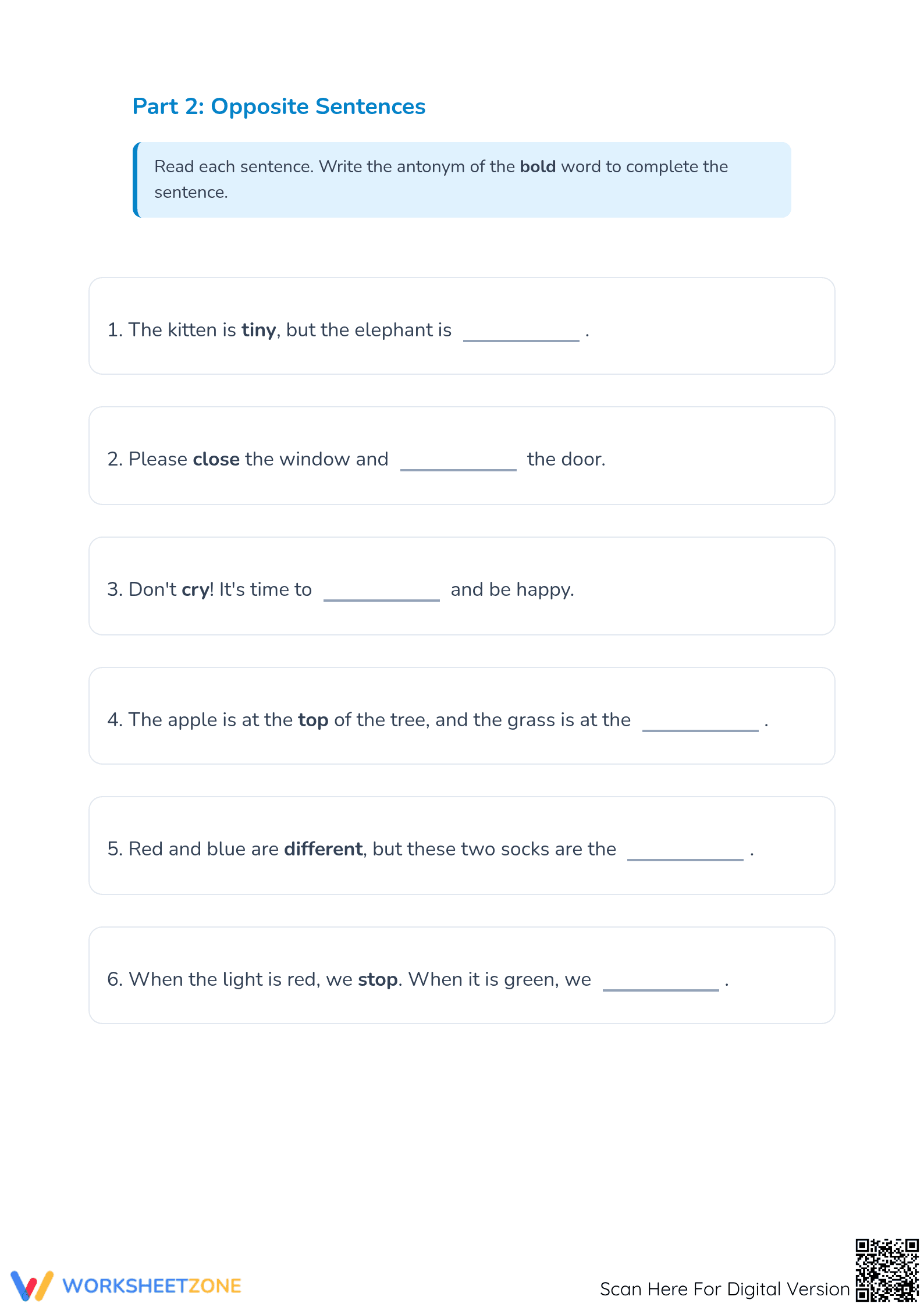
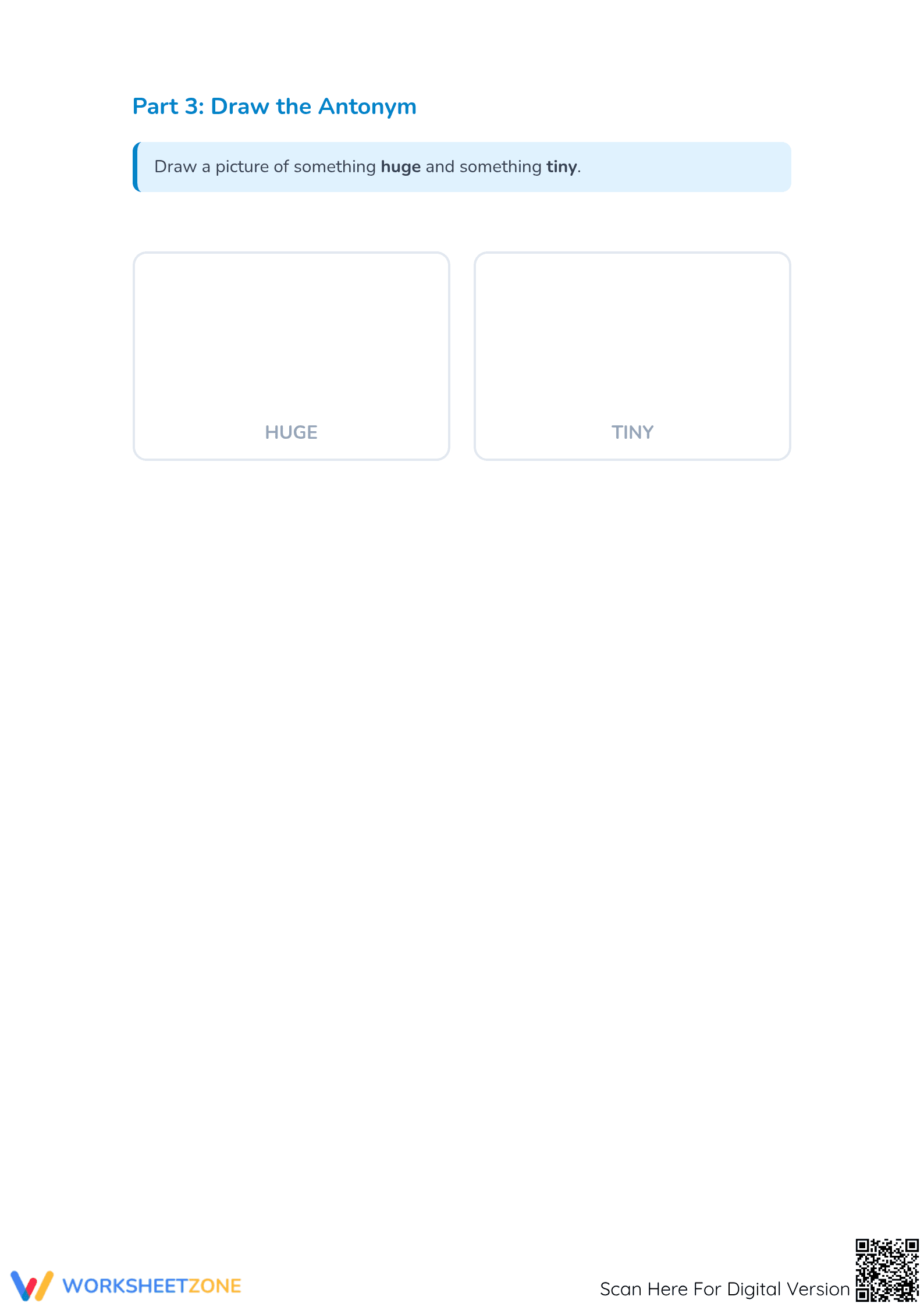
This 3-page packet features three distinct parts to solidify vocabulary. Part one includes a word bank matching activity with 8 core pairs. Part two provides 6 context-rich sentences where students complete the thought using the correct antonym. The final page invites visual learners to draw "huge" and "tiny" objects. A full answer key is provided for quick grading.
Skill Progression
- Guided Practice: The initial matching task uses a word bank to scaffold the identification of 8 high-frequency antonym pairs.
- Supported Practice: Students advance to sentence-level application, using bolded cues to determine the missing opposite in 6 structured sentences.
- Independent Practice: The final creative drawing task requires students to express size opposites through original illustration.
This sequence follows the gradual-release model to ensure student mastery and concept retention.
Standards Alignment
This resource is directly aligned with CCSS.ELA-LITERACY.L.1.5, which requires students to demonstrate understanding of word relationships. Specifically, it targets the ability to identify and use antonyms to clarify the meaning of words. A supporting alignment includes CCSS.ELA-LITERACY.L.1.5.B, focusing on defining words by attributes. Both standard codes can be copied directly into lesson plans, IEP goals, or district curriculum mapping tools.
How to Use It
This worksheet is ideal for independent practice following a whole-group lesson. Use the "Antonym Match" section as a formative assessment check; observe if students correctly pair abstract terms like "foolish" and "wise." The 3-page set typically takes 25 minutes to complete, making it a perfect addition to a literacy center rotation or a sub-plan for emergency coverage.
Who It's For
Designed primarily for first-grade students, this packet also serves as excellent remediation for second graders or as an enrichment tool for advanced kindergarteners. It is particularly effective for English Language Learners (ELL) who benefit from the visual cues in the drawing section. Naturally pair this resource with a shared reading of an opposites-themed picture book or a classroom anchor chart.
The development of word relationship knowledge is a critical component of early literacy. Students who can identify antonyms show improved semantic processing in later grades. According to the NAEP framework, vocabulary depth is a strong predictor of long-term reading success. This worksheet targets lexical opposites through a three-part methodology that aligns with the "word consciousness" approach highlighted in EdReports 2024 reviews of effective K-2 curricula. By requiring students to match, write, and draw antonyms like CCSS.ELA-LITERACY.L.1.5 requires, the material ensures students are conceptualizing the abstract relationship between conflicting meanings. The drawing tasks address the need for multiple modalities in early childhood education, a practice supported by RAND AIRS 2024 research into differentiated literacy instruction. This comprehensive approach ensures that foundational language skills are anchored in meaningful, research-backed practice.


