


























Views
Downloads

Printable Grade 1 Matching Antonyms Worksheet
Paste this activity's link or code into your existing LMS (Google Classroom, Canvas, Teams, Schoology, Moodle, etc.).
Students can open and work on the activity right away, with no student login required.
You'll still be able to track student progress and results from your teacher account.
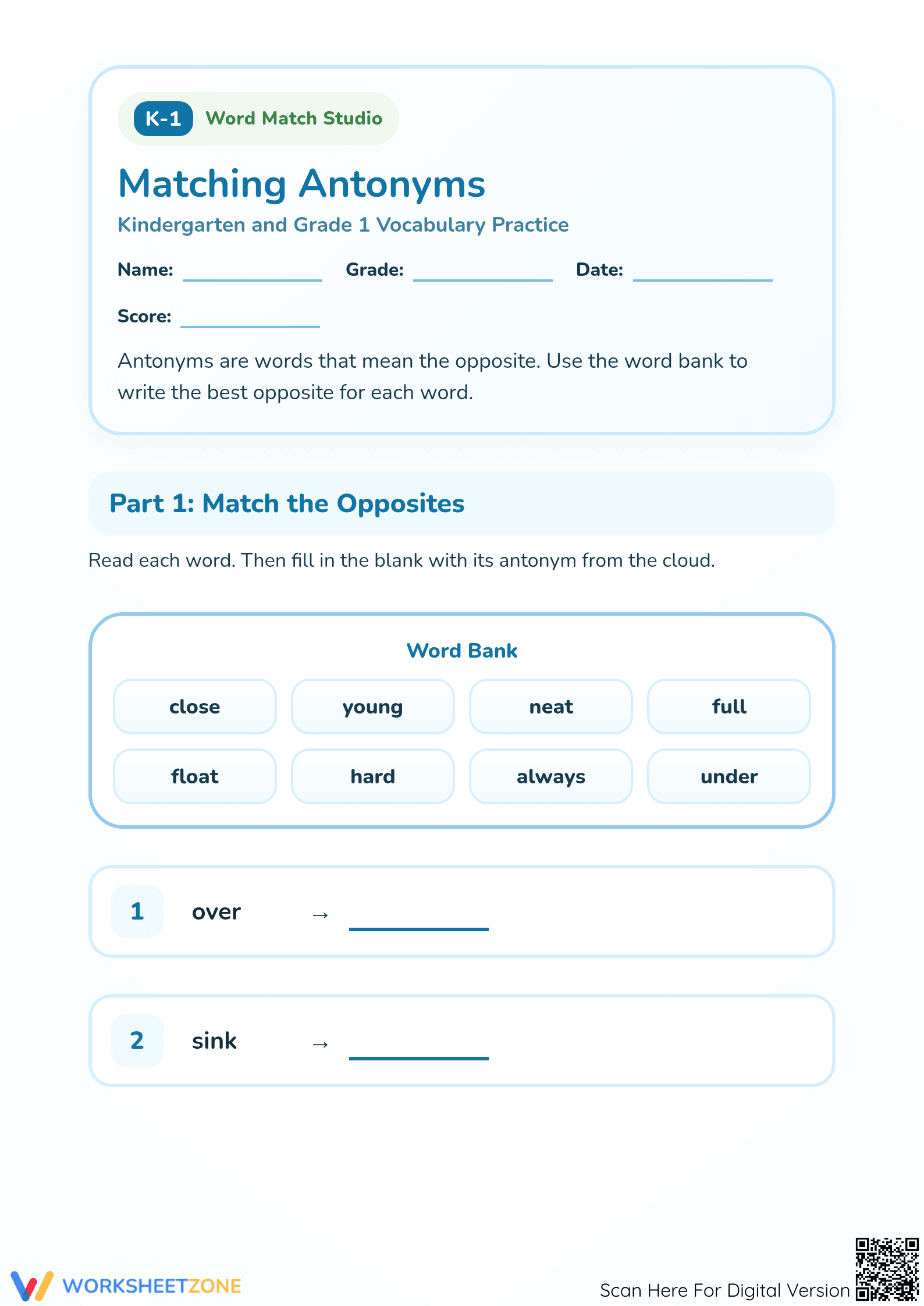
This Grade 1 antonyms worksheet provides essential vocabulary practice by challenging students to identify and match word opposites. By connecting familiar terms with their lexical counterparts, learners strengthen their reading comprehension and expressive language skills. This resource ensures students can accurately define and use common antonyms within their daily writing and speaking.
At a Glance
- Grade: 1 · Subject: English Language Arts (ELA)
- Standard:
CCSS.ELA-LITERACY.L.1.5— Demonstrate understanding of word relationships and nuances in word meanings- Skill Focus: Identifying and matching antonyms
- Format: 3 pages · 12 problems · Answer key included · PDF
- Best For: Independent vocabulary practice and quick assessments
- Time: 15–20 minutes
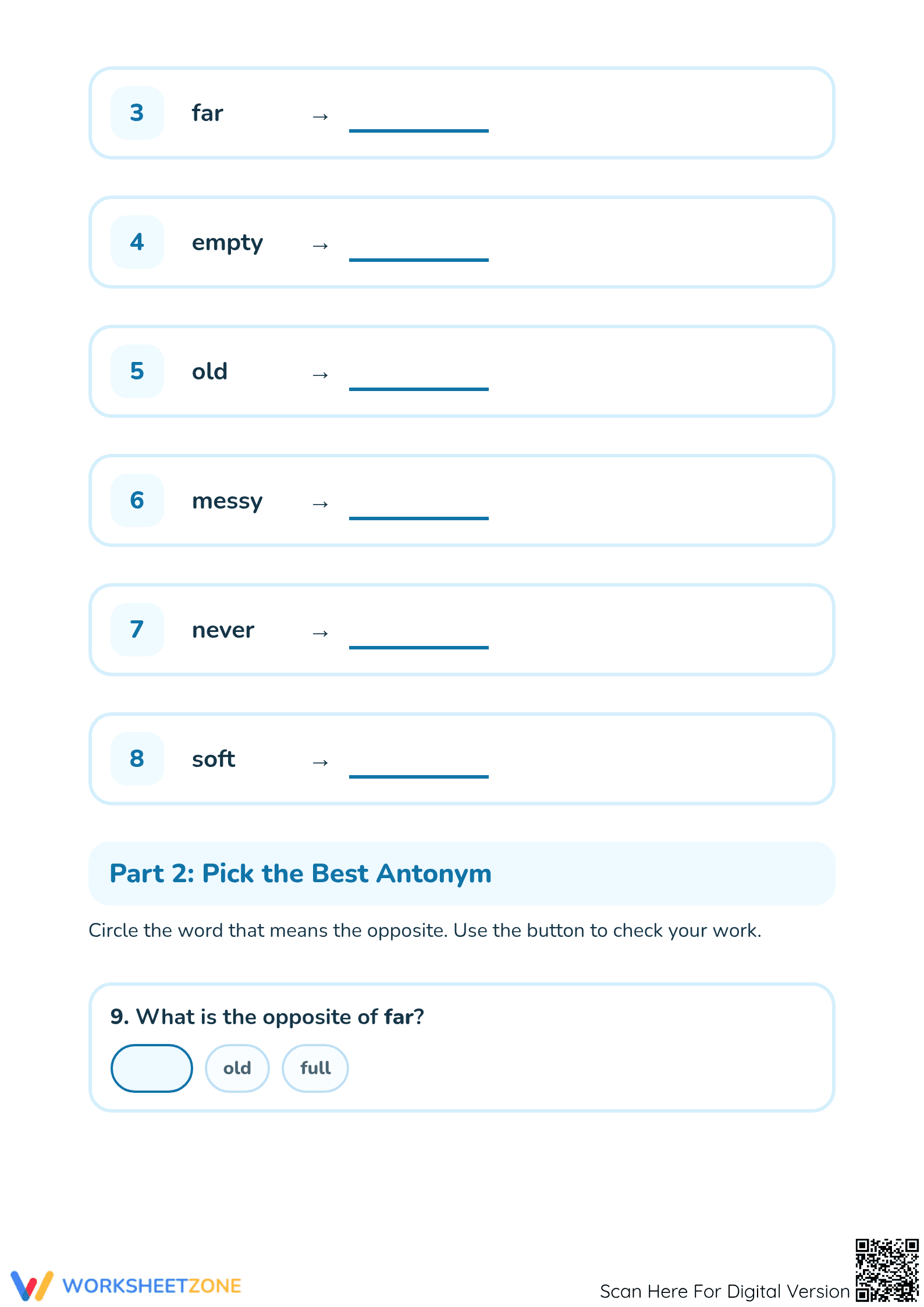
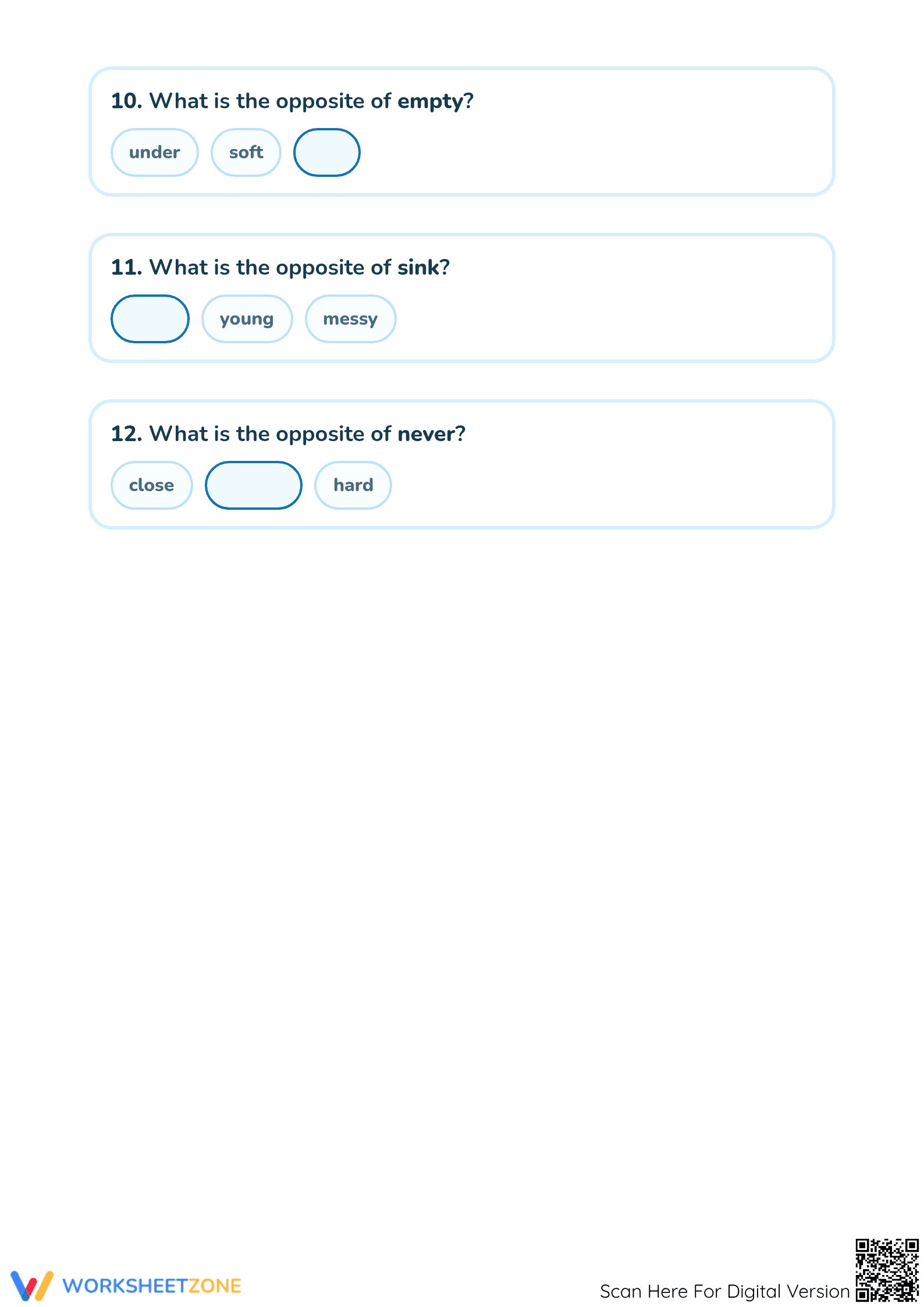
Inside this 3-page PDF, you will find 12 structured problems designed to build confidence in lexical relationships. The first section features a clear word bank inside a graphic cloud, where students match antonyms for words like over, sink, and messy. The final section transitions to a multiple-choice format, requiring students to pick the best opposite from a small list to demonstrate deeper mastery of the concept.
This printable resource is designed for an immediate, zero-prep workflow. First, print the three pages for your class set, which takes less than one minute of preparation. Second, distribute the worksheets during your literacy block for immediate student engagement without any lengthy teacher explanation. Finally, use the provided answer key to review student work in under two minutes, making it ideal for sub plans or morning work.
Aligned to CCSS.ELA-LITERACY.L.1.5, this worksheet focuses on helping students understand word relationships and nuances. Specifically, it targets the ability to distinguish between opposites and categorize words by their meanings. This standard code can be copied directly into lesson plans, IEP goals, or district curriculum mapping tools to ensure instructional alignment with national requirements for Grade 1 English Language Arts.
Use this worksheet as a formative assessment after an introductory lesson on opposites. Teachers can observe how students utilize the word bank to narrow down choices, which provides insight into their process of elimination skills. Alternatively, assign it as a homework reinforcement activity. The clear formatting and included word bank make it accessible for students to complete with minimal parental support at home.
This resource is perfect for first-grade students and advanced kindergarteners who are beginning to explore complex word relationships. It serves as an excellent differentiation tool for English Language Learners who need visual support and word banks to succeed with new vocabulary. Pair this worksheet with a shared reading passage focused on descriptive adjectives to help students see these antonyms used in a narrative context.
According to Fisher & Frey (2014), explicit vocabulary instruction on word relationships like antonyms significantly enhances reading comprehension. This worksheet addresses CCSS.ELA-LITERACY.L.1.5 by providing 12 instances of lexical contrast, moving learners toward a functional understanding of how opposites define language. Research suggests that active matching tasks help students retain definitions of both words in a pair. By utilizing a scaffolded approach with a word bank and multiple-choice questions, this resource supports the gradual release of responsibility. Educators can rely on this aligned material to provide the repetition necessary for early readers to achieve mastery in Grade 1 vocabulary standards. This summary highlights the resource's role in building foundational literacy skills for young learners, ensuring they are prepared for more complex texts in later grades.


