


























Views
Downloads

Printable Matching Antonyms Worksheet | Grade 1 ELA
Paste this activity's link or code into your existing LMS (Google Classroom, Canvas, Teams, Schoology, Moodle, etc.).
Students can open and work on the activity right away, with no student login required.
You'll still be able to track student progress and results from your teacher account.
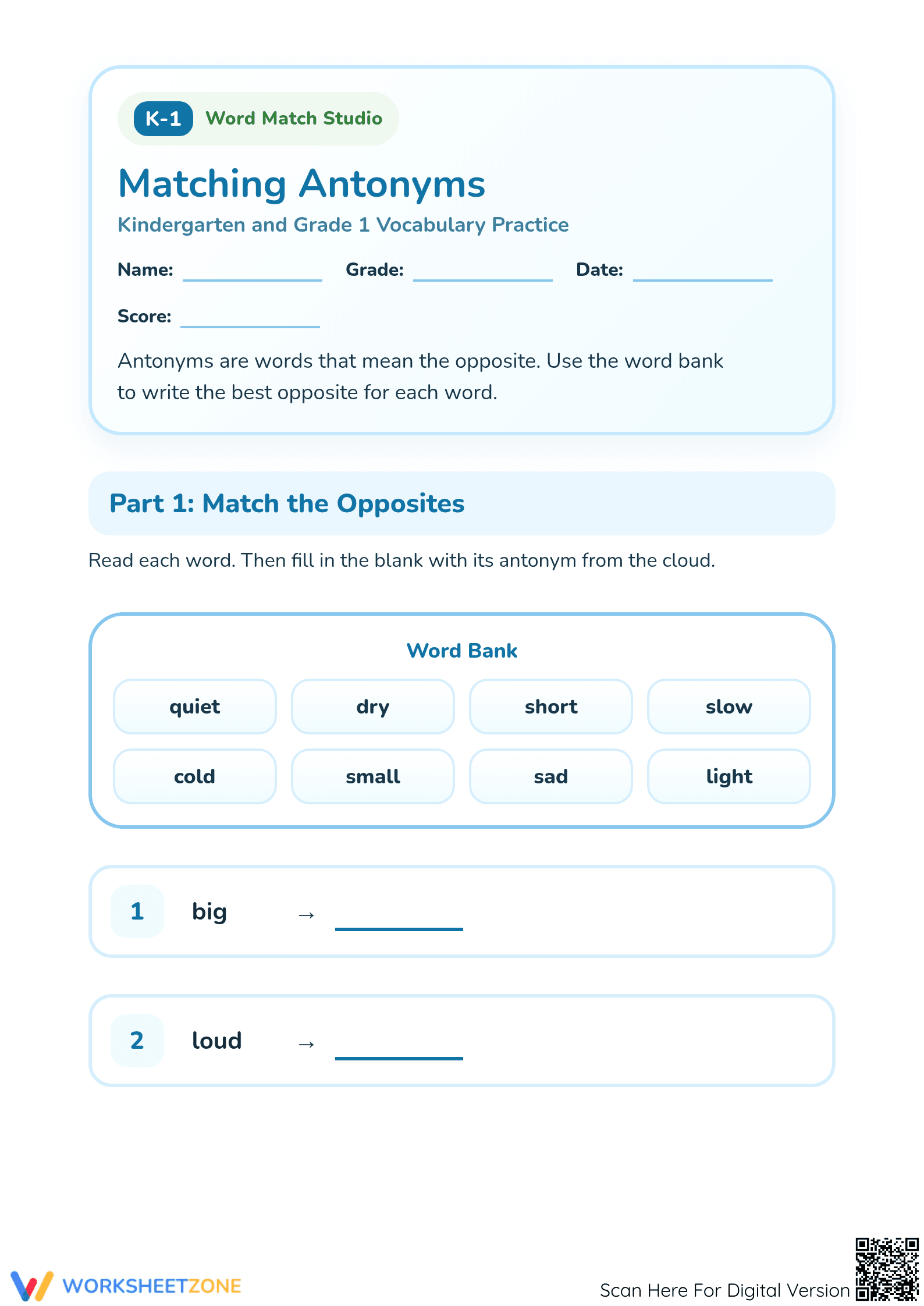
This Grade 1 matching antonyms worksheet helps students master opposite words through structured pairing and identification tasks. Students will develop a deeper understanding of lexical relationships by matching common adjectives to their opposites using a provided word bank. This exercise strengthens vocabulary acquisition and semantic awareness in early learners.
At a Glance
- Grade: 1 · Subject: English Language Arts
- Standard:
CCSS.ELA-LITERACY.L.1.5— With guidance and support, demonstrate understanding of word relationships- Skill Focus: Antonym Identification & Matching
- Format: 3 pages · 12 problems · Answer key included · PDF
- Best For: Independent vocabulary practice and morning work
- Time: 15–20 minutes
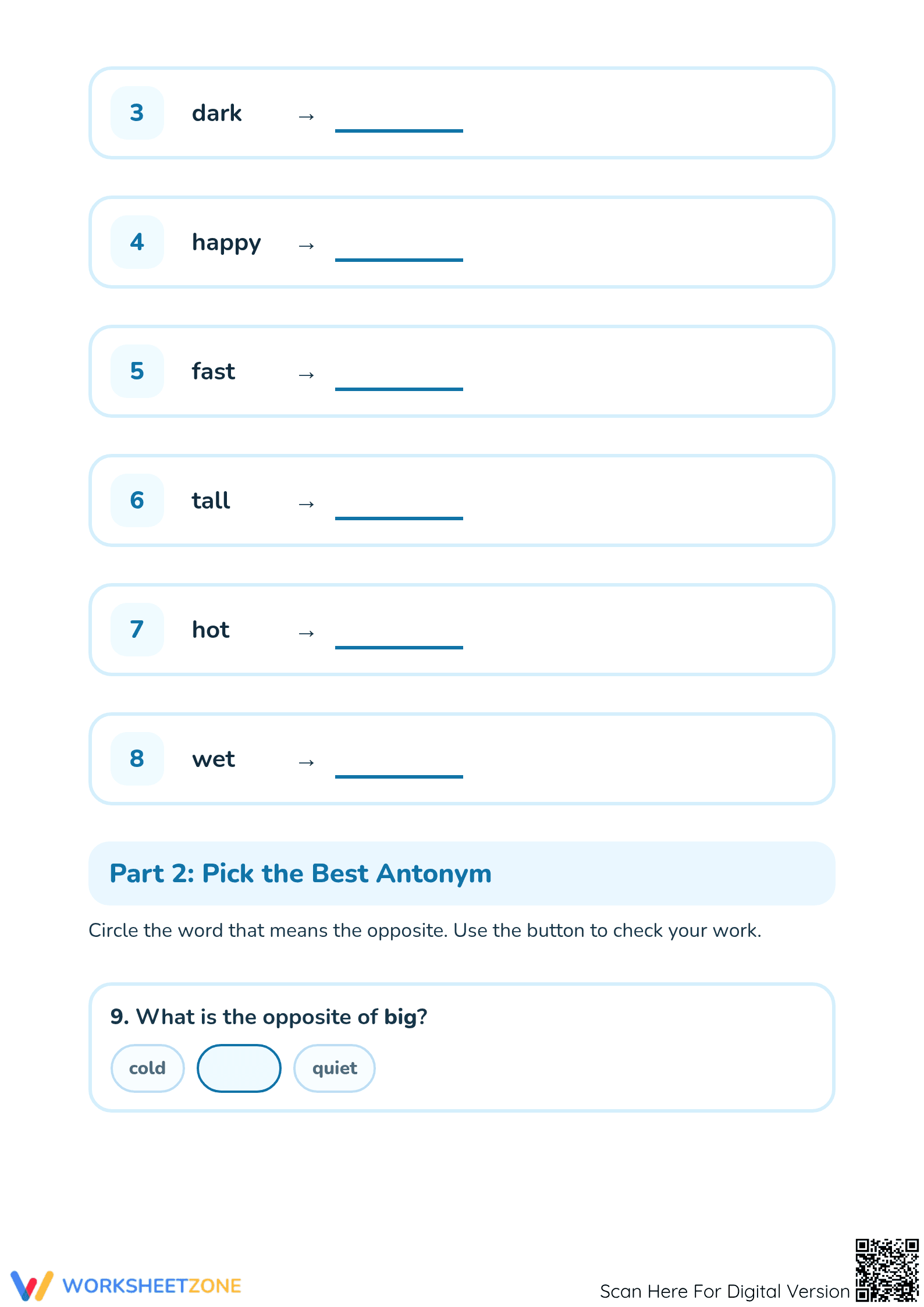
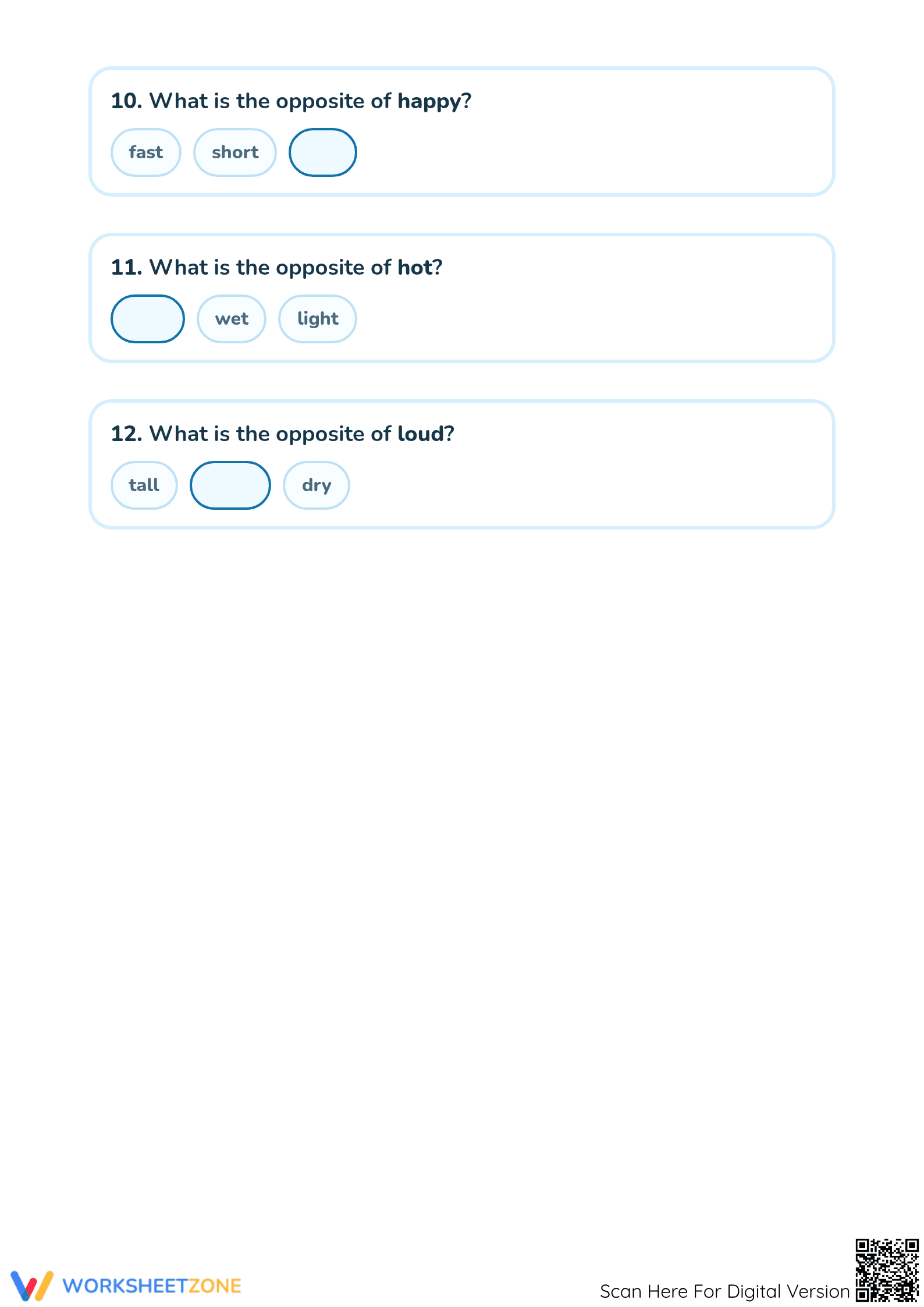
This 3-page PDF provides two distinct sections of lexical practice. Part 1 features an eight-word bank in a cloud-shaped organizer, requiring students to write the correct opposite for common adjectives such as "big," "loud," and "dark." Part 2 transitions to multiple-choice identification, asking students to circle the best antonym from a set of options. A complete answer key is provided for immediate grading and feedback.
Zero-Prep Workflow
1. Print: Send the 3-page document to the printer in seconds (1 minute).
2. Distribute: Hand out the sheets during independent work time or as a sub plan (1 minute).
3. Review: Use the included answer key to check for accuracy or allow students to self-correct during centers (1 minute).
This resource requires less than 3 minutes of total teacher preparation time, making it ideal for busy classrooms or unexpected absences.
The worksheet aligns with CCSS.ELA-LITERACY.L.1.5, which focuses on word relationships and nuances in word meanings. By identifying antonyms, Grade 1 students demonstrate their ability to distinguish between shades of meaning and categorize lexical opposites. Both standard codes can be copied directly into lesson plans, IEP goals, or district curriculum mapping tools.
Assign this worksheet during the "You Do" phase of a gradual release model following a direct instruction lesson on opposites. It also serves as an excellent formative assessment tool; teachers should observe whether students can successfully navigate the word bank or if they require additional scaffolding with oral prompts. Expected completion time is approximately 15 to 20 minutes.
This resource is designed for Grade 1 students and advanced Kindergarteners needing vocabulary extension. It is particularly effective for English Language Learners (ELLs) when paired with visual anchor charts or realia to demonstrate concepts like "big" versus "small" or "hot" versus "cold." The clear layout ensures students remain focused on the primary lexical task.
Lexical development in the early grades is a critical predictor of later reading comprehension, as noted in the RAND AIRS 2024 report. This Grade 1 antonym worksheet targets CCSS.ELA-LITERACY.L.1.5 by providing 12 structured opportunities for students to relate frequently occurring adjectives to their opposites. Research from Fisher & Frey (2014) emphasizes that scaffolded practice materials like word banks are most effective for consolidating semantic relationships. By engaging with these tasks, learners solidify their grasp of lexical opposites, moving from simple recognition to active retrieval. The inclusion of a no-prep workflow ensures that high-quality instruction can occur without excessive teacher overhead. This document provides a reliable data point for tracking vocabulary acquisition progress over time, specifically focusing on the student's ability to demonstrate understanding of frequently occurring adjectives by relating them to their lexical opposites. The structured format supports the NAEP emphasis on early vocabulary depth as a foundation for literacy success.


