


























Views
Downloads



Grade 1 Antonyms Worksheet — Printable No-Prep Practice
Paste this activity's link or code into your existing LMS (Google Classroom, Canvas, Teams, Schoology, Moodle, etc.).
Students can open and work on the activity right away, with no student login required.
You'll still be able to track student progress and results from your teacher account.
This Grade 1 antonyms worksheet provides students with targeted practice identifying and using opposite word pairs to build foundational vocabulary. By engaging with matching exercises, sentence completion, and multiple-choice questions, learners master the concept of lexical opposites while improving their reading comprehension. This printable resource ensures students can confidently explain word relationships.
At a Glance
- Grade: 1 · Subject: English Language Arts (ELA)
- Standard:
CCSS.ELA-LITERACY.L.1.5— Demonstrate understanding of word relationships and nuances in word meanings- Skill Focus: Antonym Identification and Usage
- Format: 3 pages · 14 problems · Answer key included · PDF
- Best For: Independent practice or vocabulary center activity
- Time: 15–20 minutes
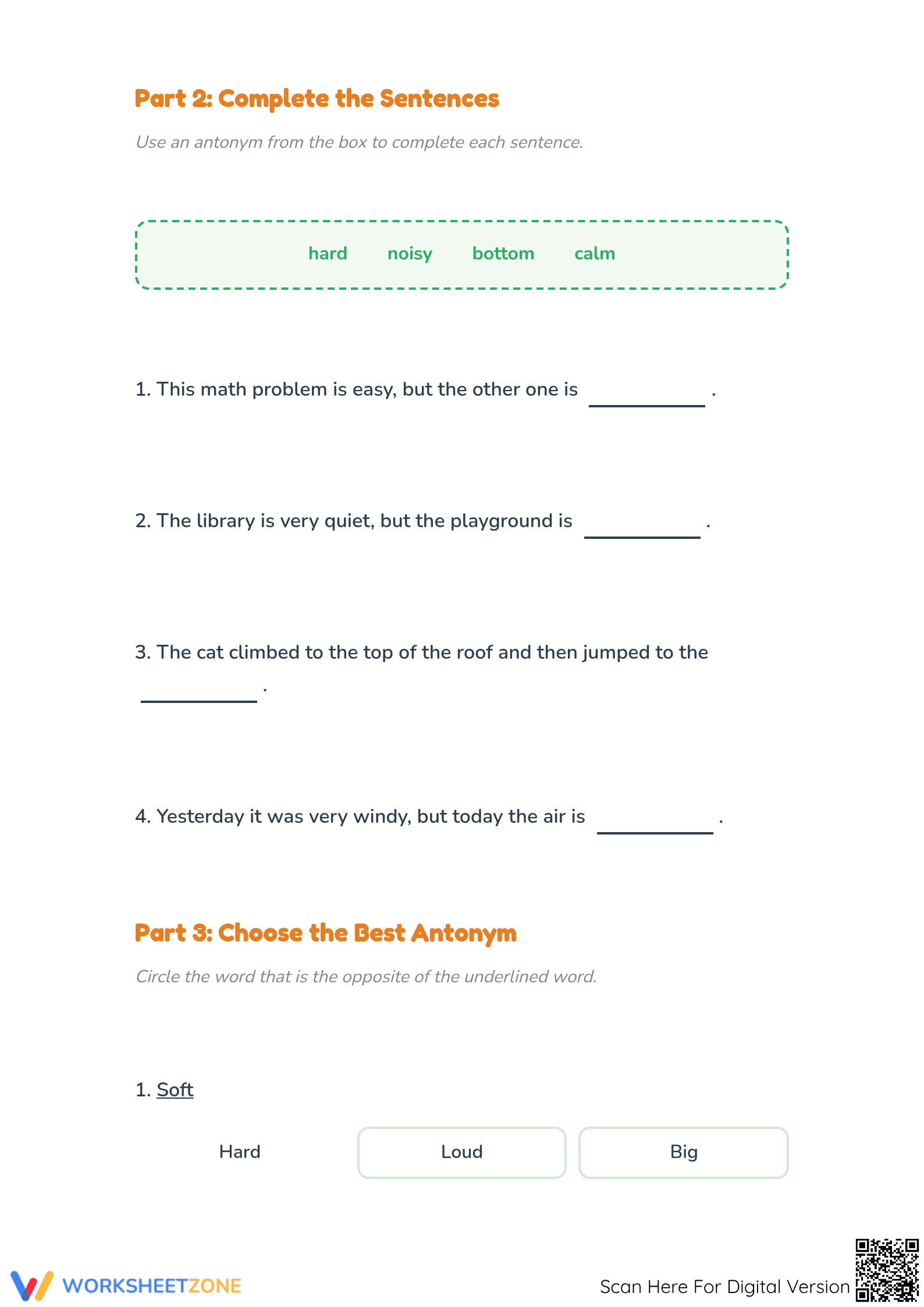
This 3-page PDF includes three scaffolded sections. Part 1 features matching for five opposite pairs. Part 2 uses a word bank for four sentence-level tasks. Part 3 provides four multiple-choice items and a challenge question, ensuring a thorough assessment with the included answer key.
Zero-Prep Workflow
The zero-prep design enables implementation in under two minutes. First, print the three pages from the PDF (30 seconds). Second, distribute to students for independent work or literacy rotations (30 seconds). Third, use the answer key for a rapid check or whole-class review (60 seconds). This streamlined workflow makes it perfect for substitute plans or last-minute vocabulary reinforcement.
Standards Alignment
This worksheet aligns to CCSS.ELA-LITERACY.L.1.5, requiring students to understand word relationships. By identifying antonyms, students explore how opposites relate within the lexical system. This standard code can be copied directly into lesson plans, IEP goals, or district curriculum mapping tools to ensure instructional consistency.
How to Use It
Use this as a concluding activity after direct instruction on opposites. It fits the independent practice phase of gradual release. For formative assessment, observe students during Part 2; those struggling with the word bank may need oral practice with sentence frames. Expect completion in fifteen to twenty minutes.
Who It's For
This resource is for Grade 1 students building early vocabulary. It also supports English Language Learners who benefit from visual structures and word banks. Pair this with a shared reading passage featuring descriptive adjectives to help students see these antonym pairs in a real-world literary context.
The "Matching Antonyms 4" worksheet is a rigorous tool for addressing CCSS.ELA-LITERACY.L.1.5 through the systematic practice of identifying word opposites. Research from Fisher & Frey (2014) highlights the critical importance of understanding word relationships in building a robust mental lexicon; students who can categorize and relate words through antonyms demonstrate much deeper semantic processing and retention. This activity provides 14 structured opportunities for students to engage with these relationships across multiple formats, from basic matching to contextual sentence application. By moving from isolated word identification to sentence-level usage, the worksheet supports the essential transition from simple recognition to functional vocabulary mastery. Educators can use this resource to gather reliable data on student progress toward language standards, as the varied task types reveal different levels of conceptual understanding. This evidence-based approach to vocabulary instruction ensures that foundational language skills are reinforced through meaningful, standards-aligned practice that is both accessible and effective for young learners.


