


























Views
Downloads

Printable Matching Antonyms Worksheet | Grade 1 ELA
Paste this activity's link or code into your existing LMS (Google Classroom, Canvas, Teams, Schoology, Moodle, etc.).
Students can open and work on the activity right away, with no student login required.
You'll still be able to track student progress and results from your teacher account.
Strengthen early vocabulary and language comprehension with this focused antonyms worksheet designed for Grade 1 learners. This resource provides a clear, structured approach to identifying opposites, helping students build the semantic connections necessary for reading and writing success. By matching and selecting pairs of contrasting words, students gain a deeper understanding of word relationships.
At a Glance
- Grade: 1 · Subject: English Language Arts (ELA)
- Standard:
CCSS.ELA-LITERACY.L.1.5— Demonstrate understanding of word relationships and nuances in word meanings.- Skill Focus: Antonym identification and matching
- Format: 2 pages · 8 problems · Answer key included · PDF
- Best For: Vocabulary building and literacy centers
- Time: 15–20 minutes
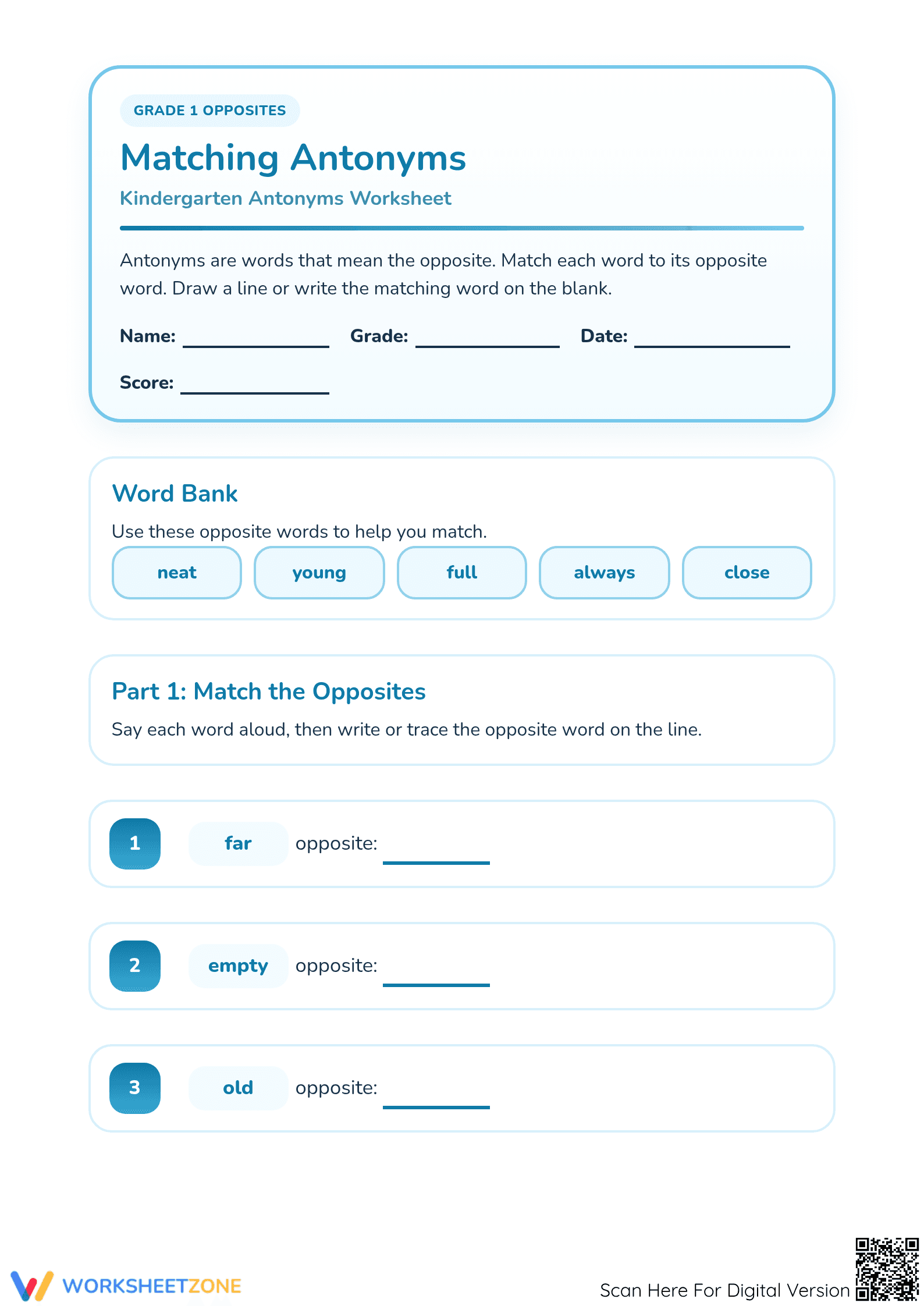
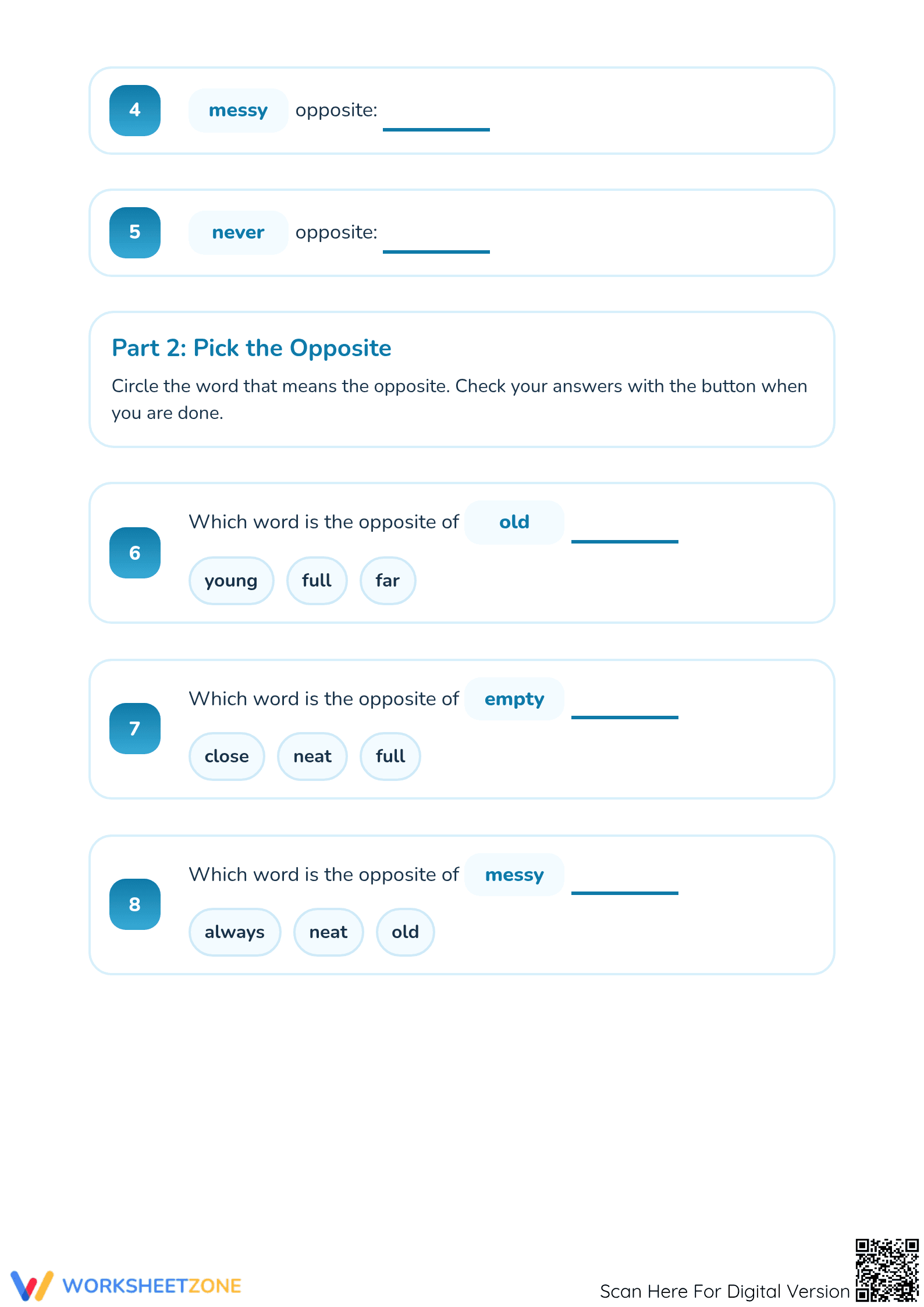
What's Inside: This two-page PDF includes a clear Word Bank to support early readers and two distinct practice sections. The first page contains a matching task where students write or trace the correct opposite, while the second page offers multiple-choice questions to reinforce the concept. A complete answer key is provided for quick grading or student self-correction.
Skill Progression
- Guided Practice: The worksheet begins with a visual Word Bank containing five high-frequency antonyms (neat, young, full, always, close) to provide immediate support for students as they begin the matching tasks.
- Supported Practice: Part 1 requires students to match three specific words to their opposites by writing the correct term on the line, bridging the gap between recognition and production.
- Independent Practice: Part 2 challenges students to independently select the correct opposite from a set of choices, ensuring they can apply the concept without direct word-to-word prompts.
This gradual-release model moves students from simple recognition to independent application of antonym pairs.
Standards Alignment
This worksheet is aligned with CCSS.ELA-LITERACY.L.1.5, which states that students should, with guidance and support from adults, demonstrate understanding of word relationships and nuances in word meanings. Specifically, it targets the ability to relate frequently occurring verbs and adjectives to their opposites. This standard code can be copied directly into lesson plans, IEP goals, or district curriculum mapping tools.
How to Use It
This resource is ideal for use during a direct instruction lesson on word classes or as a standalone activity in a literacy center. Teachers can use the first page as a guided practice session after introducing the concept of antonyms, followed by the second page as a formative assessment to check for individual understanding. For a quick check, observe if students are using the word bank accurately or relying on prior knowledge to complete the sentences.
Who It's For
This worksheet is primarily designed for Grade 1 students but is also suitable for Kindergarteners ready for a challenge or English Language Learners (ELL) who need focused practice on basic vocabulary pairs. It pairs naturally with a read-aloud focused on adjectives or a classroom anchor chart displaying common opposites found in everyday text.
Vocabulary development is crucial for early literacy, with antonym acquisition expanding a student's lexical network. By engaging with word relationships, Grade 1 learners build a structural understanding of language. This worksheet aligns with CCSS.ELA-LITERACY.L.1.5, providing scaffolded practice for students to sort and relate frequently occurring adjectives and verbs. Mastering antonyms through these 8 tasks supports accurate description of changes in state or condition, vital for narrative writing and informational text analysis, and offers a data-driven approach to formative assessment.


