


























Views
Downloads
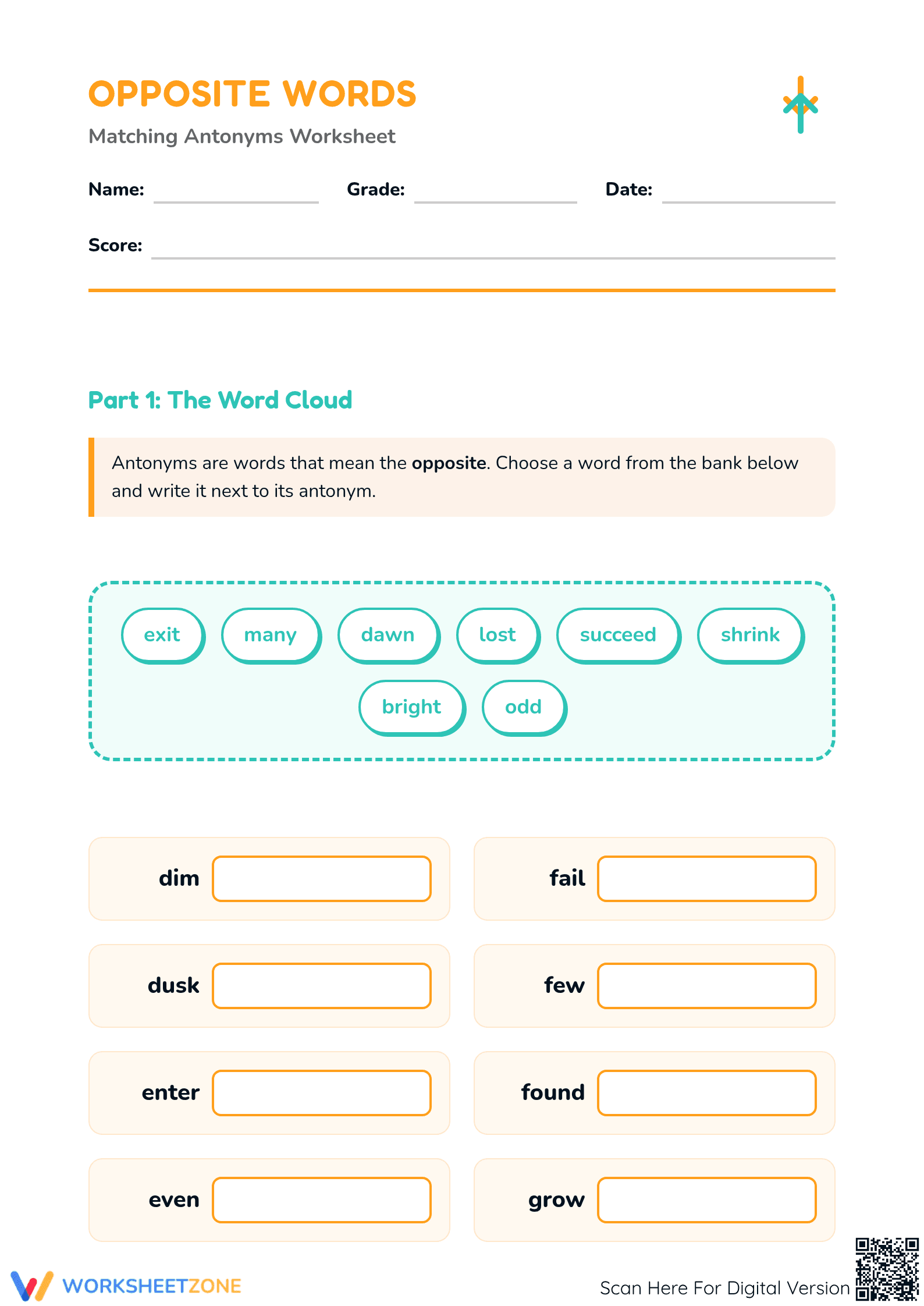


Printable Antonyms Worksheet | Grade 1 ELA Practice
Paste this activity's link or code into your existing LMS (Google Classroom, Canvas, Teams, Schoology, Moodle, etc.).
Students can open and work on the activity right away, with no student login required.
You'll still be able to track student progress and results from your teacher account.
This Grade 1 antonyms worksheet provides a complete instructional sequence for students to identify and apply opposite words. By engaging with 16 structured vocabulary tasks, learners develop a concrete understanding of how word meanings relate to one another. Students transition from basic recognition to contextual application, ensuring mastery of primary language skills and reading readiness.
At a Glance
- Grade: 1 · Subject: English Language Arts
- Standard:
L.1.5— Demonstrate understanding of word relationships and nuances in word meanings in context- Skill Focus: Antonyms and Opposite Words
- Format: 3 pages · 16 problems · Answer key included · PDF Download
- Best For: Early finishers, independent practice, or literacy centers
- Time: 15–20 minutes
What's Inside
This resource features three learning phases across three pages. The first page contains a 'Word Cloud' challenge where students select opposites from a bank of eight terms. The second page introduces visual matching for four high-frequency pairs. The final section requires students to identify antonyms within four sentences, providing critical context-clues practice. A full answer key is included for rapid grading.
Skill Progression
- Guided Practice: Students sort eight pairs of lexical antonyms using a visual word bank for support.
- Supported Practice: Learners draw lines to connect four common opposite pairs, reinforcing visual and conceptual links.
- Independent Practice: Four sentence-based problems challenge students to apply knowledge by choosing the best antonym for underlined words.
This progression mirrors the gradual release model of 'I Do, We Do, You Do' to ensure student success.
Standards Alignment
This activity is aligned to `CCSS.ELA-LITERACY.L.1.5`, which focuses on demonstrating understanding of word relationships. By matching words with their opposites, students build the foundational linguistic structures necessary for reading comprehension. This standard code can be copied directly into lesson plans, IEP goals, or district curriculum mapping tools to track student progress.
How to Use It
Use this worksheet as a formative assessment after a lesson on opposites. For a literacy center, have students work in pairs to discuss why certain words are antonyms. An observation tip is to watch if students can explain the relationship aloud. This 20-minute task is also an excellent sub-plan addition due to its zero-prep format.
Who It's For
This resource is designed for first-grade students and English Language Learners (ELLs) needing explicit vocabulary support. The clear layout accommodates different learning styles, while the adjective-focused content makes it a natural pairing for descriptive writing lessons. It works effectively alongside anchor charts or primary reading passages featuring contrasting settings.
The use of structured practice to teach antonyms is supported by Fisher & Frey (2014), who emphasize that understanding word relationships like opposites is a prerequisite for advanced reading comprehension. This worksheet targets the `L.1.5` standard by providing 16 opportunities for students to engage with lexical antonyms across three different formats. By utilizing a word bank, visual matching, and sentence context, the resource ensures that students are not just memorizing pairs but are applying their knowledge to actual text. High-quality ELA materials must provide explicit opportunities for vocabulary practice to close the achievement gap. This tool delivers that practice through 16 problems that can be completed in approximately 15 minutes, making it an essential component of a first-grade language arts curriculum. Educators can confidently use these tasks to verify mastery of primary word relationships and prepare students for more complex nuances in higher grades.


