


























Views
Downloads
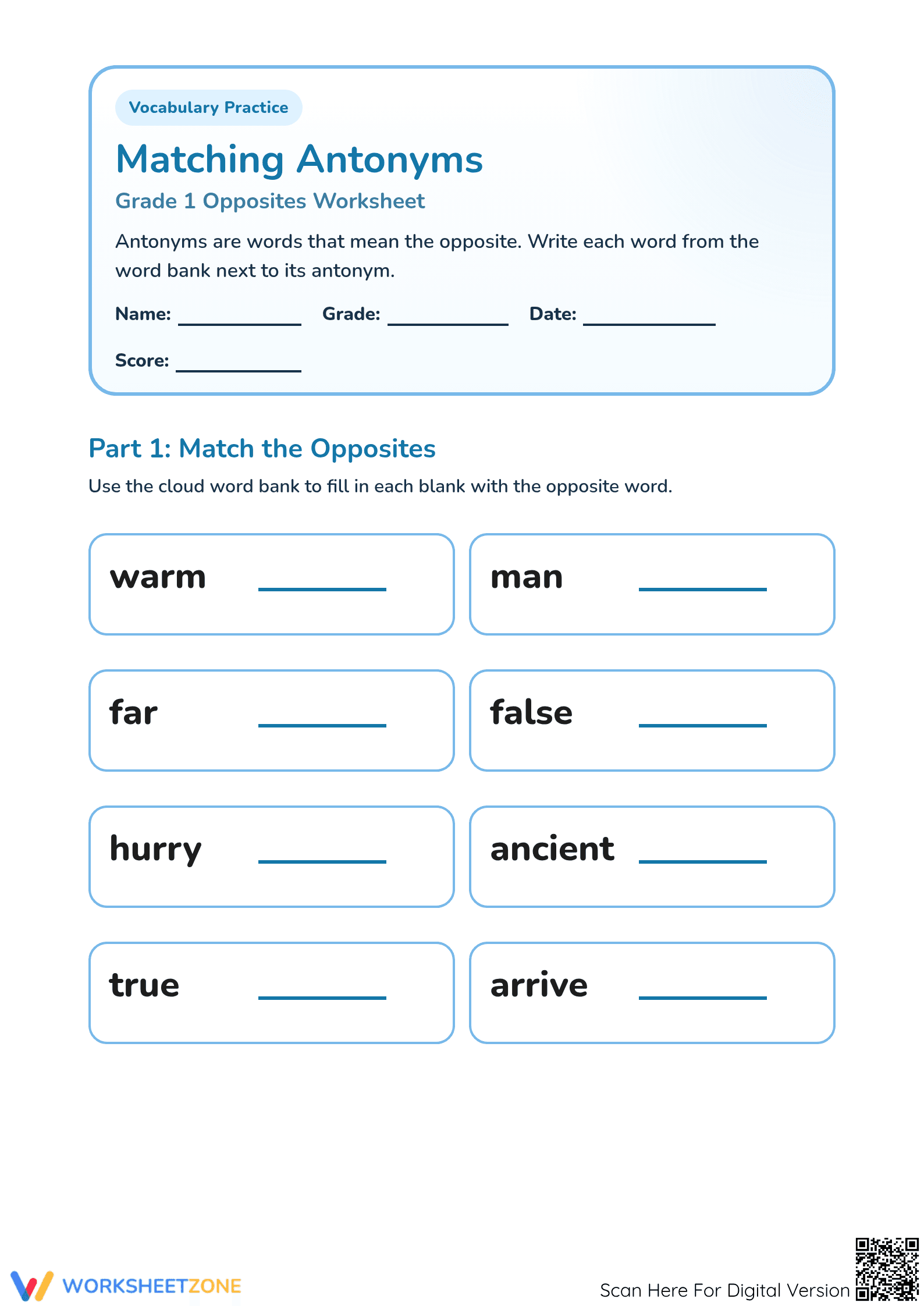
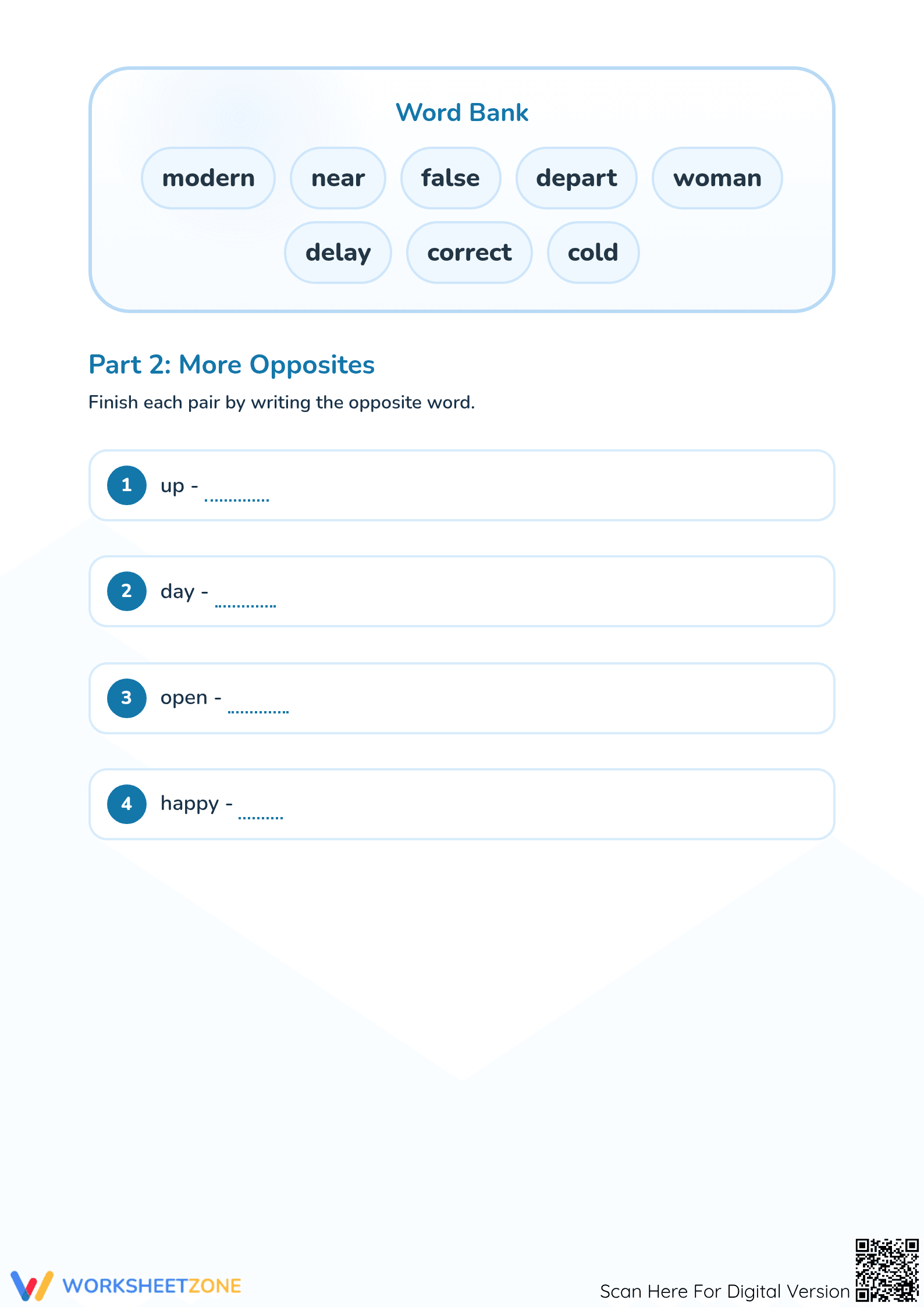

Printable Antonyms Matching Worksheet | Grade 1 ELA
Paste this activity's link or code into your existing LMS (Google Classroom, Canvas, Teams, Schoology, Moodle, etc.).
Students can open and work on the activity right away, with no student login required.
You'll still be able to track student progress and results from your teacher account.
Master Opposites with This Grade 1 Vocabulary Resource
This Grade 1 antonyms worksheet provides students with focused practice in identifying and matching opposite word pairs. By connecting lexical items like "warm" and "cold" or "ancient" and "modern," learners build a stronger foundation for reading comprehension and descriptive writing. This printable resource ensures students master essential word relationships through structured, independent practice.
At a Glance
- Grade: 1 · Subject: English Language Arts (ELA)
- Standard:
CCSS.ELA-LITERACY.L.1.5— Demonstrate understanding of word relationships and nuances in word meanings- Skill Focus: Antonym Recognition & Matching
- Format: 2 pages · 12 problems · Answer key included · PDF
- Best For: Literacy centers and independent vocabulary practice
- Time: 15–20 minutes
What's Inside
This comprehensive two-page PDF features a clean, student-friendly layout designed for early learners. The first page presents eight primary matching tasks with clear blanks for writing. The second page provides a visual "cloud" word bank to support spelling and word recognition, followed by four additional extension pairs. A full answer key is included to facilitate quick grading or student self-correction.
Skill Progression
- Guided Practice: Students begin by matching four high-frequency adjective pairs using the provided word bank to establish the concept of opposites.
- Supported Practice: Learners progress to identifying antonyms for more complex lexical items, such as "ancient" and "arrive," utilizing the remaining word bank options.
- Independent Practice: The final four problems require students to generate or retrieve opposites for common words like "up" and "day" without direct word bank support, promoting mastery.
This instructional design follows a gradual-release model, moving from heavy scaffolding to independent recall to solidify vocabulary acquisition.
Standards Alignment
This resource is specifically aligned to `CCSS.ELA-LITERACY.L.1.5`. Students demonstrate their understanding of word relationships by identifying the nuances between antonyms. Specifically, it supports sub-standard L.1.5.A by encouraging students to sort words into conceptual categories. This standard code can be copied directly into lesson plans, IEP goals, or district curriculum mapping tools.
How to Use It
This worksheet is ideal for use during the "You Do" phase of a vocabulary lesson. After introducing the concept of antonyms with a class anchor chart, distribute these pages for independent seatwork. Teachers can use this as a formative assessment by observing if students can match abstract pairs like "true" and "false" without assistance. Most first graders will complete both sections within 20 minutes.
Who It's For
While designed for Grade 1 ELA students, this resource is excellent for Kindergarteners ready for extension or Grade 2 students needing a vocabulary refresher. It pairs naturally with "opposites" themed picture books or direct instruction on descriptive adjectives. English Language Learners (ELL) will particularly benefit from the clear word bank and paired associations.
According to the RAND AIRS 2024 report on elementary literacy, structured vocabulary interventions that focus on explicit word relationships, such as antonyms and synonyms, significantly improve long-term reading fluency. This Grade 1 antonyms worksheet applies these research-based principles by requiring students to actively process lexical opposites rather than passively reading them. By aligning with CCSS.ELA-LITERACY.L.1.5, the resource ensures that students are not just memorizing words but are developing the cognitive frameworks necessary to understand nuances in meaning. Studies from EdReports (2024) emphasize that high-quality instructional materials must provide repeated exposure to core vocabulary in varied contexts. This 12-problem set offers the necessary repetition to move these opposite pairs from short-term recognition to long-term lexical storage. The inclusion of a word bank serves as a vital scaffold, allowing learners to focus on the semantic relationship rather than the cognitive load of spelling, which NAEP data suggests is a primary barrier for early writers.


