


























Views
Downloads

Kindergarten Emotions Matching Worksheet | Essential
Paste this activity's link or code into your existing LMS (Google Classroom, Canvas, Teams, Schoology, Moodle, etc.).
Students can open and work on the activity right away, with no student login required.
You'll still be able to track student progress and results from your teacher account.
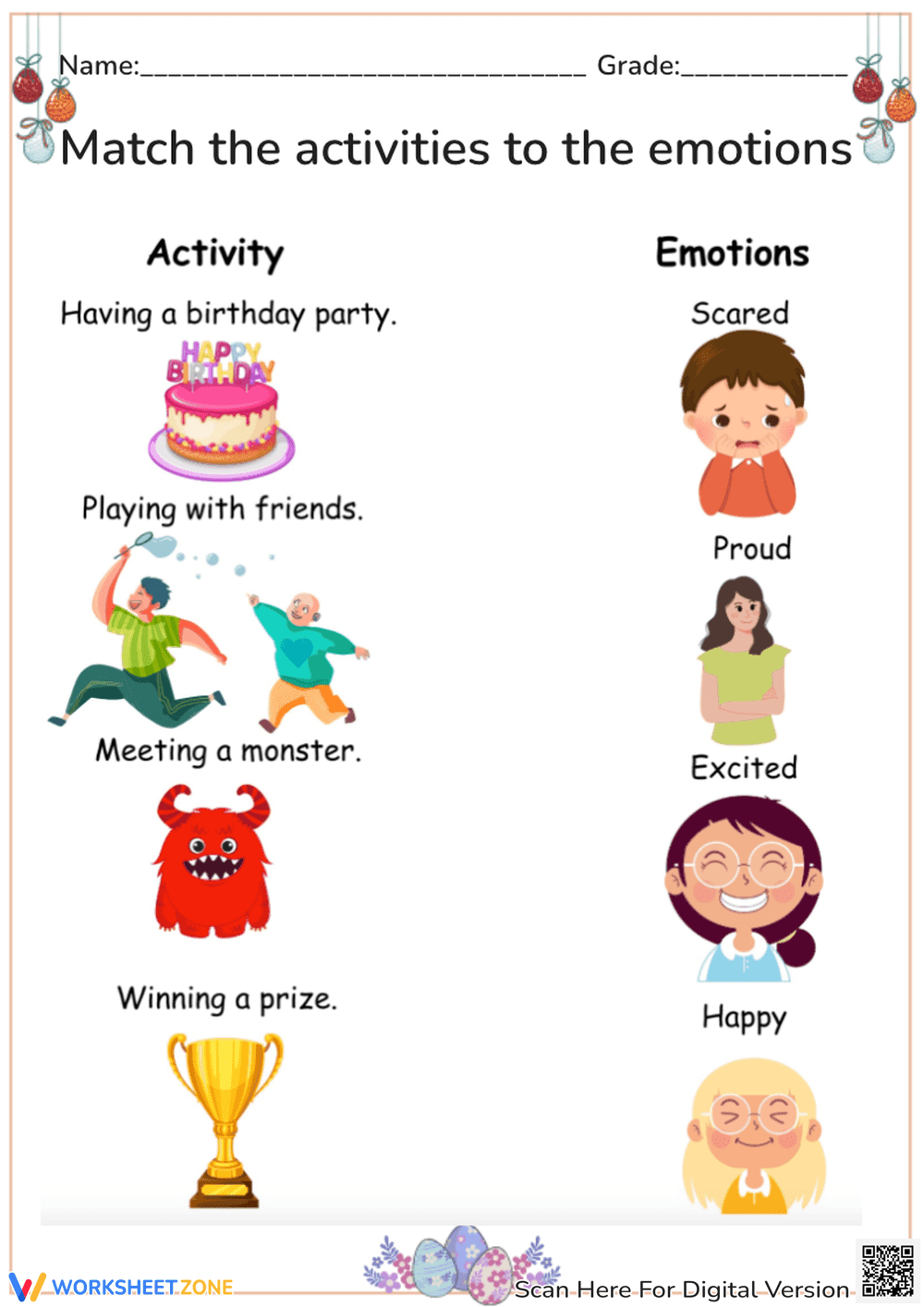
This Kindergarten emotions worksheet helps young learners identify the relationship between specific life events and the feelings they trigger. By matching activities like winning a prize or meeting a monster to facial expressions, students develop essential social-emotional vocabulary and situational awareness. It provides a clear, visual framework for understanding complex internal states.
At a Glance
- Grade: Kindergarten · Subject: Behavior & Emotions
- Standard:
CCSS.ELA-LITERACY.L.K.5.C— Identify real-life connections between words and their use- Skill Focus: Situational emotion recognition
- Format: 1 page · 4 problems · Answer key included · PDF
- Best For: Morning work or SEL lessons
- Time: 5–10 minutes
Inside this resource, you will find a single-page PDF featuring four distinct scenarios paired with four illustrated character faces. The layout uses high-quality clip art to represent activities such as a birthday party and winning a trophy. Each emotion—Scared, Proud, Excited, and Happy—is clearly labeled to support early readers while they draw connecting lines.
The zero-prep workflow for this worksheet is designed for maximum efficiency in a busy classroom. First, print the single-page PDF (30 seconds). Next, distribute the sheets to students during a transition or circle time (1 minute). Finally, review the matches as a whole group to discuss why certain activities make us feel specific ways (5 minutes). Total teacher preparation time is under 2 minutes.
This worksheet aligns with CCSS.ELA-LITERACY.L.K.5.C, which requires students to identify real-life connections between words and their use. It also supports CASEL competencies for self-awareness and social awareness. Both standard codes can be copied directly into lesson plans, IEP goals, or district curriculum mapping tools.
Use this as a formative assessment after a read-aloud about feelings. Observe if students can distinguish between "Excited" and "Happy," as these are often conflated by five-year-olds. It also serves as an excellent "calm down" activity or a quick check-in during small group counseling sessions. Completion typically takes 5 to 10 minutes.
This resource is ideal for general education Kindergarten students, English Language Learners (ELLs) needing visual vocabulary support, and students with developmental delays working on social cues. It pairs naturally with an "Emotions Anchor Chart" or a classroom "Mood Meter" to reinforce the day's social-emotional learning objectives.
According to the RAND AIRS 2024 report, explicit instruction in social-emotional vocabulary during early childhood significantly improves long-term behavioral regulation and academic persistence. This worksheet targets CCSS.ELA-LITERACY.L.K.5.C by requiring students to map abstract emotion words like "Proud" or "Scared" onto concrete, relatable scenarios. By engaging with these 4 specific situational prompts, Kindergarteners move beyond simple labeling toward a functional understanding of how environment influences affect. Research from Fisher & Frey (2014) emphasizes that visual scaffolds, such as the illustrations provided here, are critical for helping young learners bridge the gap between internal feelings and external language. This resource provides a structured, evidence-based approach to building the foundational literacy and behavioral skills necessary for classroom success. It is a reliable tool for any educator looking to integrate SEL into their daily instructional routine without adding to their preparation burden.


