


























Views
Downloads

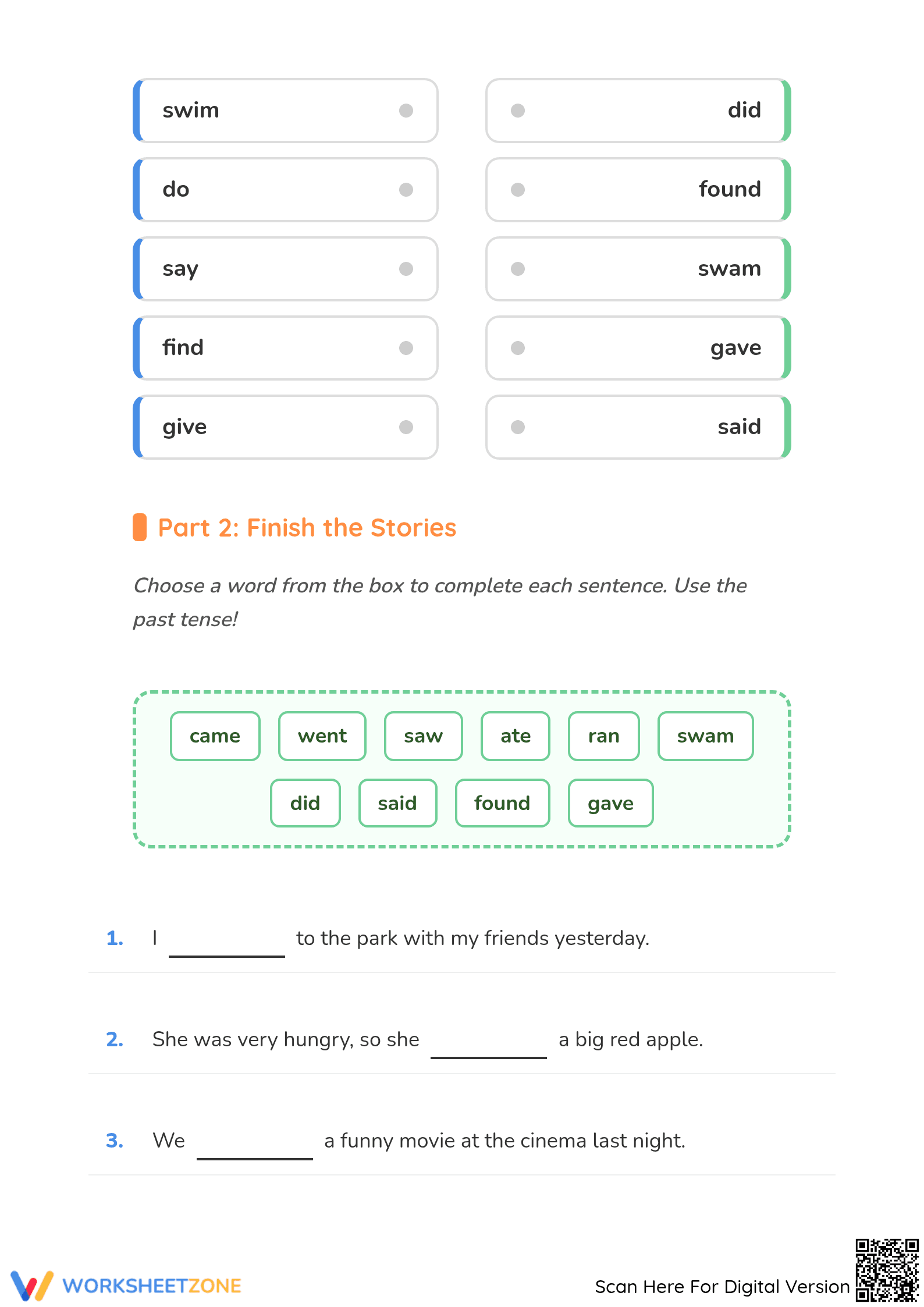


Grade 1 Irregular Past Tense: Essential Printable Worksheet
Paste this activity's link or code into your existing LMS (Google Classroom, Canvas, Teams, Schoology, Moodle, etc.).
Students can open and work on the activity right away, with no student login required.
You'll still be able to track student progress and results from your teacher account.
This Grade 1 ELA worksheet provides targeted practice for identifying and using irregular past tense verbs. Students transition from simple recognition through matching to application in context with sentence completion. By the end of these activities, learners will demonstrate a clear understanding of how common action verbs change form when describing past events.
At a Glance
- Grade: 1 · Subject: ELA
- Standard:
CCSS.ELA-LITERACY.L.1.1.E— Use verbs to convey a sense of past, present, and future- Skill Focus: Irregular Past Tense Verbs
- Format: 4 pages · 21 problems · Answer key included · PDF
- Best For: Independent practice or formative assessment
- Time: 15–20 minutes
The resource contains three distinct sections across four pages. Part 1 features 10 matching pairs where students connect present tense verbs like "go" and "see" to their irregular past tense counterparts. Part 2 offers 10 "Finish the Stories" cloze sentences requiring students to select the correct verb from a word bank. Finally, a "Bonus: Your Turn!" section encourages original sentence construction. A full answer key is provided for immediate feedback.
This resource is designed for a zero-prep classroom workflow. Teachers can print the PDF in under 1 minute. Distribution takes seconds, as the instructions are self-explanatory for first-grade readers. Reviewing the work is streamlined by the included answer key, allowing for a total teacher preparation and grading time of less than 5 minutes. It is an ideal solution for unexpected sub plans or morning work.
This worksheet is specifically aligned with CCSS.ELA-LITERACY.L.1.1.E. This standard requires students to use verbs to convey a sense of past, present, and future. While many first-grade verbs follow the "-ed" suffix rule, this resource focuses on the high-frequency irregulars that often trip up early writers. Both standard codes can be copied directly into lesson plans, IEP goals, or district curriculum mapping tools.
Use this worksheet during the independent practice phase of a lesson on verb tenses. After modeling "now" versus "then" actions, assign the matching section to check for recognition. For a formative assessment, observe students during the cloze activity to see if they can identify the temporal cues like "yesterday" or "last night" that signal the need for a past tense verb. Expected completion time is 15 to 20 minutes.
This resource is tailored for Grade 1 students but serves as excellent remediation for Grade 2 learners or English Language Learners (ELLs) struggling with English verb morphology. It pairs naturally with a classroom anchor chart listing common irregular verbs or a shared reading passage that utilizes past tense narrative structures to provide context for the lexical changes.
According to Fisher & Frey (2014), the gradual release of responsibility is most effective when students move from scaffolded recognition to independent application. This worksheet follows that pedagogical path by starting with simple matching before requiring students to generate their own sentences. Mastery of CCSS.ELA-LITERACY.L.1.1.E is a critical milestone in early literacy, as irregular verbs comprise a significant portion of high-frequency English vocabulary. Research from the NAEP indicates that early fluency with verb tenses correlates strongly with overall reading comprehension and writing clarity in later elementary years. By providing 21 structured opportunities to interact with these linguistic forms, this resource ensures that students move beyond rote memorization toward functional usage. The inclusion of a writing prompt further solidifies the connection between grammar rules and expressive communication, making it a robust tool for any primary ELA curriculum.


