


























Views
Downloads
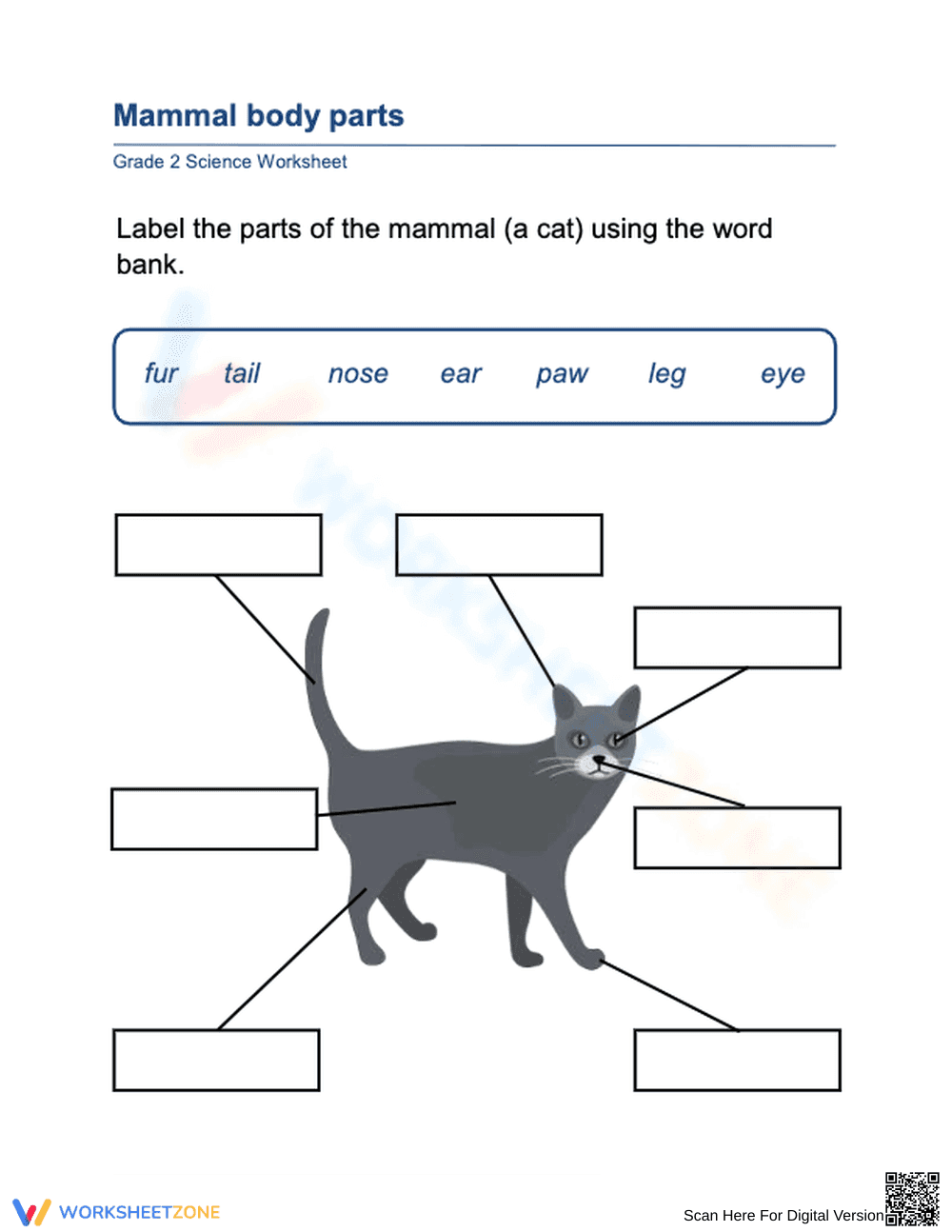

Essential Mammal Body Parts Worksheet | Grade 2 Science
Paste this activity's link or code into your existing LMS (Google Classroom, Canvas, Teams, Schoology, Moodle, etc.).
Students can open and work on the activity right away, with no student login required.
You'll still be able to track student progress and results from your teacher account.
This Grade 2 Science worksheet provides a focused labeling activity to help young learners identify external mammal body parts using a cat as a biological model. By matching anatomical terms from a word bank to specific physical structures, students develop the foundational vocabulary necessary for describing animal characteristics and observing biological diversity.
At a Glance
- Grade: 2 · Subject: Science
- Standard:
1-LS1-1— Use materials to design a solution to a human problem by mimicking how animals use their external parts to survive- Skill Focus: Mammal Anatomy Identification
- Format: 2 pages · 7 problems · Answer key included · PDF
- Best For: Introduction to animal structures and survival
- Time: 10–15 minutes
What's Inside
The resource includes a high-contrast worksheet featuring a clear illustration of a mammal with seven distinct leader lines. A comprehensive word bank containing essential vocabulary—including fur, tail, nose, ear, paw, leg, and eye—supports independent student work. A full-page answer key is also provided, allowing for quick teacher verification or student self-correction during practice.
Zero-Prep Workflow
- Print: Print the single-page worksheet for each student in under 30 seconds.
- Distribute: Hand out materials as a warm-up or transition activity during your science block.
- Review: Check for anatomical accuracy using the included answer key for whole-group feedback.
Total teacher preparation time for this activity is less than two minutes, making it an ideal choice for busy classrooms or emergency sub plans.
Standards Alignment
The primary standard addressed is 1-LS1-1, which focuses on how animals use their external parts to survive and meet their needs. While labeled for Grade 2, this worksheet serves as a vital bridge for students mastering the prerequisite knowledge of identifying those parts before analyzing their complex biological functions. Both standard codes can be copied directly into lesson plans or curriculum mapping tools.
How to Use It
Use this worksheet as an entry ticket during a unit on living things to gauge prior knowledge of animal anatomy. Alternatively, assign it as a post-lesson assessment after a read-aloud about mammals to verify vocabulary acquisition. Teachers should observe if students can differentiate between the textures described by "fur" versus the structural purpose of "paws" or "legs" during the process.
Who It's For
This resource is specifically tailored for Grade 2 students but is also effective for English Language Learners who need visual scaffolding to build scientific vocabulary. It pairs naturally with an anchor chart depicting various mammal habitats, providing the necessary terminology for students to explain how a cat’s ears or nose help it navigate its environment.
The effective use of visual labeling in early science education is supported by the RAND AIRS 2024 analysis, which highlights that scaffolded diagrams improve the retention of specialized vocabulary in primary grades. By providing a clear biological model with a word bank, this worksheet reduces cognitive load, allowing students to focus on the spatial relationship between anatomical terms and physical structures. The 1-LS1-1 standard emphasizes identifying external parts as a foundational step toward understanding biological adaptation and survival. Research from the NAEP indicates that students who master basic scientific identification in early elementary years demonstrate greater proficiency in experimental observation in later stages. This worksheet delivers seven distinct labeling tasks that provide the measurable evidence of mastery required for standards-based reporting and formative assessment within the life science curriculum.


