




























Views
Downloads

Printable Make it the Same Worksheet | Grade 1 Math

Paste this activity's link or code into your existing LMS (Google Classroom, Canvas, Teams, Schoology, Moodle, etc.).
Students can open and work on the activity right away, with no student login required.
You'll still be able to track student progress and results from your teacher account.
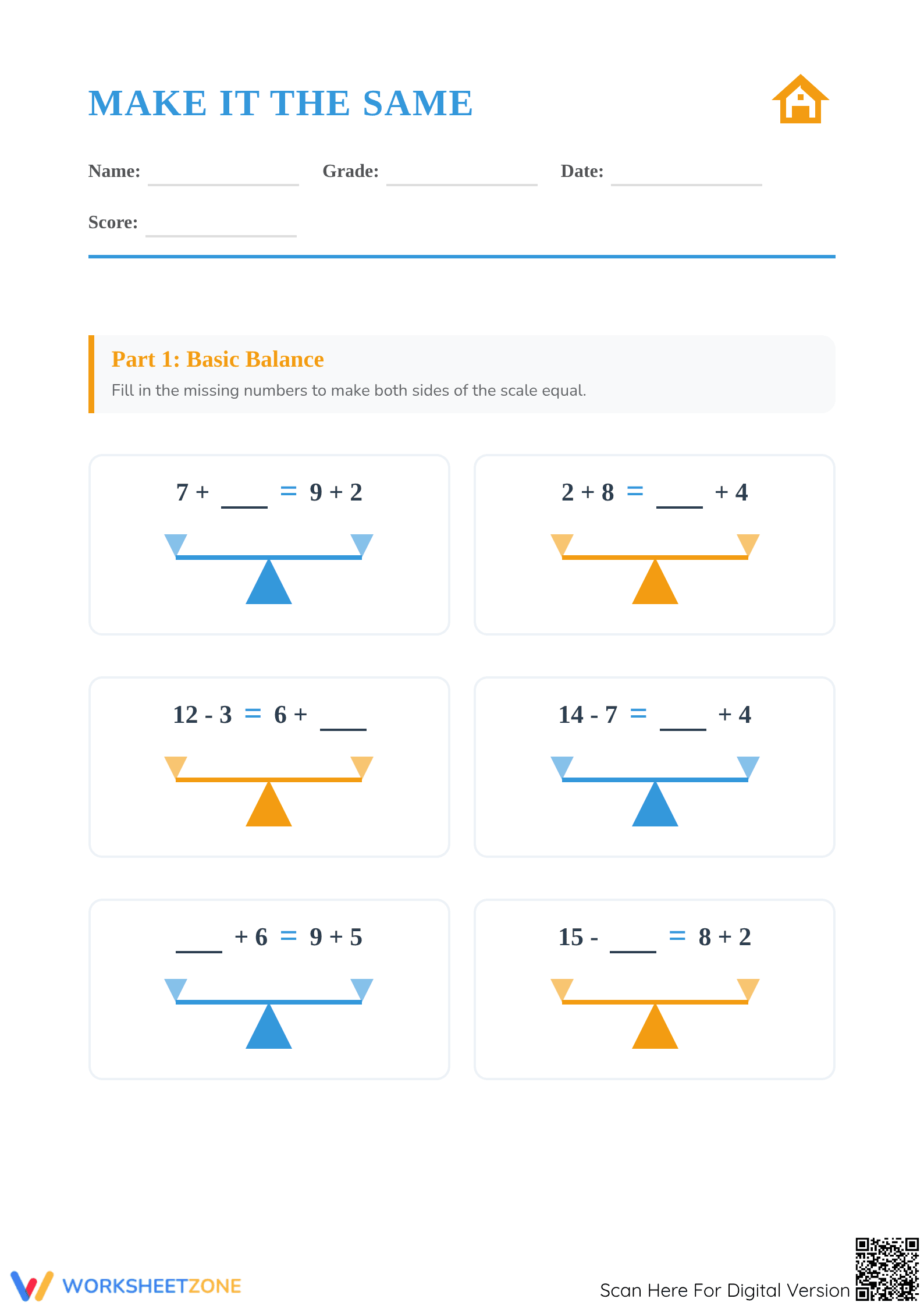
This Printable Grade 1 math worksheet focuses on the fundamental concept of the equal sign as a symbol of balance rather than just a signal to compute. Students solve 18 engaging problems by finding missing numbers to make both sides of an equation equivalent. This resource effectively transitions learners from basic arithmetic to algebraic thinking by emphasizing the relationship between quantities.
At a Glance
- Grade: 1 · Subject: Math
- Standard:
1.OA.D.7— Understand that the equal sign means both sides have the same value.- Skill Focus: Balancing Equations and Missing Addends
- Format: 3 pages · 18 problems · Answer key included · PDF
- Best For: First grade math centers or independent practice
- Time: 20–30 minutes
What's Inside
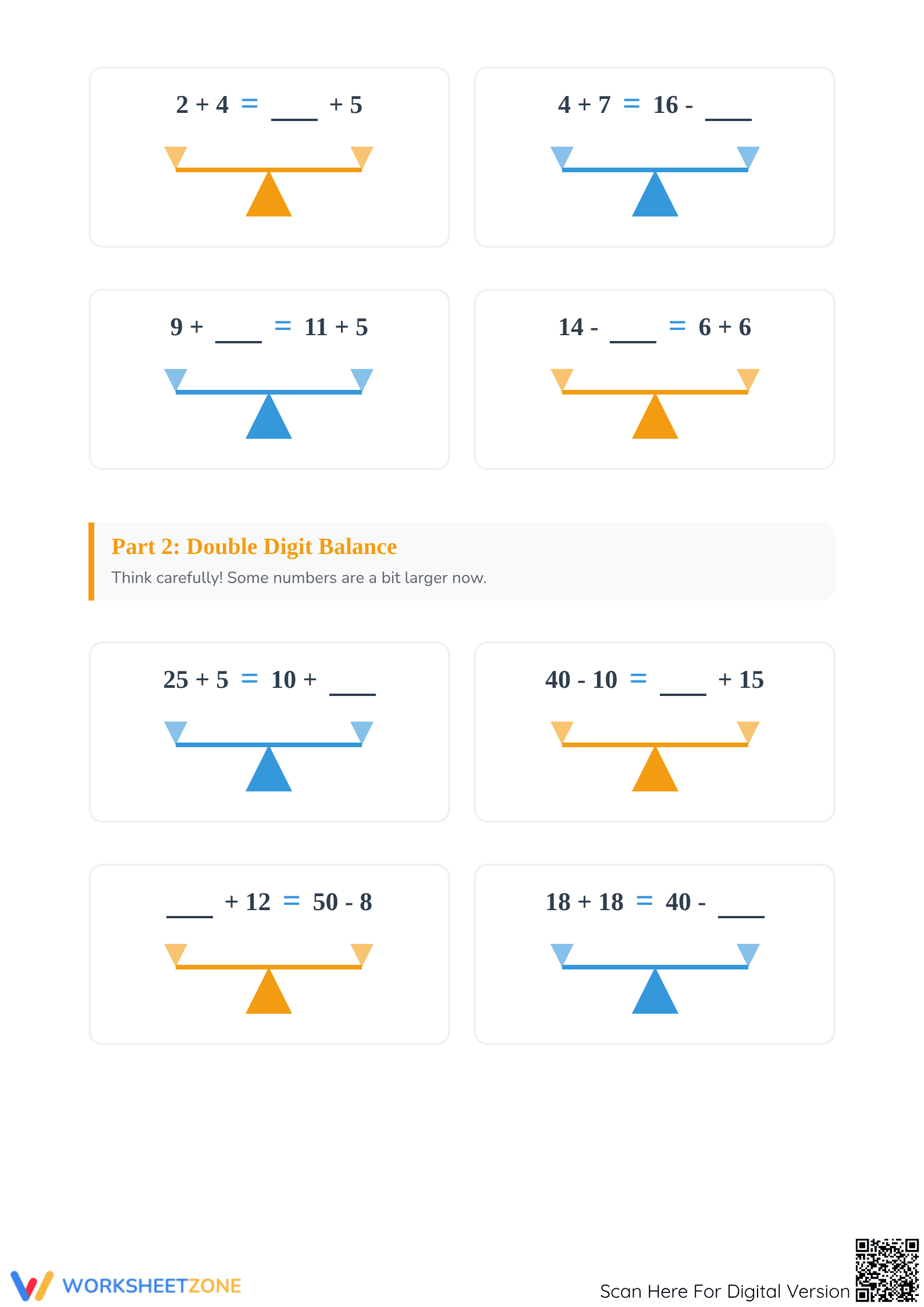
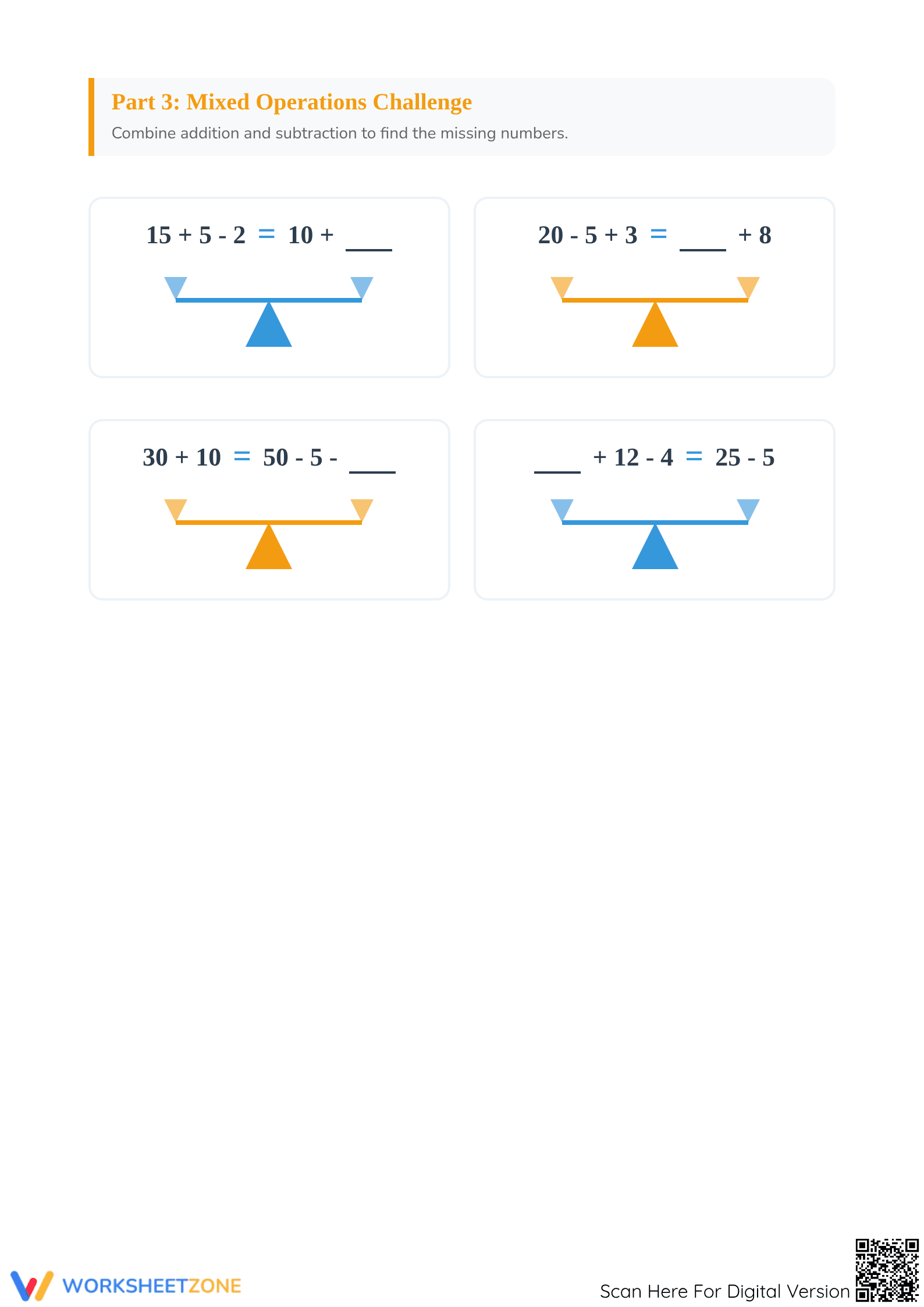
The package includes three structured pages designed to build student confidence. The first page presents six "Basic Balance" problems using visual scales to reinforce the concept of equality. Page two introduces "Double Digit Balance" with larger numbers, while the final page provides a "Mixed Operations Challenge" combining addition and subtraction. A full answer key is provided to ensure quick and easy grading for teachers and parents.
Skill Progression
- Guided Practice: The worksheet begins with six problems featuring visual balance scales, providing a concrete model for the abstract concept of equality.
- Supported Practice: Eight problems transition students to larger numbers and double-digit sums, requiring more rigorous mental math while maintaining the familiar balance structure.
- Independent Practice: Four challenge problems require students to navigate mixed operations, such as 15 + 5 - 2 = 10 + ___, demanding high-level focus and operational fluency.
This structured progression follows a gradual-release model, moving from visual scaffolds to independent mastery of complex algebraic structures.
Standards Alignment
This resource is directly aligned to standard 1.OA.D.7. Students must understand that the equal sign means "is the same as" and use that knowledge to solve for unknowns in varied positions. It also supports 1.OA.B.4 by relating subtraction to addition through balanced equations. Both standard codes can be copied directly into lesson plans, IEP goals, or district curriculum mapping tools.
How to Use It
Use this worksheet as a mid-unit assessment or during small-group instruction to identify common misconceptions about the equal sign. Teachers should observe if students treat the equal sign as a signal to "calculate the answer" or as a "balance point" for the scale. This activity typically takes 25 minutes to complete and works perfectly as a post-lesson formative check or a homework assignment.
Who It's For
This is specifically designed for Grade 1 students but serves as an excellent intervention for Grade 2 learners who may be struggling with algebraic concepts. It pairs naturally with physical balancing scale manipulatives or a digital interactive whiteboard lesson. The clear sections allow educators to assign specific pages based on individual student readiness levels.
Aligned to 1.OA.D.7, this worksheet addresses the critical transition from operational to relational thinking in early mathematics. Research from Fisher & Frey (2014) highlights the importance of the gradual release of responsibility, which this three-part resource mirrors through its tiered difficulty levels. By moving from visual scales to mixed-operation challenges, students develop a robust understanding of equality that prevents common middle-school misconceptions. The 18 structured tasks require students to balance equations by identifying missing addends and subtrahends, a skill foundational to later success in algebra. According to the RAND AIRS 2024 report, high-quality printable resources that emphasize the "meaning of the equal sign" are essential for closing achievement gaps in Title I settings. This zero-prep PDF provides the scaffolding necessary for Grade 1 learners to master complex mathematical relationships with confidence and accuracy.


