


























Views
Downloads

Printable Grade 3 Crossword Maker | Essential Spelling
Paste this activity's link or code into your existing LMS (Google Classroom, Canvas, Teams, Schoology, Moodle, etc.).
Students can open and work on the activity right away, with no student login required.
You'll still be able to track student progress and results from your teacher account.
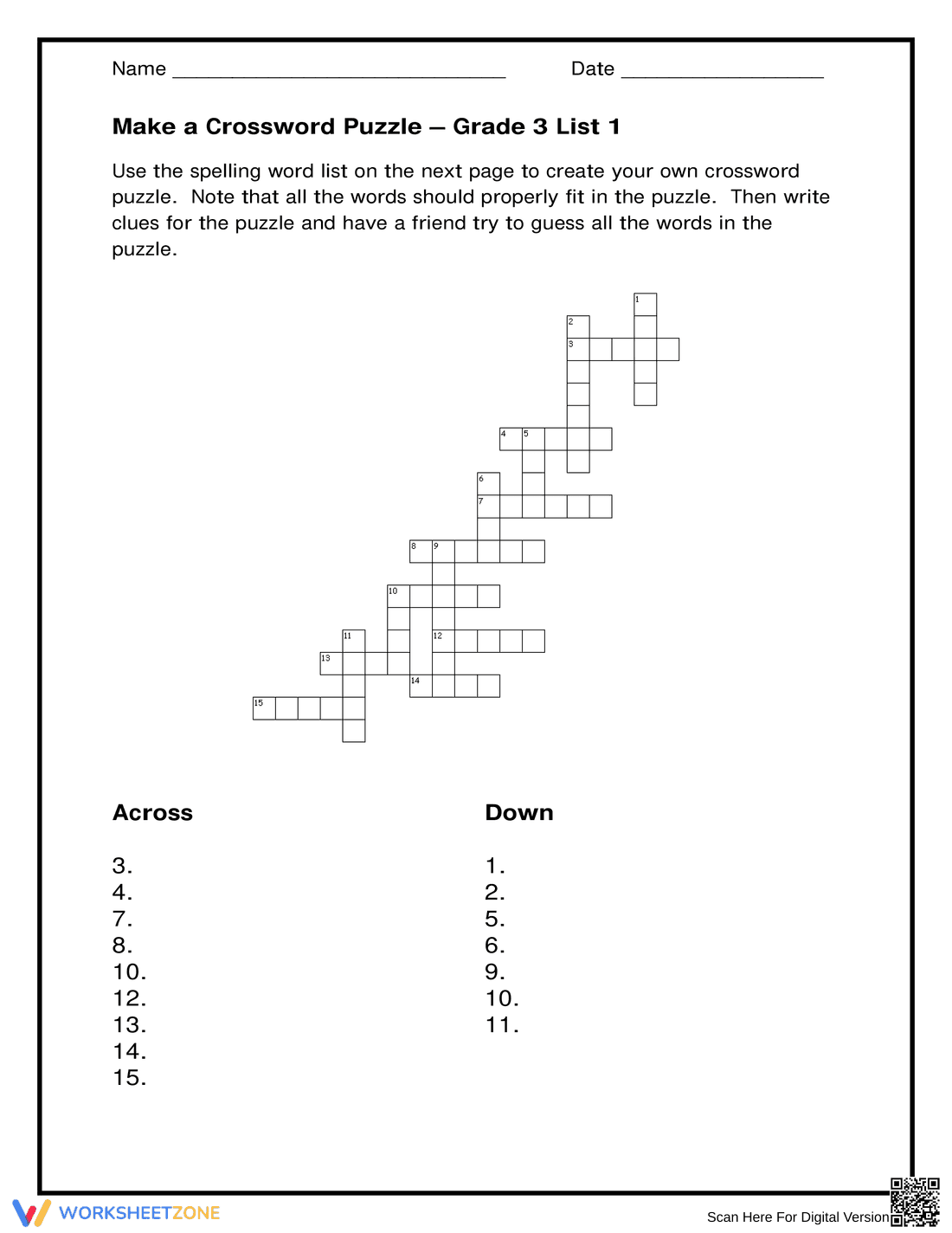
This Grade 3 spelling worksheet empowers students to master their weekly word list by transforming static terms into a dynamic crossword puzzle. Instead of rote memorization, learners engage in deep semantic processing by crafting their own clues. This creative approach ensures that spelling patterns are internalized through active application rather than passive repetition.
At a Glance
- Grade: 3 · Subject: English
- Standard:
CCSS.ELA-LITERACY.L.3.2.F— Use spelling patterns and word rules to write words correctly- Skill Focus: Spelling and Vocabulary
- Format: 2 pages · 16 problems · Answer key included · PDF
- Best For: Independent spelling centers and sub plans
- Time: 20–30 minutes
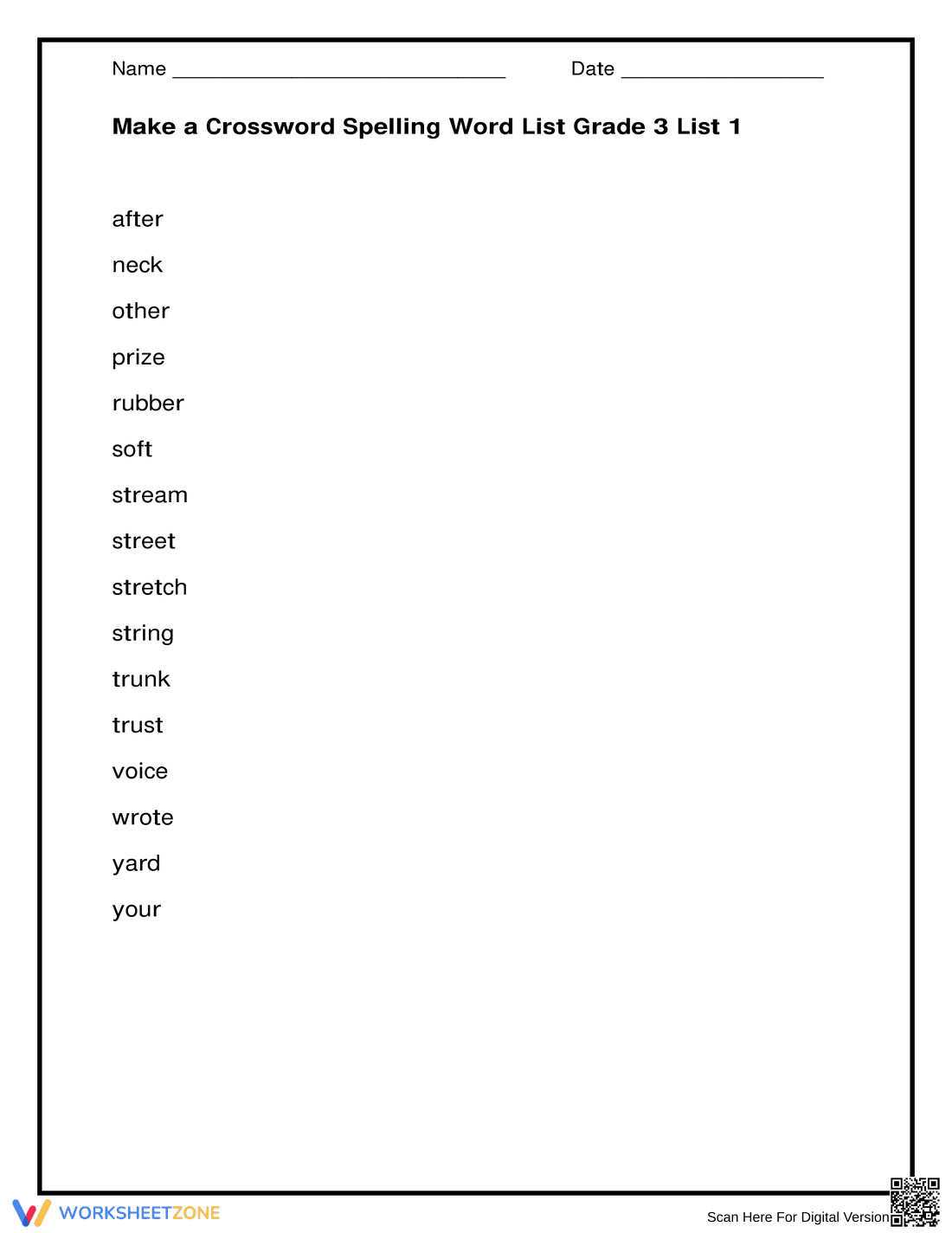
Inside this resource, you will find a professionally designed 16-word crossword grid accompanied by organized lists for Across and Down clues. The worksheet is structured as a two-page set, including a dedicated space for the student-generated clues and a companion spelling word list. This comprehensive layout provides all the scaffolding necessary for students to build a functional puzzle from scratch while reinforcing correct letter sequencing and word structure.
Zero-Prep Workflow
- Step 1: Print (30 seconds) — Simply print the two-page PDF. No additional assembly is required to begin the lesson.
- Step 2: Distribute (1 minute) — Hand out the sheets during your ELA block or literacy centers.
- Step 3: Review (Interactive) — Students swap completed puzzles with classmates for a peer-review cycle that doubles the instructional value.
With a prep time of under two minutes, this worksheet is an ideal solution for busy educators needing high-engagement materials. It functions perfectly as a standalone activity or as a component of a substitute teacher packet.
Standards Alignment: This activity is directly aligned with CCSS.ELA-LITERACY.L.3.2.F, which requires students to use spelling patterns and generalizations in writing words. By transcribing their spelling words into the grid and defining them through clues, students demonstrate mastery of word families and syllable patterns. This standard code can be copied directly into lesson plans, IEP goals, or district curriculum mapping tools to track student progress toward literacy benchmarks.
To maximize the instructional impact, use this worksheet as a mid-week formative assessment. As students write their clues, circulate the room to observe if they can define their words clearly and accurately; this provides immediate insight into their vocabulary depth. For an extra challenge, encourage students to include one synonym or antonym in each clue they write, further expanding their linguistic flexibility within the 20 to 30-minute completion window.
This resource is specifically designed for 3rd-grade students in general education, ESL, or specialized instruction settings. It pairs naturally with any standard spelling curriculum or can be used as a follow-up to a shared reading passage to reinforce target vocabulary. The open-ended nature of clue-writing allows for natural differentiation as students can write simple or complex definitions based on their individual proficiency levels.
Research from Fisher & Frey (2014) shows "word-solving" activities, like creating crossword puzzles, are more effective for long-term retention than traditional drills. By having students generate clues for their Grade 3 spelling words (CCSS.ELA-LITERACY.L.3.2.F), this worksheet promotes generative learning, integrating new vocabulary into existing mental frameworks. This ensures spelling patterns are encoded for authentic writing, not just memorized for tests. The dual-process of filling a grid and writing definitions targets both orthographic and semantic pathways. NAEP data indicates students engaged in regular, structured vocabulary play improve reading comprehension. This printable resource offers high-impact instructional strategy without adding teacher workload, becoming a classroom-ready literacy toolkit staple.


