


























Views
Downloads

Printable Main Idea & Details Worksheet | Grade 3 ELA
Paste this activity's link or code into your existing LMS (Google Classroom, Canvas, Teams, Schoology, Moodle, etc.).
Students can open and work on the activity right away, with no student login required.
You'll still be able to track student progress and results from your teacher account.
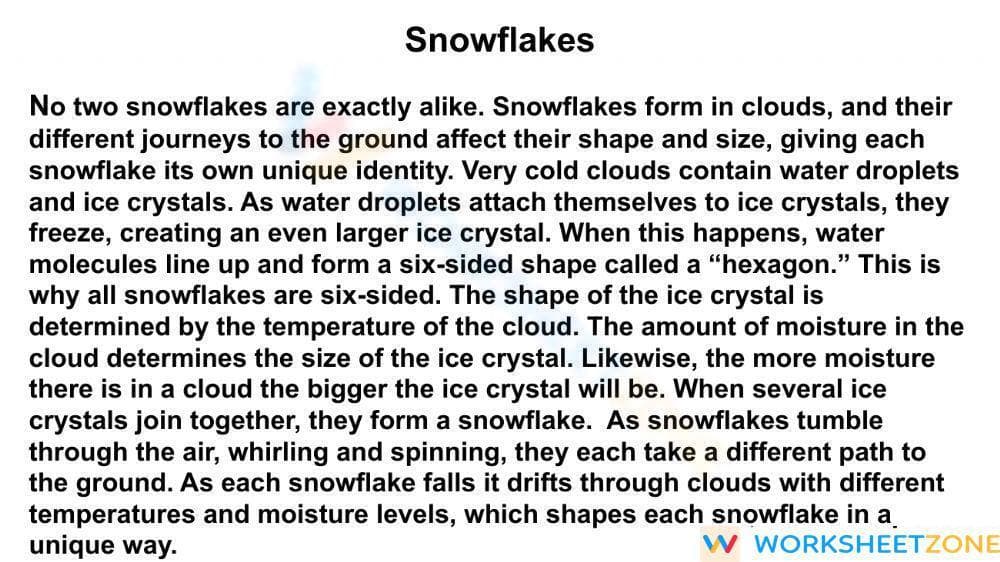
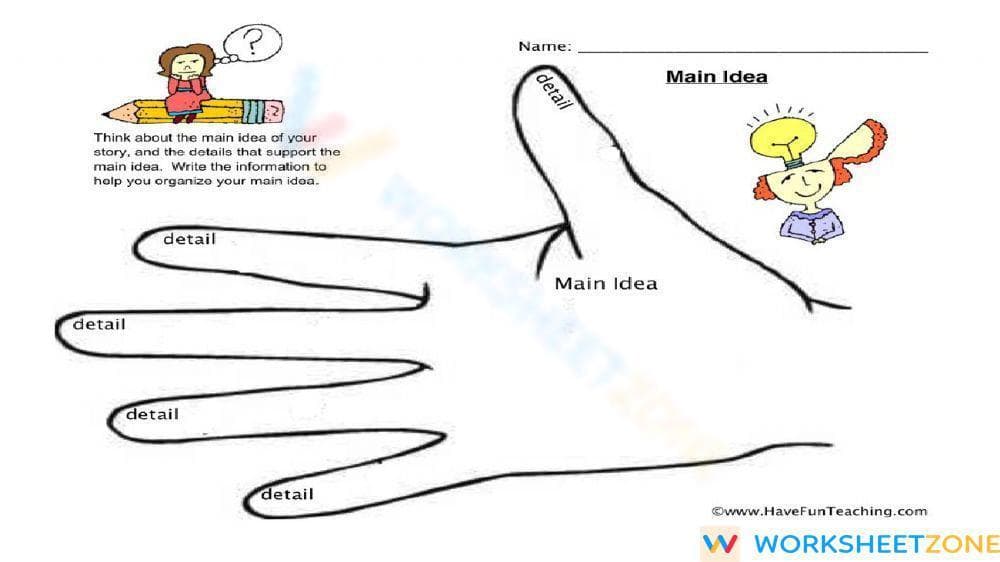
This reading comprehension worksheet helps students master identifying the main idea and supporting details of an informational text. By reading a short passage about snowflakes and completing a visual graphic organizer, learners actively practice extracting key information and structuring their understanding of the author's primary message.
At a Glance
- Grade: 3 · Subject: ELA
- Standard:
CCSS.ELA-LITERACY.RI.3.2— Determine the main idea and recount key details.- Skill Focus: Main Idea and Details
- Format: 2 pages · 6 problems · No answer key · PDF
- Best For: Independent practice or centers
- Time: 15–20 minutes
This resource includes a one-page informational text about how snowflakes form, paired with a fun, hand-shaped graphic organizer. The organizer prompts students to write the main idea in the palm and five supporting details on the fingers. This visual structure provides a concrete way for young readers to map out the relationship between the central concept and the specific facts that support it.
Designed for immediate classroom use, this zero-prep resource follows a simple workflow:
- Print (1 minute): Easily print the two-page PDF for your entire class.
- Distribute (1 minute): Hand out the passage and the graphic organizer to each student.
- Review (3 minutes): Briefly explain how the hand diagram works before letting students read independently.
With under two minutes of total teacher prep time, this activity is an excellent choice for emergency sub plans, morning work, or a quick literacy center station.
This worksheet is directly aligned to CCSS.ELA-LITERACY.RI.3.2: "Determine the main idea of a text; recount the key details and explain how they support the main idea." It also supports foundational reading comprehension skills by requiring students to refer back to the text to find specific evidence. Both standard codes can be copied directly into lesson plans, IEP goals, or district curriculum mapping tools.
Teachers can use this worksheet during independent reading time to assess comprehension of informational texts. It also works perfectly as a post-instruction activity after a whole-group lesson on finding the main idea. As a formative assessment tip, observe whether students are writing full sentences or just keywords on the "fingers" of the graphic organizer; this will tell you if they are truly grasping the details or just copying random words. Expected completion time is 15 to 20 minutes.
This activity is ideal for third-grade students, though it can easily be used for review in fourth grade or as an extension for advanced second graders. The visual nature of the hand organizer provides excellent scaffolding for visual learners and students who struggle with traditional outlining. Pair this worksheet with an anchor chart on "Main Idea vs. Details" to reinforce the concept before students begin.
Developing the ability to determine the main idea and recount key details is a critical milestone in elementary literacy, directly addressed by CCSS.ELA-LITERACY.RI.3.2. According to Fisher & Frey (2014), utilizing graphic organizers significantly improves students' capacity to visualize text structures and retain informational content. When learners map out the central concept and its supporting evidence, they transition from passive reading to active comprehension. This cognitive mapping is essential for tackling increasingly complex texts in later grades. By integrating a straightforward reading passage with a structured visual tool, educators can effectively support students in isolating the most important information. This foundational skill not only enhances reading proficiency but also improves students' ability to organize their own writing, making it a versatile and necessary component of any comprehensive literacy program.


