


























Views
Downloads

Essential Grade 1-2 Magnets Activity: Printable Science
Paste this activity's link or code into your existing LMS (Google Classroom, Canvas, Teams, Schoology, Moodle, etc.).
Students can open and work on the activity right away, with no student login required.
You'll still be able to track student progress and results from your teacher account.
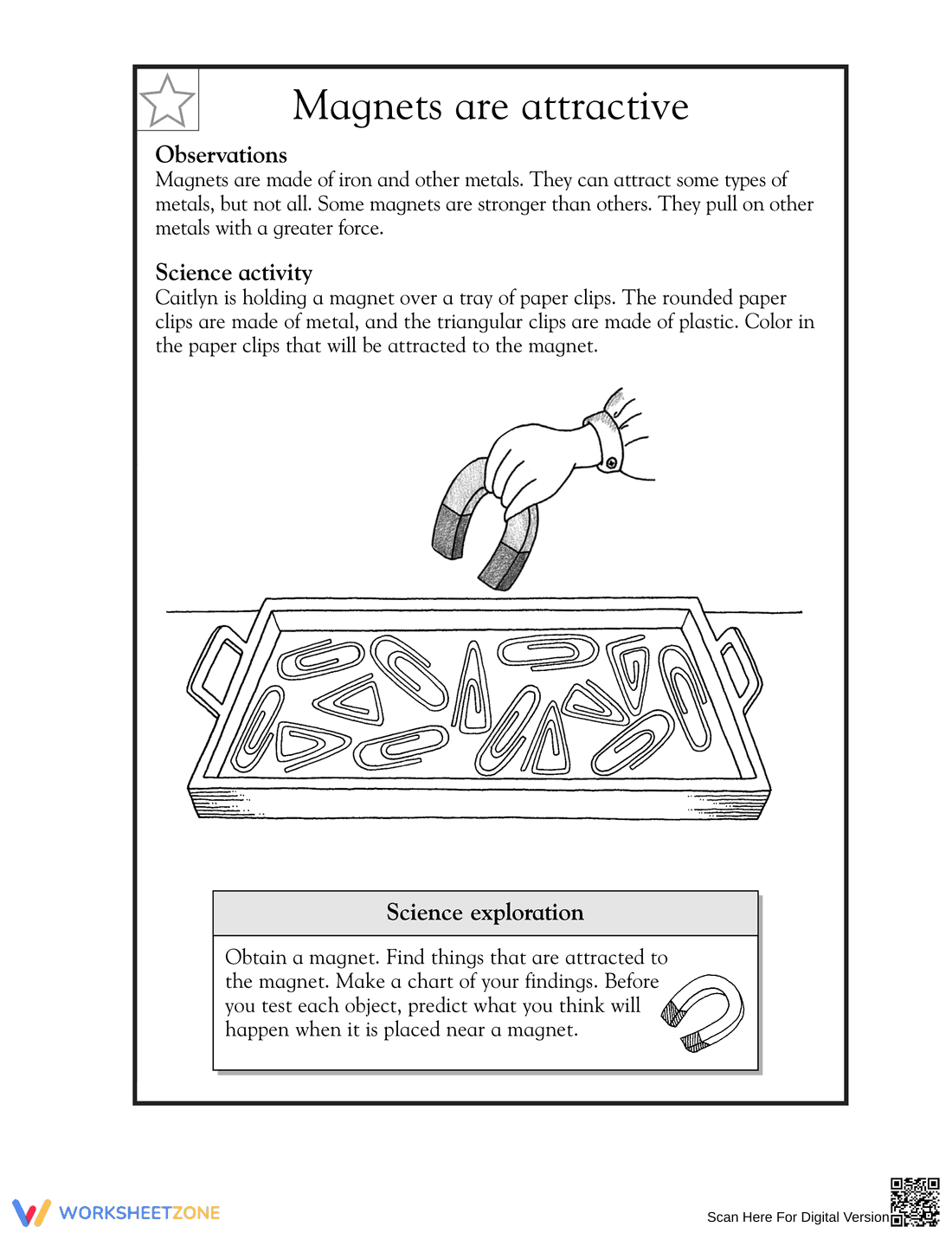
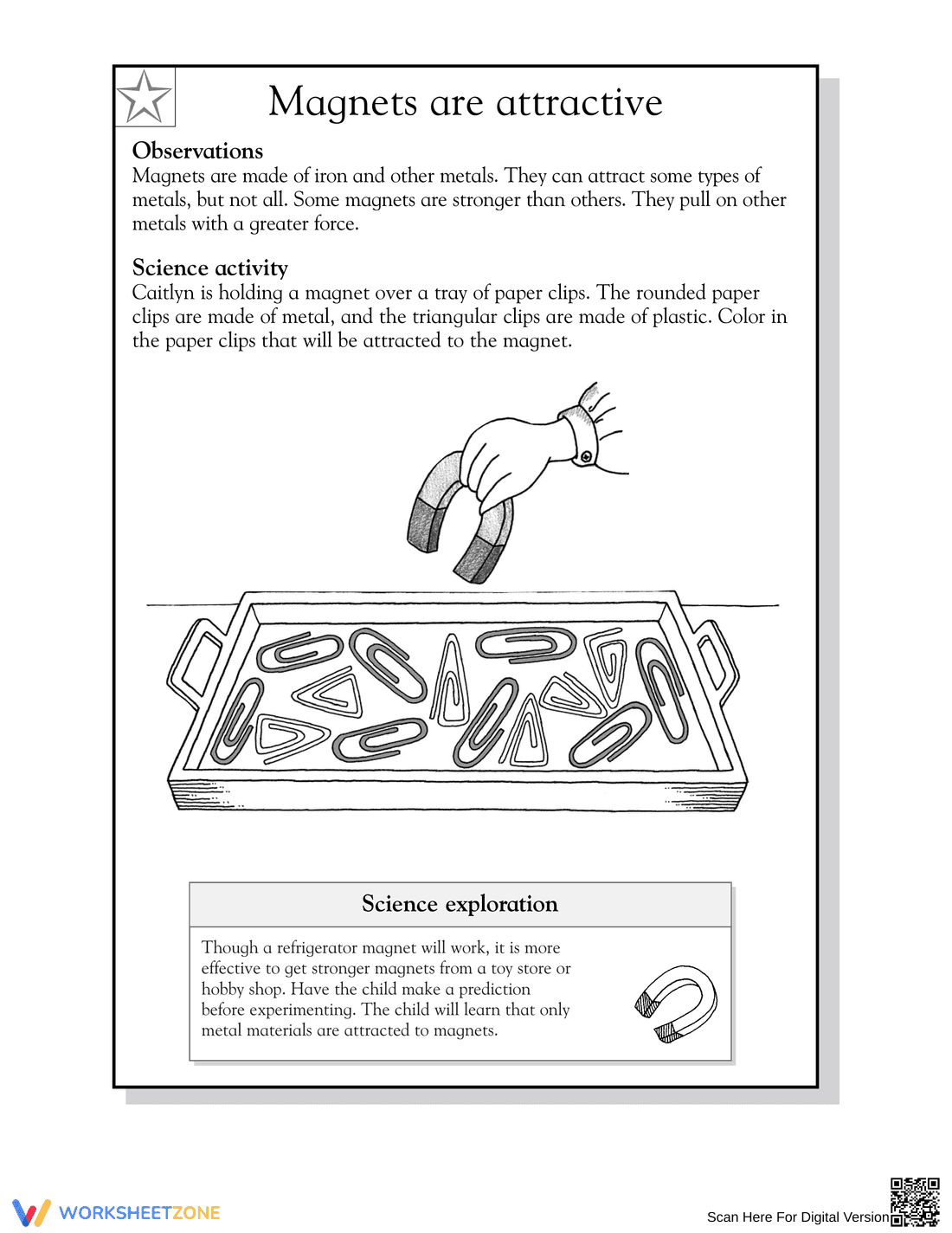
This printable Grade 1-2 magnets worksheet helps students identify magnetic properties through observable evidence. Students differentiate between metallic and non-metallic materials by predicting and coloring items attracted to a magnet. This hands-on activity simplifies complex physical science concepts, ensuring young learners grasp the fundamental principles of force and motion before moving to advanced experiments.
At a Glance
- Grade: 1-2 · Subject: Science
- Standard:
2-PS1-1— Classify different materials by their observable properties, including magnetic attraction- Skill Focus: Magnetic attraction and material properties
- Format: 1 page · 12 interactive tasks · Answer key included · PDF
- Best For: Independent science centers or homework
- Time: 15–20 minutes
The worksheet features a clear instructional Observations section that defines magnets and their composition from iron and other metals. The primary Science Activity provides 12 distinct objects for students to evaluate, specifically contrasting metal paper clips with plastic variants. A Science Exploration extension box encourages students to apply their knowledge in the real world by creating a prediction chart for classroom objects.
Implementing this resource requires zero teacher setup. First, print the single-page PDF (30 seconds) and gather coloring supplies. Second, distribute the sheets for students to complete as a transition task (15 minutes). Finally, review the findings as a class to address misconceptions about which materials magnets pull with force (5 minutes). This simple workflow makes it an ideal addition to any physical science unit.
This resource aligns directly with `2-PS1-1`, which requires students to plan and conduct investigations to describe and classify different kinds of materials by their observable properties. By distinguishing between magnetic and non-magnetic materials, students build the foundational knowledge necessary for the NGSS physical science progression. Both standard codes can be copied directly into lesson plans, IEP goals, or district curriculum mapping tools.
Use this worksheet as a formative assessment after an introductory lesson on forces. Observe how students differentiate between the rounded and triangular clips to gauge their reading comprehension and scientific reasoning. Alternatively, use it as a sub plan activity that provides meaningful science instruction without requiring specialized lab equipment or teacher-led demonstrations. It serves as an excellent check for understanding during the initial learning phase.
This activity is designed for first and second-grade students who are beginning to explore physical properties. It is especially effective for visual learners and students who benefit from fine-motor tasks like coloring. Pair this worksheet with a physical horseshoe magnet and a tray of mixed materials to create a multisensory learning experience in a science center. Differentiation is naturally supported through the open-ended exploration task.
Scientific literacy in early childhood depends on connecting abstract concepts to concrete observations. According to Fisher & Frey (2014), the gradual release of responsibility model—moving from observation to independent exploration—is critical for mastery in STEM subjects. This worksheet facilitates that transition by providing a structured environment where students test hypotheses about magnetic attraction. By identifying that magnets attract iron but not plastics, learners meet standard `2-PS1-1` while developing critical thinking skills for complex physical science investigations. The prediction phase in the exploration section mirrors the scientific method, grounding early education in authentic practice. This resource ensures Grade 2 students achieve proficiency in material classification, a key milestone identified by the ScienceDirect TpT Analysis of primary science curricula. By engaging with these specific material properties, students gain the confidence needed to succeed in future laboratory settings.


