




























Views
Downloads

Grade 3 Magnetism — Printable No-Prep Worksheet

Paste this activity's link or code into your existing LMS (Google Classroom, Canvas, Teams, Schoology, Moodle, etc.).
Students can open and work on the activity right away, with no student login required.
You'll still be able to track student progress and results from your teacher account.
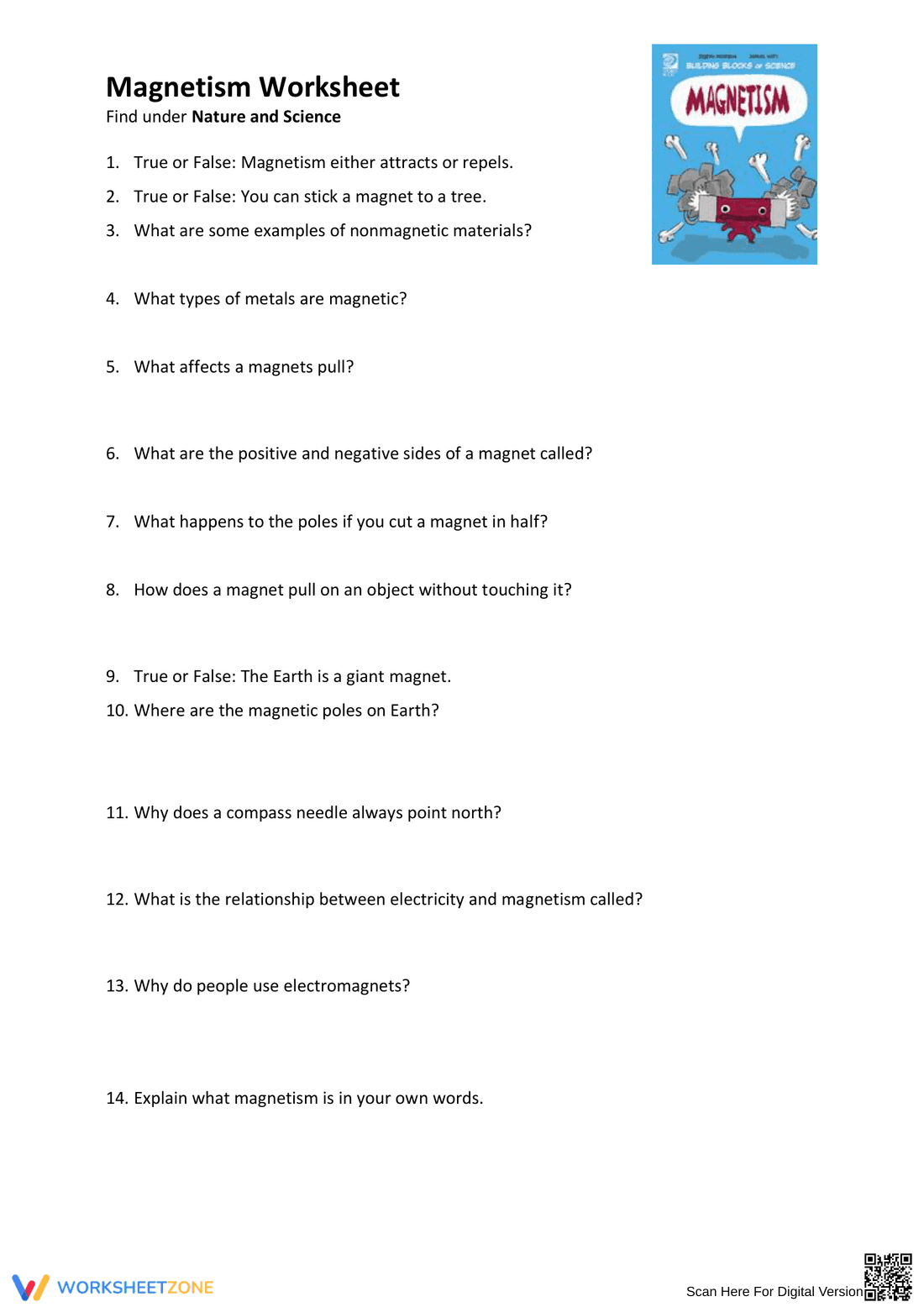
This ready-to-use science worksheet helps students understand the fundamental principles of magnetism and magnetic fields. By answering targeted questions, learners will identify magnetic materials, explain how poles interact, and explore real-world applications like compasses and electromagnets, building a strong foundation in physical science concepts.
At a Glance
- Grade: 3 · Subject: Science
- Standard:
3-PS2-3— Determine cause and effect of magnetic interactions- Skill Focus: Magnetism and magnetic fields
- Format: 2 pages · 14 problems · Answer key included · PDF
- Best For: Independent practice or review
- Time: 15–20 minutes
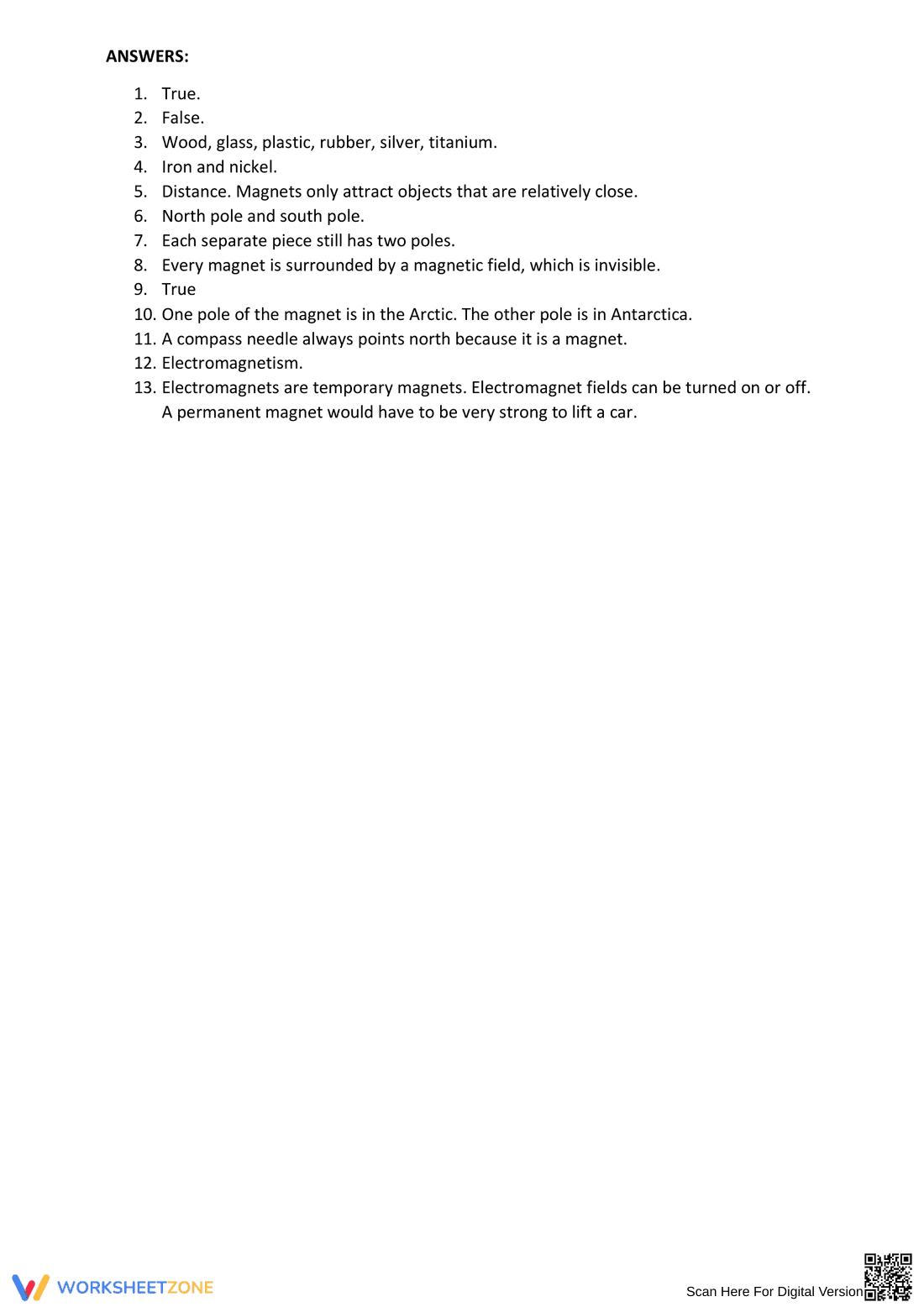
This resource features a single-page student worksheet containing 14 questions that mix true/false statements and short-answer prompts. The questions guide students through core concepts, from basic attraction and repulsion to the Earth's magnetic poles. A complete, separate answer key is provided on the second page, ensuring quick and accurate grading for educators or easy self-checking for students.
Designed for maximum efficiency, this worksheet requires virtually no teacher setup:
- Print (1 minute): Simply download the PDF and print the student-facing page. The clean layout is optimized for standard black-and-white printing.
- Distribute (1 minute): Hand out the worksheet as a standalone assignment, homework task, or quick assessment.
- Review (1 minute): Use the included answer key to rapidly score responses or project it on the board for whole-class review.
With a total prep time of under two minutes, this resource is highly suitable for emergency sub plans or last-minute schedule changes.
This activity is aligned to 3-PS2-3: Ask questions to determine cause and effect relationships of electric or magnetic interactions between two objects not in contact with each other. It also supports general physical science inquiry skills by asking students to explain scientific phenomena in their own words. Both standard codes can be copied directly into lesson plans, IEP goals, or district curriculum mapping tools.
Teachers can deploy this worksheet during the core instructional phase after a hands-on magnet experiment to solidify newly acquired vocabulary. Alternatively, it serves as an excellent end-of-unit review before a formal assessment. As a formative assessment observation tip, monitor how students answer question 14 ("Explain what magnetism is in your own words") to gauge their true conceptual understanding versus rote memorization. The entire activity has an expected completion time range of 15 to 20 minutes.
This resource is primarily designed for third-grade general education students, though it functions well as a review tool for fourth and fifth graders. For differentiation, teachers can provide sentence frames for the short-answer questions to support English Language Learners or students with writing difficulties. It pairs naturally with hands-on science stations featuring bar magnets, iron filings, and compasses.
Integrating structured question-and-answer activities into elementary science instruction significantly reinforces conceptual retention. According to a ScienceDirect TpT Analysis, providing students with immediate opportunities to apply new vocabulary in written formats improves long-term recall of physical science principles. This worksheet directly addresses 3-PS2-3 by having students determine cause and effect of magnetic interactions through targeted prompts about poles, magnetic fields, and electromagnets. By moving from simple true/false identification to complex open-ended explanations, the activity scaffolds cognitive demand appropriately for young learners. The inclusion of real-world examples, such as the Earth's magnetic field and compass navigation, helps bridge the gap between abstract physics concepts and observable phenomena. Utilizing this targeted practice ensures students build the foundational knowledge required for more advanced scientific inquiry in later grades.


