




























Views
Downloads
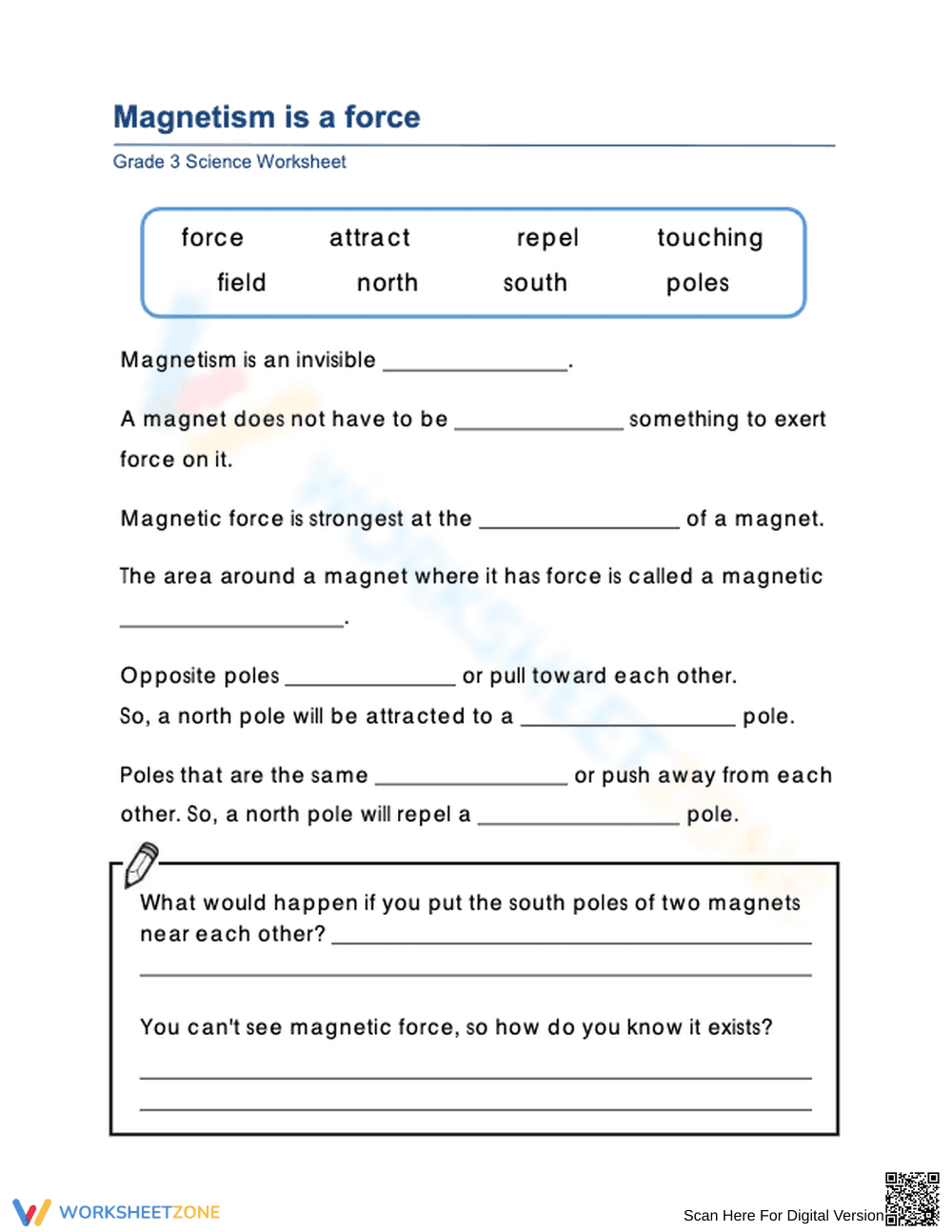

Essential Magnetism Worksheet | Grade 3 Science

Paste this activity's link or code into your existing LMS (Google Classroom, Canvas, Teams, Schoology, Moodle, etc.).
Students can open and work on the activity right away, with no student login required.
You'll still be able to track student progress and results from your teacher account.
This Grade 3 science worksheet provides a structured way for students to explore the fundamental principles of magnetism. By engaging with key vocabulary and conceptual questions, learners identify how magnets exert force without touching and how poles interact. This resource ensures students can explain the scientific reasoning behind magnetic attraction and repulsion through guided practice.
At a Glance
- Grade: 3 · Subject: Science
- Standard:
3-PS2-3— Ask questions to determine cause and effect relationships of magnetic interactions- Skill Focus: Magnetic forces and poles
- Format: 2 pages · 10 problems · Answer key included · PDF
- Best For: Independent practice or quick assessment
- Time: 15–20 minutes
The worksheet contains a comprehensive student activity page and a clear answer key. The main section features a word bank with eight essential terms: force, attract, repel, touching, field, north, south, and poles. Students use these terms to complete eight conceptual sentences that define the properties of magnets. Below the cloze activity, two open-ended questions challenge students to predict outcomes and provide evidence for invisible forces.
This resource is designed for a two-minute setup. Step 1: Print the single-page student sheet in seconds. Step 2: Distribute to the class for a 15-minute independent work session. Step 3: Use the provided answer key for a 5-minute whole-group review or peer-grading session. It is an ideal option for substitute folders, morning work, or unexpected schedule changes where high-quality content is needed immediately.
Primary alignment is 3-PS2-3. This standard requires students to determine cause-and-effect relationships of magnetic interactions. The worksheet specifically addresses how distance and orientation of poles affect the strength and direction of the force. Both standard codes can be copied directly into lesson plans, IEP goals, or district curriculum mapping tools to ensure compliance with NGSS frameworks.
Use this as a formative assessment after a hands-on lab with bar magnets. It allows teachers to see if students have transitioned from exploring magnets to understanding the scientific terminology. Alternatively, assign it as a homework reinforcement task. Observe if students can correctly identify that magnets do not need to be touching to exert force, which is a common misconception in early elementary science.
This is tailored for 3rd-grade students but serves as an excellent review for 4th graders or a challenge for advanced 2nd graders. The included word bank provides necessary scaffolding for English Language Learners (ELLs) and students with IEPs who require vocabulary support during science writing tasks. It pairs naturally with physical science units focusing on forces and motion.
According to Fisher & Frey (2014), the use of scaffolded vocabulary within science instruction significantly improves the retention of complex physical concepts. This worksheet applies those findings by utilizing a word bank to bridge the gap between observation and academic language. By focusing on the 3-PS2-3 standard, the resource targets the specific cause-and-effect relationships that define magnetic interactions. Research from the NAEP suggests that students who can articulate the properties of invisible forces, such as magnetic fields, demonstrate higher proficiency in later physics modules. This 10-task activity provides the necessary repetition to move these concepts into long-term memory. The inclusion of an answer key allows for immediate feedback, which is a critical component of the gradual release of responsibility model. Educators can use this tool to verify that 100% of students understand the directional nature of magnetic poles before moving to more complex electromagnetic units.


