


























Views
Downloads

Nature-Inspired Designs Worksheet | Grade 1 Essential
Paste this activity's link or code into your existing LMS (Google Classroom, Canvas, Teams, Schoology, Moodle, etc.).
Students can open and work on the activity right away, with no student login required.
You'll still be able to track student progress and results from your teacher account.
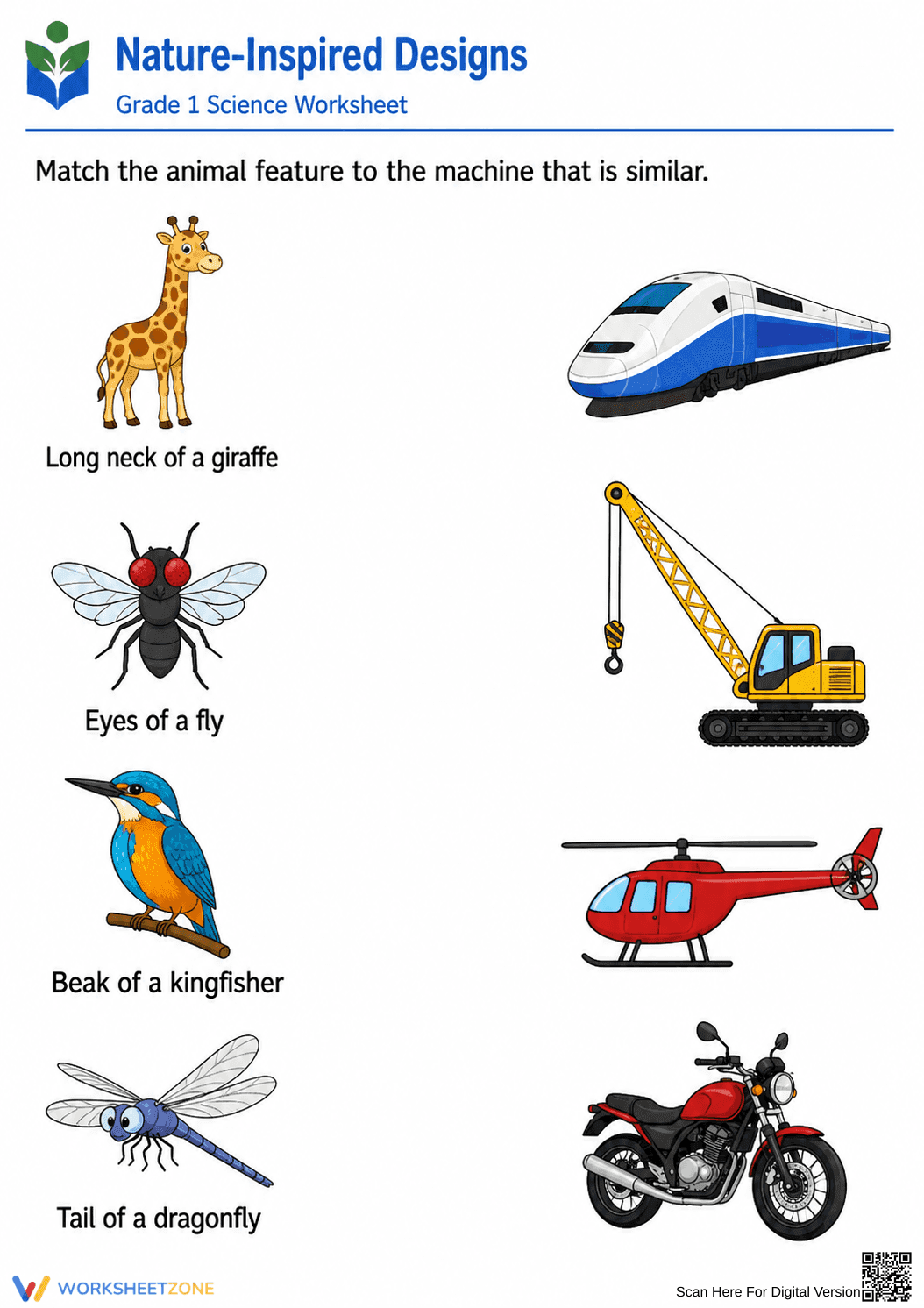
Students identify how animal traits influence engineering with this focused biomimicry activity. By matching biological features like a giraffe's neck to machines, learners develop observation skills. This worksheet simplifies complex engineering concepts into a visual format that ensures clear student understanding of natural design principles and the relationship between structure and function.
At a Glance
- Grade: 1 · Subject: Science
- Standard:
1-LS1-1— Use materials to design a solution by mimicking how animals use external parts- Skill Focus: Biomimicry and Functional Design
- Format: 1 page · 4 problems · Answer key included · PDF
- Best For: Introduction to engineering and biological structures in primary classrooms
- Time: 10–15 minutes
What's Inside
This PDF features four high-quality illustrations of animals paired with machine counterparts. Students draw lines connecting specific biological adaptations—such as a dragonfly's tail—to the human-made technology they resemble. The clear labeling and intuitive layout support early readers while focusing on visual literacy and comparative analysis in the scientific realm.
Zero-Prep Workflow
This resource integrates immediately with minimal oversight. First, print the single-page activity in under 60 seconds. Second, distribute the sheets as an independent practice or sub-plan activity requiring zero additional materials besides a pencil. Third, review the matching pairs as a group to reinforce the logic, completing the preparation cycle in less than two minutes.
Standards Alignment
Aligned primarily to `1-LS1-1`, this activity requires students to observe how external parts of animals help them function and how humans mimic these traits. It supports cross-cutting concepts of Structure and Function. This standard code can be copied directly into lesson plans, IEP goals, or district curriculum mapping tools.
How to Use It
Use this worksheet during the 'Explain' phase of a 5E lesson on animal adaptations. It serves as an excellent bridge between biological studies and physical science units. For a formative assessment observation, watch for students who struggle to connect the kingfisher's beak to the train; this identifies a need for instruction on aerodynamics. Most first-grade students complete the matching in 12 minutes.
Who It's For
Optimized for Grade 1 Science, this activity provides visual support for ELL students through high-contrast imagery. It pairs naturally with an anchor chart or read-aloud about inventors. The scaffolded format ensures students with varying literacy levels can participate fully in scientific inquiry without being hindered by complex text.
The 1-LS1-1 standard emphasizes the practical application of biomimicry, where students move from simple observation to understanding functional design. According to the RAND AIRS 2024 report on early science instruction, visual matching activities that connect biological structures to mechanical analogues significantly improve long-term retention of structural-functional relationships in primary learners. By isolating four distinct examples—the giraffe, fly, kingfisher, and dragonfly—this worksheet provides a manageable cognitive load that allows students to focus on the underlying scientific principle of mimicry rather than getting lost in excessive data. Research suggests that when students engage with these concepts early, they develop a more sophisticated engineering lens through which they view the natural world. This worksheet provides an essential bridge between life science and engineering design, ensuring that Grade 1 students meet national proficiency benchmarks while fostering genuine curiosity about how the world around them is improved through biological inspiration.


