


























Views
Downloads
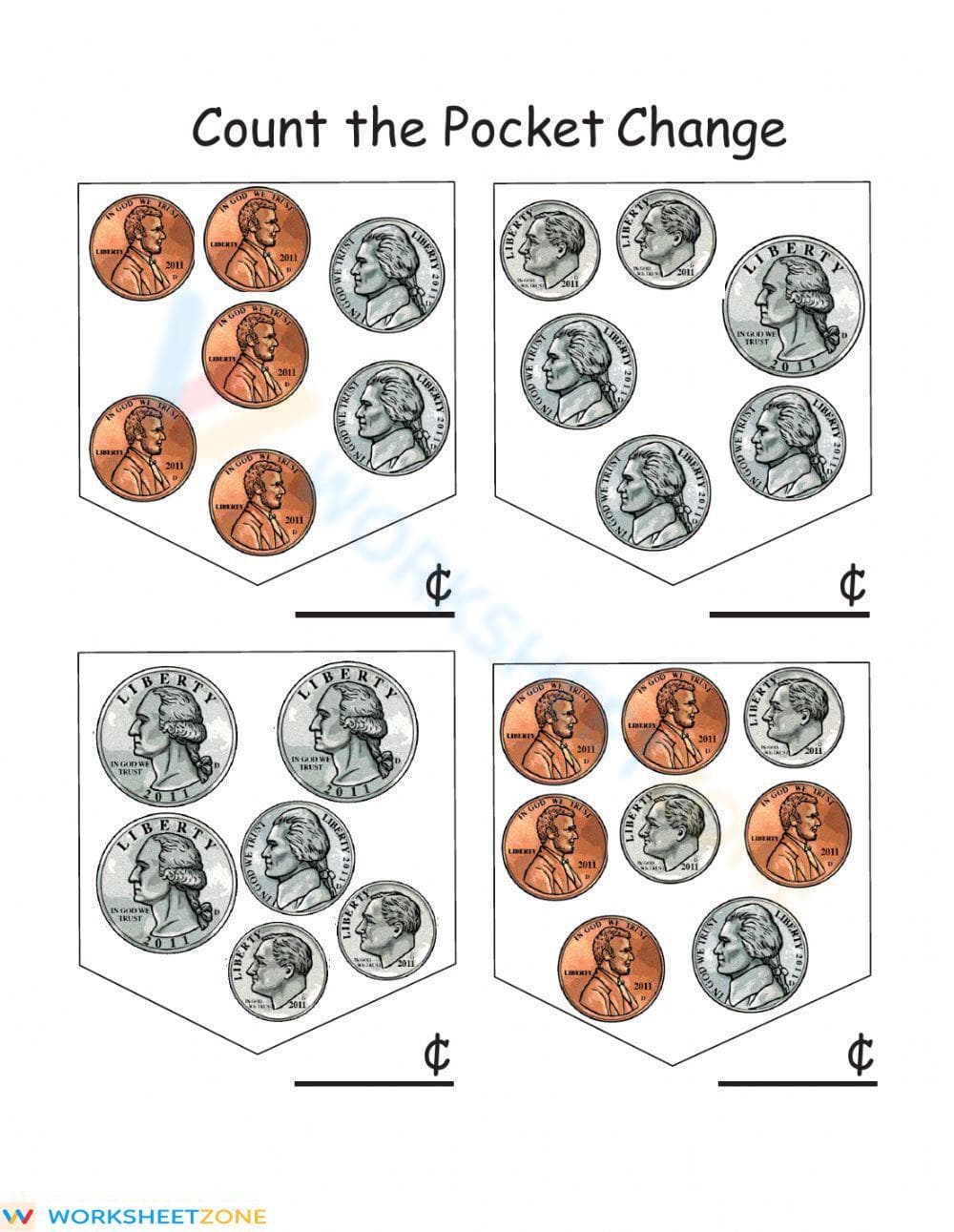

Counting Coins Worksheet | Grade 2 Essential Math
Paste this activity's link or code into your existing LMS (Google Classroom, Canvas, Teams, Schoology, Moodle, etc.).
Students can open and work on the activity right away, with no student login required.
You'll still be able to track student progress and results from your teacher account.
This Grade 2 counting coins worksheet provides students with targeted practice in identifying and summing the values of mixed US currency. By engaging with realistic visual representations of pennies, nickels, dimes, and quarters, learners develop the skip-counting and addition skills necessary for real-world financial literacy. This resource ensures students can confidently determine total values in cents.
At a Glance
- Grade: 2 · Subject: Math
- Standard:
CCSS.MATH.CONTENT.2.MD.C.8— Solve problems involving quarters, dimes, nickels, and pennies using cent symbols.- Skill Focus: Counting mixed US coins
- Format: 1 page · 4 problems · Answer key included · PDF
- Best For: Independent practice or quick formative assessment
- Time: 10–15 minutes
This single-page PDF features four distinct "pocket change" scenarios. Each problem contains a collection of high-quality coin illustrations, including both heads and tails views to help with identification. Students are provided with a dedicated line to write the total value using the cent symbol. A comprehensive answer key is included to facilitate rapid grading or student self-correction.
The zero-prep workflow for this resource is designed for maximum efficiency in busy classrooms. First, print the single-page PDF (30 seconds). Second, distribute the worksheets to students as a morning warm-up or transition activity (1 minute). Third, review the answers as a whole group to address common misconceptions about coin values (5 minutes). Total teacher preparation time is under 2 minutes, making it an ideal choice for substitute folders or last-minute lesson supplements.
The primary focus is CCSS.MATH.CONTENT.2.MD.C.8: "Solve word problems involving dollar bills, quarters, dimes, nickels, and pennies, using $ and ¢ symbols appropriately." This worksheet specifically targets the foundational skill of finding the total value of a group of coins. This standard code can be copied directly into lesson plans, IEP goals, or district curriculum mapping tools.
Use this worksheet during the "independent practice" phase of a math lesson on money. It serves as an excellent formative assessment tool; observe if students are sorting coins by value before counting or if they struggle to transition between skip-counting by 10s, 5s, and 1s. Completion typically takes 10 to 15 minutes, depending on the student's fluency with coin identification.
This resource is tailored for second-grade students mastering the base-ten system through currency. It is also highly effective for English Language Learners (ELLs) who need visual support to learn US currency names and values. Pair this worksheet with physical plastic coins or a digital interactive whiteboard display for a multi-sensory learning experience.
According to the RAND AIRS 2024 report on elementary mathematics, the use of high-fidelity visual representations in early numeracy tasks significantly improves the transfer of skills from classroom exercises to real-world applications. This worksheet aligns with those findings by utilizing clear, recognizable images of US currency to support the mastery of CCSS.MATH.CONTENT.2.MD.C.8. By requiring students to sum mixed sets of pennies, nickels, dimes, and quarters, the resource reinforces the cognitive shift between different skip-counting patterns. Research from Fisher & Frey (2014) emphasizes that such structured practice is vital for the gradual release of responsibility, moving students from teacher-led identification to independent calculation. This 1-page printable provides the necessary repetition for students to achieve fluency in counting pocket change, a prerequisite for more complex financial word problems. Educators can rely on this evidence-based design to support diverse learners in meeting Grade 2 measurement and data standards effectively.


