


























Views
Downloads

Counting 1-10 Ten-Frame Cards | Printable Kindergarten Math
Paste this activity's link or code into your existing LMS (Google Classroom, Canvas, Teams, Schoology, Moodle, etc.).
Students can open and work on the activity right away, with no student login required.
You'll still be able to track student progress and results from your teacher account.
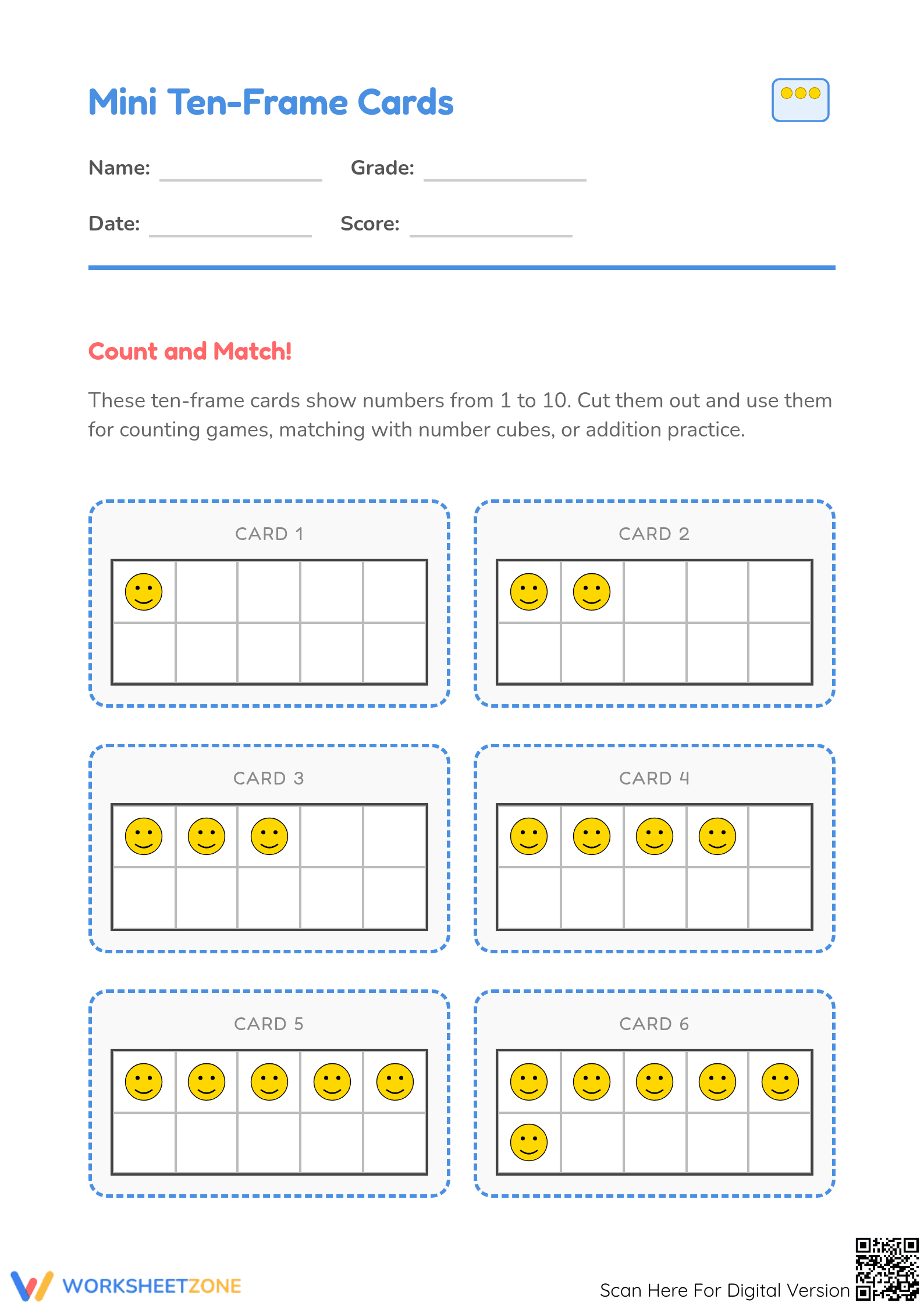
This Kindergarten math worksheet helps students build foundational number sense by counting objects from one to ten. Using visual ten-frames, early learners connect physical quantities to numerical values. The hands-on cards provide an interactive way for children to practice one-to-one correspondence and subitizing skills in the classroom.
At a Glance
- Grade: Kindergarten · Subject: Math
- Standard:
CCSS.MATH.CONTENT.K.CC.B.5— Count to answer how many objects are in a group- Skill Focus: Counting 1-10 with ten-frames
- Format: 2 pages · 10 problems · No answer key · PDF
- Best For: Math centers and small groups
- Time: 15–20 minutes
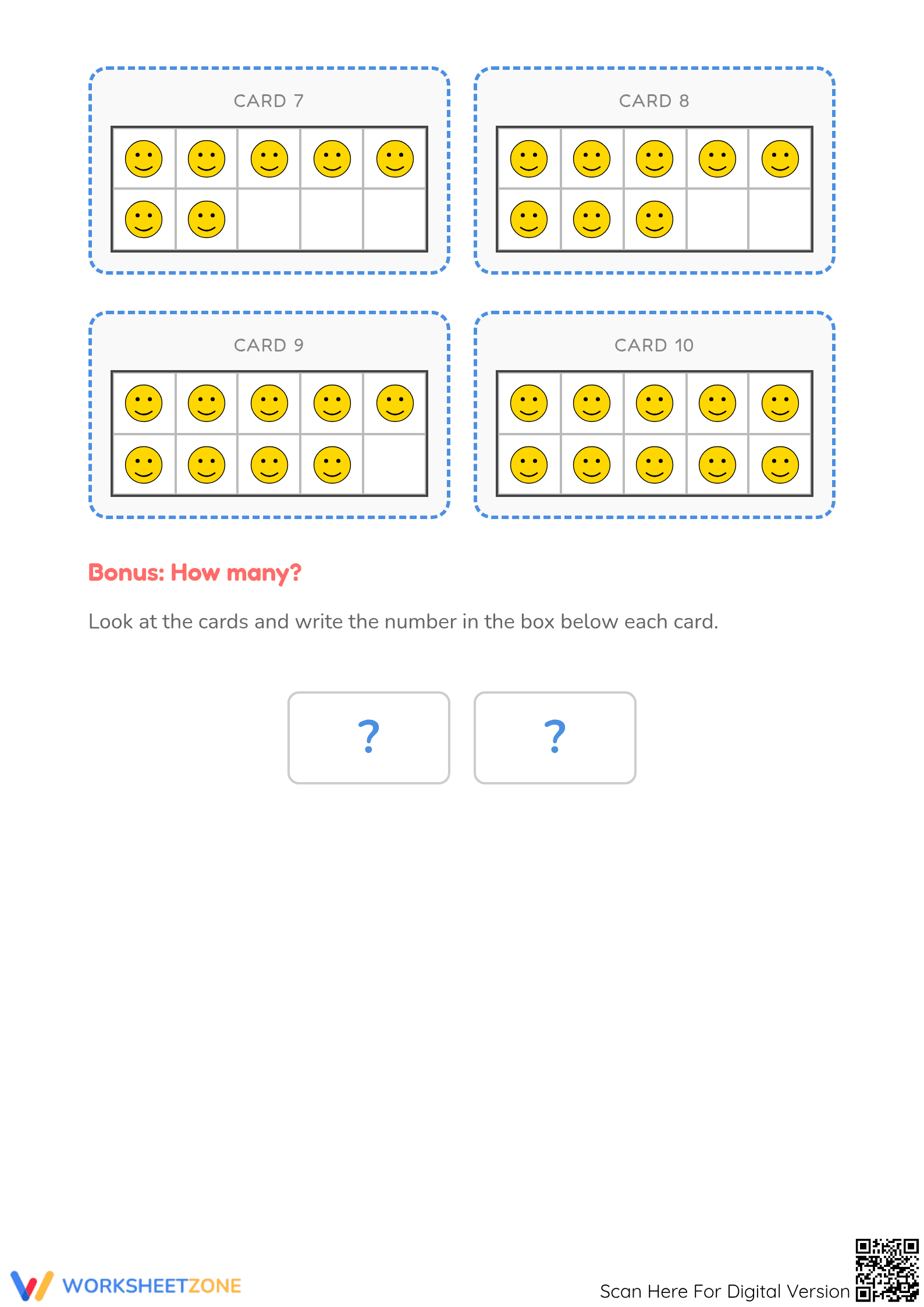
This two-page printable includes ten distinct mini ten-frame cards, each displaying a number from one to ten using friendly smiley face icons. The cards are designed with clear dashed borders, making them easy to cut out and manipulate. Additionally, the second page features a bonus "How many?" section where students can practice writing the correct numeral that corresponds to a given ten-frame card.
- Guided practice: Teachers can introduce the first few cards during whole-group instruction, modeling how to count each smiley face one by one.
- Supported practice: Students work in pairs to match the cut-out ten-frame cards with physical manipulatives like counting cubes or counters.
- Independent practice: Children complete the bonus section on their own, counting the objects and writing the corresponding numeral in the provided boxes.
This follows a gradual-release I Do, We Do, You Do model.
This resource is aligned to primary standard CCSS.MATH.CONTENT.K.CC.B.5: Count to answer "how many?" questions about as many as 20 things arranged in a line, a rectangular array, or a circle. It also supports early cardinality and number recognition skills. Both standard codes can be copied directly into lesson plans, IEP goals, or district curriculum mapping tools.
These cards are versatile for early math instruction. Use them during small group math centers as a matching game where students pair the cards with numeral flashcards. Alternatively, they serve as excellent visual aids for a "number of the day" routine before direct instruction begins. As a formative assessment tip, observe whether students are touching each smiley face as they count (one-to-one correspondence) or if they can instantly recognize the quantity (subitizing). Expected completion time is 15 to 20 minutes depending on the activity.
This resource is designed for Kindergarten students developing early numeracy skills. It is particularly helpful for visual and kinesthetic learners who benefit from hands-on manipulation of learning materials. For differentiation, teachers can limit the deck to numbers 1-5 for students needing extra support, or mix the cards out of order for advanced learners. Pair these cards with physical counting blocks or a direct instruction lesson on basic addition.
Developing strong number sense in early childhood is a critical predictor of future mathematical achievement. This resource targets CCSS.MATH.CONTENT.K.CC.B.5, helping students count to answer how many objects are in a group. According to the comprehensive RAND AIRS 2024 report on early numeracy interventions, utilizing visual models like ten-frames significantly improves a student's ability to subitize and understand base-ten concepts. The structured layout of a ten-frame allows young learners to anchor numbers to five and ten, effectively reducing cognitive load during counting tasks. By physically interacting with these printable cards, students transition from rote counting to true conceptual understanding of quantity. Integrating these evidence-based visual supports into daily math routines ensures that foundational counting skills are firmly established before introducing more complex arithmetic operations.


