


























Views
Downloads
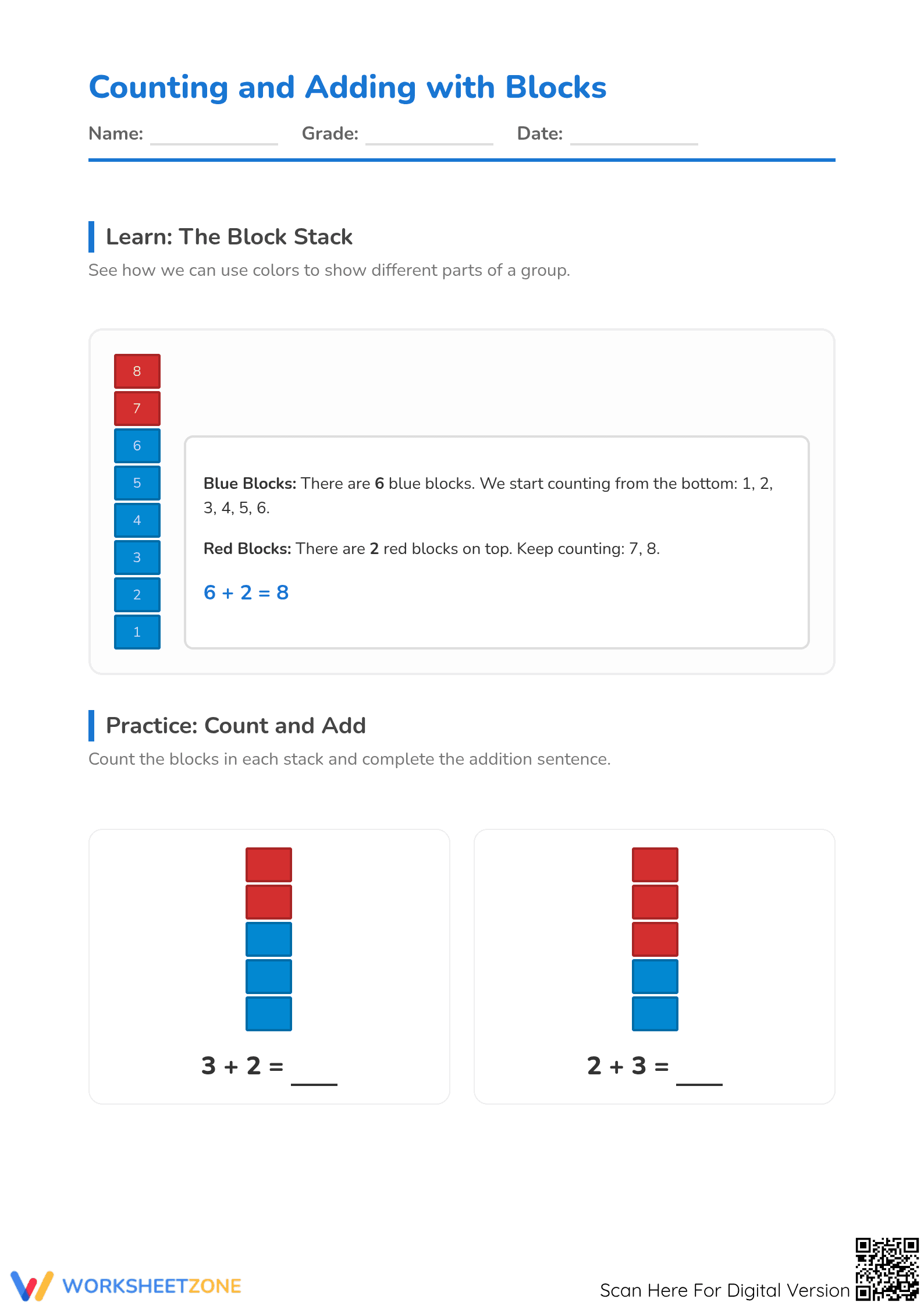


Kindergarten Counting & Adding Blocks | Essential Worksheet
Paste this activity's link or code into your existing LMS (Google Classroom, Canvas, Teams, Schoology, Moodle, etc.).
Students can open and work on the activity right away, with no student login required.
You'll still be able to track student progress and results from your teacher account.
This Kindergarten math worksheet helps students master the fundamentals of addition by using visual block stacks. By counting distinct colored groups and combining them into a single total, learners develop a concrete understanding of how numbers join together. It provides a clear bridge between counting objects and writing formal addition equations.
At a Glance
- Grade: Kindergarten · Subject: Math
- Standard:
CCSS.MATH.CONTENT.K.OA.A.1— Represent addition with objects, fingers, mental images, drawings, or sounds- Skill Focus: Counting and Adding Blocks
- Format: 3 pages · 9 problems · Answer key included · PDF
- Best For: Independent practice or math centers
- Time: 15–20 minutes
What's Inside
This 3-page PDF includes a guided "Learn" section that models the counting-on strategy using blue and red blocks. Following the example, students encounter 9 practice problems featuring vertical block stacks and corresponding addition sentences. The layout uses high-contrast visuals to support early learners, and a comprehensive answer key is provided for quick grading.
Zero-Prep Workflow
- Print: Select the three practice pages and the answer key (30 seconds).
- Distribute: Hand out the worksheets to students during your math block; the visual instructions require minimal verbal explanation (1 minute).
- Review: Use the provided answer key to check for accuracy or project it for a whole-class self-correction session (1 minute).
Total teacher preparation time is under 3 minutes, making it an ideal sub plan or morning work option.
Standards Alignment
The primary focus is CCSS.MATH.CONTENT.K.OA.A.1, which requires students to represent addition with objects and drawings. By interacting with the block stacks, students also practice CCSS.MATH.CONTENT.K.CC.B.4, understanding the relationship between numbers and quantities. Both standard codes can be copied directly into lesson plans, IEP goals, or district curriculum mapping tools.
How to Use It
Use this worksheet during the "You Do" phase of a gradual release lesson on addition. It works exceptionally well as a formative assessment tool; observe if students are counting every block individually or if they are beginning to "count on" from the first group. Expect most Kindergarteners to complete the 9 tasks within a 15 to 20-minute window.
Who It's For
This resource is tailored for Kindergarten students who are transitioning from basic counting to operational math. It is particularly effective for visual learners and students requiring fine-motor practice in writing numerals. Pair this worksheet with physical Unifix cubes or an anchor chart showing part-part-whole relationships for maximum instructional impact.
Research from Fisher & Frey (2014) emphasizes the importance of visual representations in early numeracy, noting that concrete-to-abstract transitions are most effective when students can physically or visually track quantities. This worksheet utilizes the "Block Stack" method to ground the abstract concept of addition in observable facts. By requiring students to count two distinct sets and then find the sum, the resource reinforces the cardinality principle and the associative property of addition. According to the NAEP framework, early exposure to representing operations with objects is a significant predictor of later mathematical fluency. This Grade K resource aligns with these findings by providing 9 structured opportunities for students to map physical counts to symbolic addition sentences. The inclusion of a "Bonus Challenge" further supports cognitive development by asking students to generate their own visual models, a key indicator of mathematical mastery.


