


























Views
Downloads


Essential Letter Sound Cards | Kindergarten ELA
Paste this activity's link or code into your existing LMS (Google Classroom, Canvas, Teams, Schoology, Moodle, etc.).
Students can open and work on the activity right away, with no student login required.
You'll still be able to track student progress and results from your teacher account.
These Kindergarten letter sound cards provide a visual foundation for early literacy by connecting uppercase and lowercase letters to familiar objects. Students develop phonemic awareness by identifying the initial sounds of 20 different words across five distinct letter groups. This resource serves as a vital bridge between letter recognition and decoding skills.
At a Glance
- Grade: Kindergarten · Subject: ELA
- Standard:
CCSS.ELA-LITERACY.RF.K.3.A— Demonstrate basic knowledge of one-to-one letter-sound correspondences by producing the primary sound- Skill Focus: Initial Letter Sounds
- Format: 2 pages · 20 illustrations · Reference Cards · PDF
- Best For: Phonics centers and small group instruction
- Time: 10–15 minutes
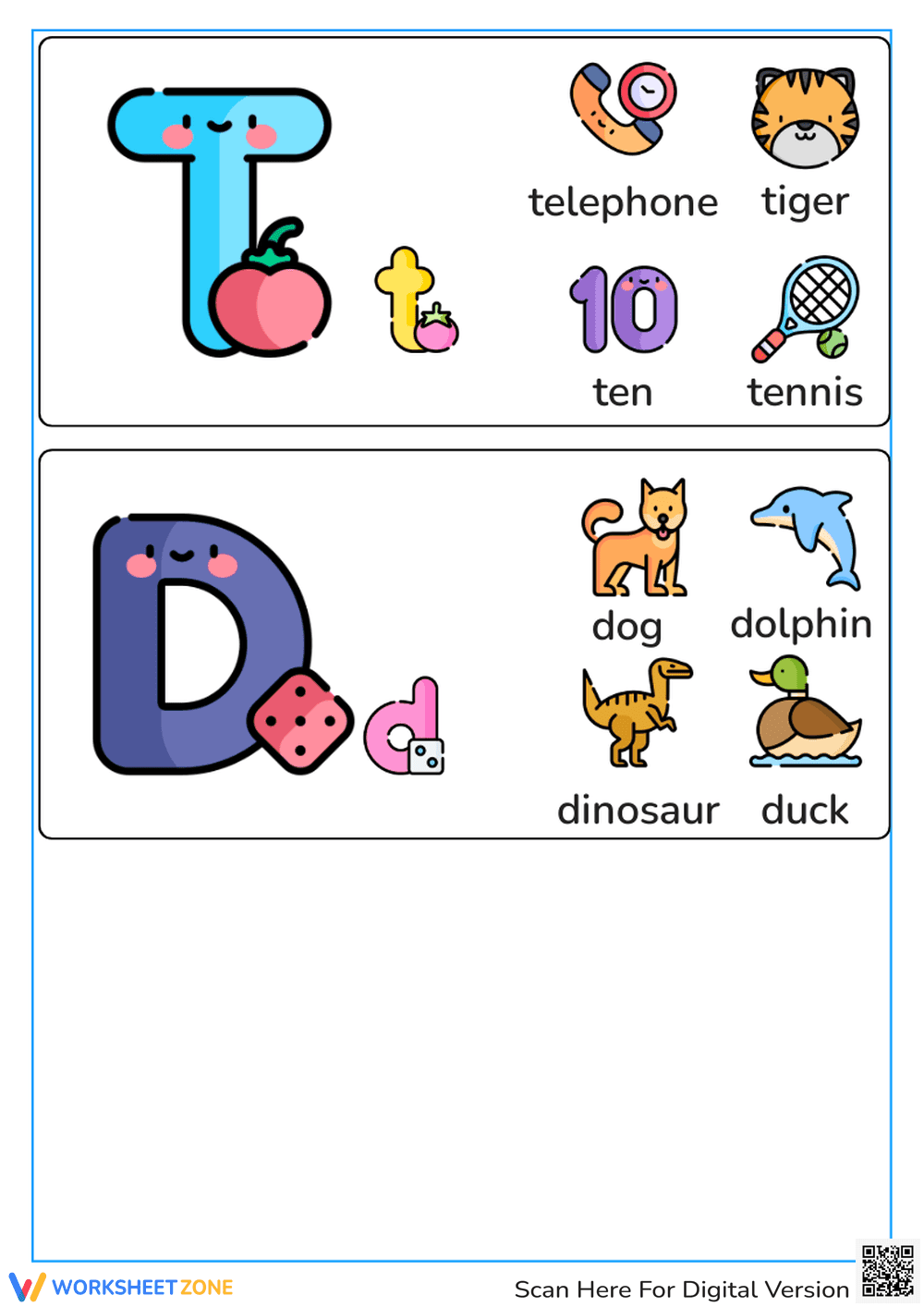
This two-page PDF contains five high-quality alphabet cards covering the letters M, N, B, T, and D. Each card features a large, stylized uppercase and lowercase letter pair accompanied by four labeled illustrations that represent the target phoneme. The clear, colorful graphics include common nouns like "mouse," "ninja," and "dolphin" to ensure students can easily identify the starting sounds without teacher intervention.
Skill Progression
- Guided practice: Teachers lead the class in choral response, pointing to the letter and naming the four associated images to establish the phonemic connection.
- Supported practice: Students work in pairs to "read" the cards to one another, using the visual cues to reinforce the relationship between the grapheme and the initial sound.
- Independent practice: Learners use the cards as a personal desk reference during writing or sorting activities, applying their knowledge to 20 unique vocabulary words.
This sequence follows a gradual-release model to ensure students move from observation to mastery through consistent visual reinforcement.
Standards Alignment
This resource is specifically aligned with `CCSS.ELA-LITERACY.RF.K.3.A`, which requires students to demonstrate basic knowledge of one-to-one letter-sound correspondences. By providing multiple visual examples for each letter, the worksheet supports the acquisition of primary consonant sounds. Both standard codes can be copied directly into lesson plans, IEP goals, or district curriculum mapping tools.
How to Use It
Use these cards as a formative assessment tool during small group rotations. Observe if students can independently name the pictures and isolate the beginning sound without prompting. Alternatively, print and laminate the cards to create a permanent "Sound Wall" or anchor chart. The expected completion time for a guided sorting activity using these cards is approximately 15 minutes.
Who It's For
This resource is designed for Kindergarten students beginning their phonics journey, but it is also highly effective for English Language Learners (ELLs) who need visual support for vocabulary development. It pairs naturally with letter-tracing activities or a direct instruction lesson on consonant sounds.
According to research from Fisher & Frey (2014) regarding the gradual release of responsibility, visual anchors are essential for scaffolding early literacy skills in the primary grades. This worksheet addresses the core requirements of `CCSS.ELA-LITERACY.RF.K.3.A` by providing a structured environment for students to practice one-to-one letter-sound correspondences. By utilizing 20 distinct visual examples across five consonant groups, the material reinforces phonemic awareness through repetitive exposure and association. Studies from the NAEP suggest that early mastery of these foundational skills is a strong predictor of future reading fluency and comprehension. Educators can utilize these cards to build the necessary phonological foundations required for decoding more complex CVC words later in the academic year. The clear distinction between uppercase and lowercase forms further supports orthographic development, making this a comprehensive tool for early childhood ELA classrooms.


