




























Views
Downloads

Printable Number Line Worksheet: Grade 1 Math

Paste this activity's link or code into your existing LMS (Google Classroom, Canvas, Teams, Schoology, Moodle, etc.).
Students can open and work on the activity right away, with no student login required.
You'll still be able to track student progress and results from your teacher account.
This printable Grade 1 math worksheet provides a blank number line template to help students compare and order two-digit numbers. By placing numbers visually on the line, learners build a concrete understanding of relative size and place value. This tool supports direct instruction, independent practice, and formative assessment of early number sense.
At a Glance
- Grade: Grade 1 · Subject: Math and Numbers
- Standard:
CCSS.MATH.CONTENT.1.NBT.B.3— Compare two two-digit numbers using place value concepts- Skill Focus: Comparing and ordering two-digit numbers on a line
- Format: 1 printable page · 1 blank template · PDF format
- Best For: Whole-class modeling, small groups, and guided practice
- Time: 10–20 minutes
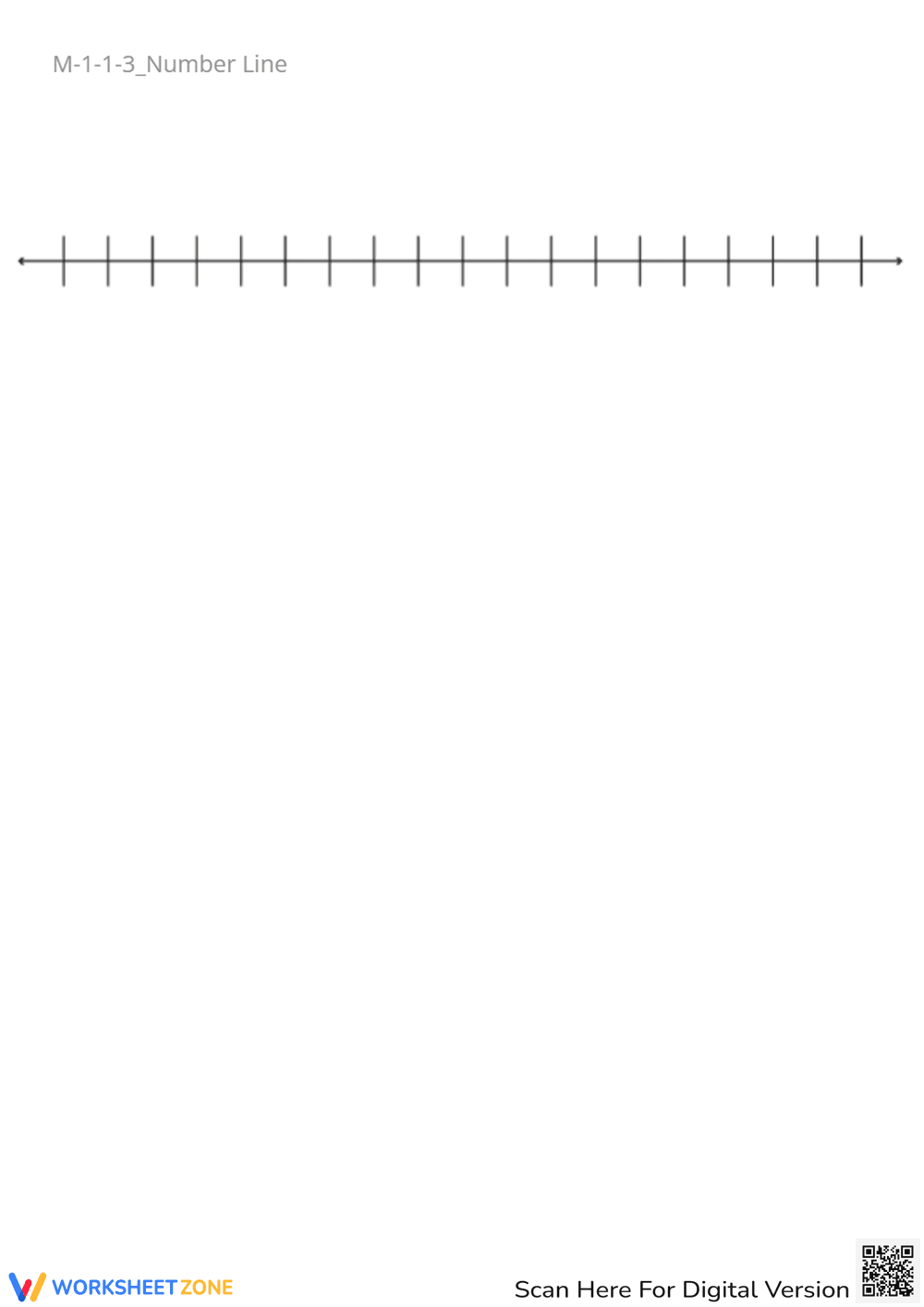
This resource features a single-page layout containing one large, clean, blank number line with 19 tick marks. The minimalist design eliminates visual distractions, allowing young learners to focus entirely on the mathematical task. Teachers can customize the starting and ending values to target specific ranges of two-digit numbers, making it a highly versatile tool for various lesson objectives.
This zero-prep worksheet integrates into your daily math routine. First, print the single-page PDF in less than 1 minute. Second, distribute the sheet to your students and write your chosen two-digit numbers on the board. Third, review student placement of numbers during a brief 5-minute wrap-up discussion. The entire setup takes under 2 minutes, making this template an ideal option for emergency sub plans, quick warm-ups, or exit tickets.
Standards Alignment
This worksheet aligns with Common Core Standard CCSS.MATH.CONTENT.1.NBT.B.3, requiring students to compare two-digit numbers based on tens and ones digits, using symbols >, =, and <. A visual number line helps students conceptualize relative magnitude. Both standard codes can be copied directly into lesson plans, IEP goals, or district curriculum mapping tools.
How to Use It
Use this template during guided practice. Write two numbers, like 34 and 43, on the board and have students label the endpoints to place and compare them. Alternatively, use it as a post-instruction formative assessment. Observe whether students correctly space the numbers; this task takes approximately 10 to 15 minutes.
Who It's For
This resource is designed for first-grade students learning place value and number comparison. It serves as an intervention tool for second-grade students needing visual support. Pair this template with physical base-ten blocks or a digital counting board to reinforce the connection between concrete models and abstract number line representations.
According to the EdReports 2024 evaluation of early mathematics curricula, visual representations like number lines are critical for developing spatial-numerical associations in young learners. This worksheet directly supports the acquisition of CCSS.MATH.CONTENT.1.NBT.B.3 by providing a structured yet flexible framework for comparing two-digit numbers. By mapping numbers onto a physical line, students transition from rote counting to conceptualizing magnitude and order. Research indicates that early mastery of these spatial relationships correlates strongly with later success in multi-digit arithmetic and general mathematical fluency. This single-page template offers educators an efficient, evidence-based tool to assess and reinforce these foundational skills during small-group interventions or whole-class instruction. The open-ended design allows teachers to adapt the difficulty level, ensuring all students build the necessary cognitive frameworks to compare numbers accurately.


