


























Views
Downloads
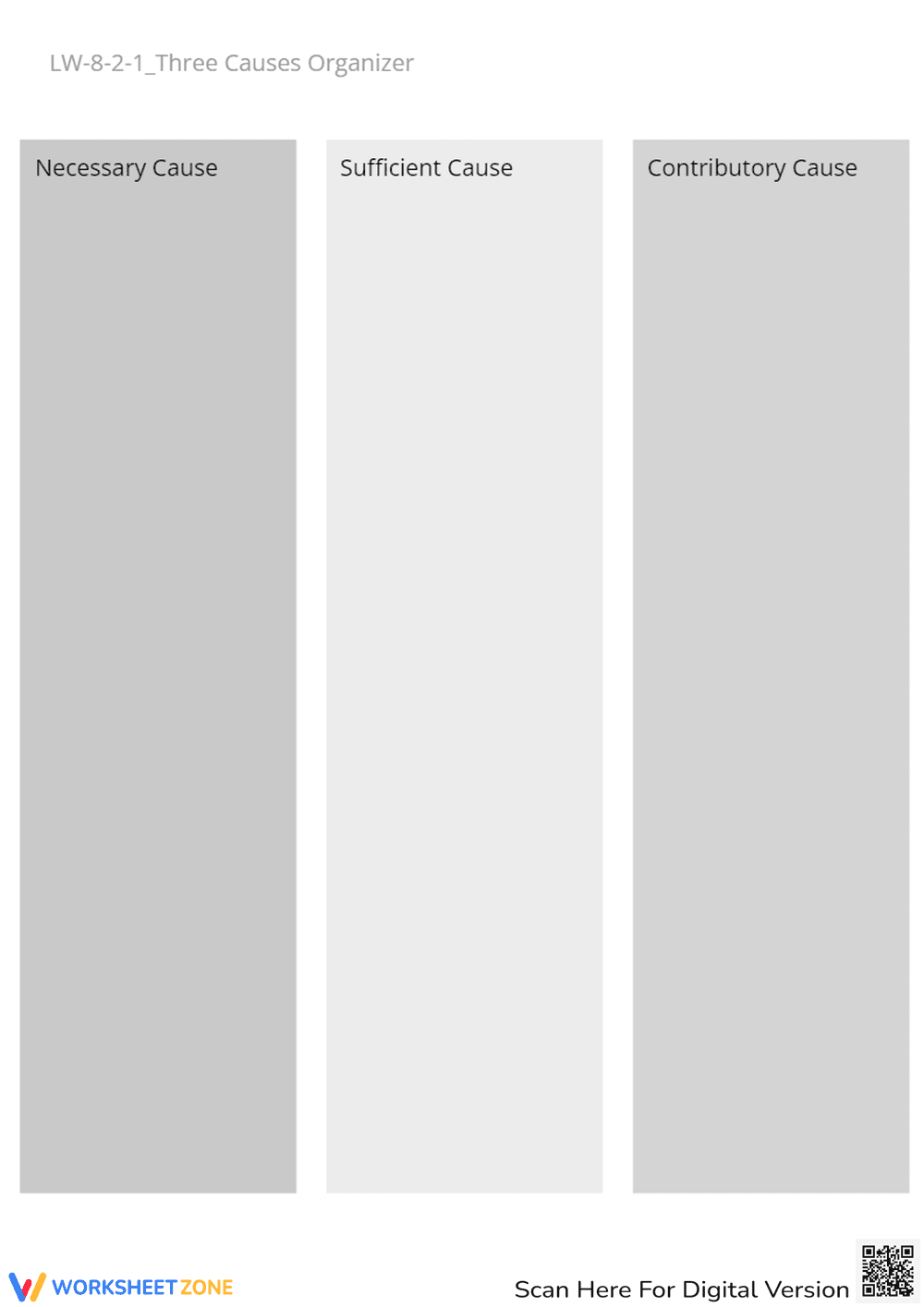

Three Causes Organizer: Printable Grade 8 ELA Worksheet
Paste this activity's link or code into your existing LMS (Google Classroom, Canvas, Teams, Schoology, Moodle, etc.).
Students can open and work on the activity right away, with no student login required.
You'll still be able to track student progress and results from your teacher account.
This Grade 8 graphic organizer helps students analyze complex causal relationships in informational texts. By categorizing factors into necessary, sufficient, and contributory causes, learners develop critical thinking skills required for advanced reading comprehension. Students map out textual evidence to construct logical arguments and improve analytical writing.
At a Glance
- Grade: Grade 8 · Subject: ELA Reading
- Standard:
CCSS.ELA-LITERACY.RI.8.3— Analyze connections and distinctions between points in text- Skill Focus: Causal analysis
- Format: 1 page · 3 tasks · Graphic organizer · PDF
- Best For: Reading comprehension and essay planning
- Time: 15–25 minutes
This single-page PDF features a clean, three-column layout designed to scaffold logical analysis. The organizer divides causal factors into three distinct categories: necessary causes, sufficient causes, and contributory causes. This structure provides a clear visual framework for students to sort evidence from any complex informational text or historical document without distracting visual clutter.
Zero-Prep Classroom Workflow
This resource requires under 2 minutes of total teacher preparation time, making it an ideal tool for daily lessons or emergency sub plans. Follow these three steps to integrate the organizer:
- Print (1 minute): Photocopy the single-page PDF document for your class.
- Distribute (1 minute): Hand out the organizer during reading analysis.
- Review (5 minutes): Lead a brief discussion to share student classifications of different causal factors.
Standards Alignment
This worksheet aligns directly with the Common Core State Standard `CCSS.ELA-LITERACY.RI.8.3`, which requires students to analyze how a text makes connections among and distinctions between individuals, ideas, or events. By isolating necessary, sufficient, and contributory causes, students practice making precise distinctions between historical or scientific events. Both standard codes can be copied directly into lesson plans, IEP goals, or district curriculum mapping tools.
How to Use It
Use this organizer during close reading activities to break down complex informational texts. Introduce the worksheet after direct instruction on causal relationships to help students map out arguments. For formative assessment, walk around the room and observe if students correctly distinguish between a necessary cause and a contributory cause. Expected completion time is 15 to 25 minutes.
Who It's For
This worksheet is designed for Grade 8 students learning to analyze complex texts, including general education students and English language learners who benefit from visual scaffolds. It works well when paired with a short historical article or science passage detailing multi-causal events, such as the causes of a war or a scientific phenomenon.
According to research by Fisher & Frey (2014) on close reading and scaffolded instruction, graphic organizers improve reading comprehension by helping students visualize abstract text structures. This worksheet targets `CCSS.ELA-LITERACY.RI.8.3` by prompting eighth-grade students to perform causal analysis, distinguishing between necessary, sufficient, and contributory factors. By organizing textual evidence into structured columns, students transition from basic recall to high-level evaluation of informational texts. This structured approach supports cognitive offloading, allowing learners to focus on the logical relationships between events. Educators can use this tool to measure student mastery of causal reasoning during formative assessments. The clear division of causes ensures that students build the analytical skills necessary for high school writing and text analysis, aligning with evidence-based literacy strategies that promote deeper text engagement.


