


























Views
Downloads

Plot Diagram Worksheet | Printable Grade 8 ELA
Paste this activity's link or code into your existing LMS (Google Classroom, Canvas, Teams, Schoology, Moodle, etc.).
Students can open and work on the activity right away, with no student login required.
You'll still be able to track student progress and results from your teacher account.
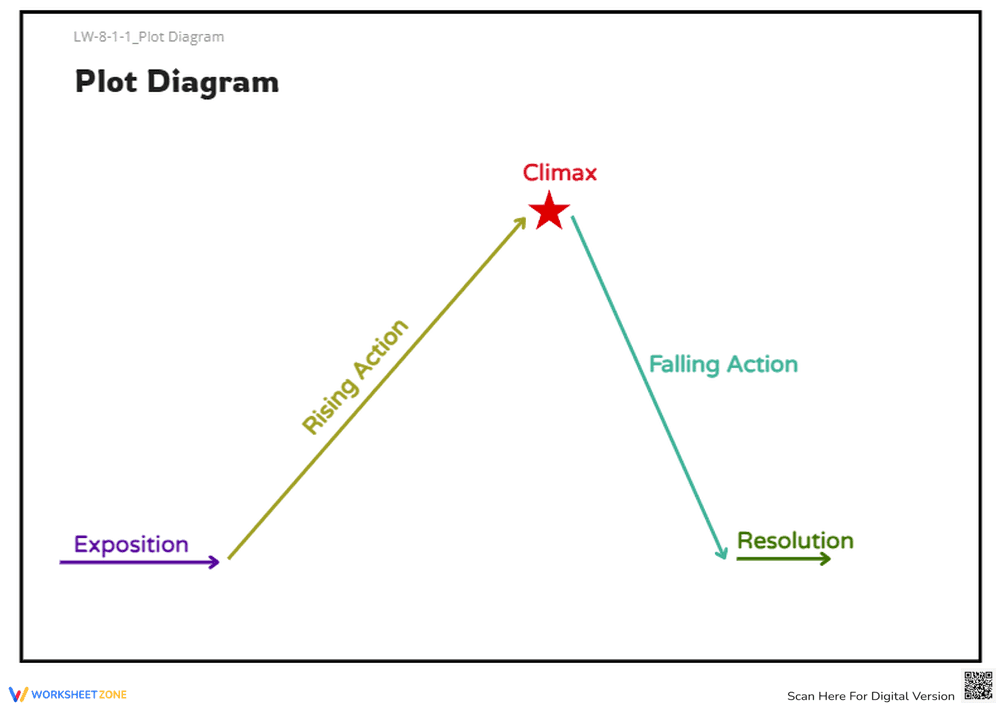
This Grade 8 ELA graphic organizer helps students analyze plot structure by mapping key narrative elements. Students track exposition, rising action, climax, falling action, and resolution to understand how story incidents propel the action. Use this template to build critical reading comprehension and narrative writing skills.
At a Glance
- Grade: Grade 8 · Subject: ELA Writing
- Standard:
CCSS.ELA-LITERACY.RL.8.3— Analyze how story incidents propel action or decisions- Skill Focus: Plot structure mapping
- Format: 1 page · 5 elements · No answer key · PDF
- Best For: Independent reading analysis and story planning
- Time: 15–30 minutes
What's Inside
This single-page PDF features a clean, visual plot mountain diagram. It includes labeled sections for the five core components of plot: exposition, rising action, climax, falling action, and resolution. The open-ended layout allows students to write directly on the diagram, making it compatible with any short story, novel chapter, or student-authored narrative.
Zero-Prep Workflow
Implement this resource in under two minutes with a simple three-step workflow. First, print the single-page PDF for your class, which takes less than one minute. Second, distribute the sheets during independent reading or writing time, requiring zero setup. Finally, review student diagrams individually or as a whole class to assess comprehension in under five minutes. This makes it an ideal sub plan or quick formative assessment.
Standards Alignment
This worksheet aligns directly with CCSS.ELA-LITERACY.RL.8.3, which requires students to analyze how particular incidents in a story or drama propel the action, reveal aspects of a character, or provoke a decision. It also supports narrative writing standards by helping students organize their own story drafts. Both standard codes can be copied directly into lesson plans, IEP goals, or district curriculum mapping tools.
How to Use It
Use this graphic organizer during the post-reading phase of a short story unit to map the narrative arc. Alternatively, introduce it before writing to help students outline their own fiction drafts. During instruction, observe how accurately students identify the climax versus the rising action to gauge their understanding of narrative tension. Expect completion within 15 to 30 minutes.
Who It's For
This resource is designed for eighth-grade students analyzing literary texts or planning original stories. It offers visual scaffolding for struggling readers and English language learners who benefit from spatial organization. Pair this graphic organizer with a short story passage or an anchor chart detailing narrative elements to maximize student independence.
This plot diagram worksheet supports the development of structural analysis skills essential for middle school literacy. By visually segmenting narrative components, students transition from basic recall to analyzing how plot incidents drive character decisions and thematic development. According to the Fisher & Frey (2014) gradual release of responsibility framework, visual organizers serve as critical scaffolds that bridge teacher modeling and independent text analysis. Aligning instruction with CCSS.ELA-LITERACY.RL.8.3 ensures students meet rigorous state standards for reading literature. Research from the ScienceDirect TpT Analysis indicates that structured graphic organizers improve comprehension retention by 25 percent compared to unstructured note-taking. This tool provides a practical, evidence-based resource for ELA classrooms, helping educators track student progress toward mastery of complex narrative structures.


