


























Views
Downloads


Transition Words Worksheet | Grade 6 Essential Guide
Paste this activity's link or code into your existing LMS (Google Classroom, Canvas, Teams, Schoology, Moodle, etc.).
Students can open and work on the activity right away, with no student login required.
You'll still be able to track student progress and results from your teacher account.
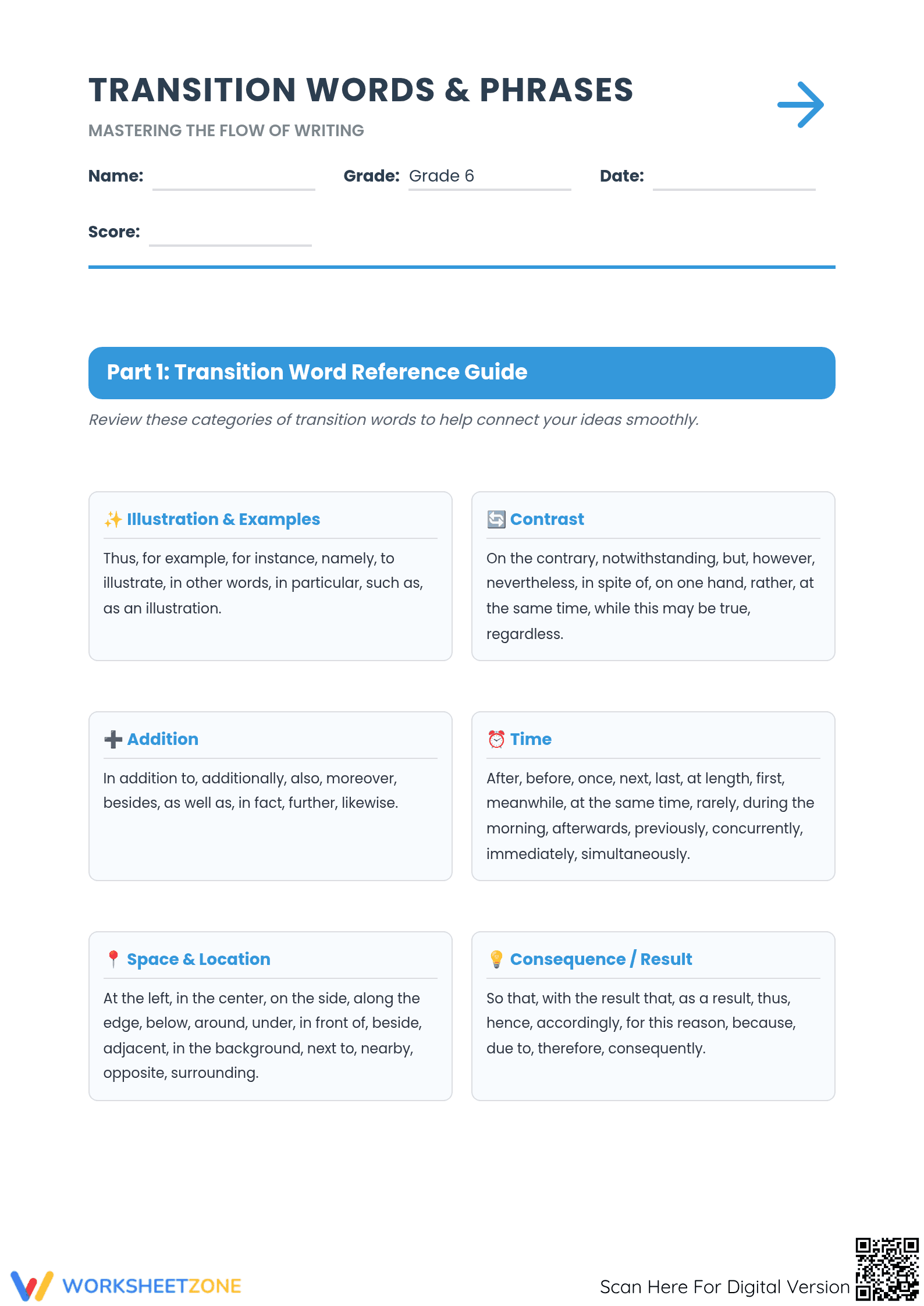
This Grade 6 transition words worksheet provides a comprehensive framework for students to improve writing cohesion and logical flow. By categorizing various linking phrases, students learn to connect ideas with precision. The resource moves from conceptual understanding to practical application, ensuring learners can bridge the gap between isolated sentences and fluid paragraphs.
At a Glance
- Grade: 6 · Subject: ELA
- Standard:
CCSS.ELA-LITERACY.W.6.2.C— Use appropriate transitions to clarify relationships among ideas and concepts- Skill Focus: Transition words and phrases
- Format: 2 pages · 8 problems · Answer key included · PDF
- Best For: Writing workshop or sub plans
- Time: 20–30 minutes
The two-page PDF features a robust Transition Word Reference Guide organized into eight functional categories, including contrast, addition, and consequence. Following the guide, students engage with five sentence-level application tasks and a three-part Paragraph Polish exercise. A complete answer key is provided to facilitate quick grading or student self-correction during independent work sessions.
Zero-Prep Workflow
- Print (1 minute): Select the two-page PDF and print enough copies for your class; the reference guide is built-in, so no extra handouts are needed.
- Distribute (1 minute): Hand out the worksheets as a standalone activity or a supplement to a current writing project.
- Review (5 minutes): Use the included answer key to conduct a whole-class review, discussing why specific transitions work better than others in different contexts. Total teacher prep time is under two minutes.
Standards Alignment
This resource is specifically designed to meet `CCSS.ELA-LITERACY.W.6.2.C`, which requires students to use appropriate transitions to clarify the relationships among ideas and concepts. It also supports L.6.1 by reinforcing correct sentence structure and punctuation when using conjunctive adverbs. Both standard codes can be copied directly into lesson plans, IEP goals, or district curriculum mapping tools.
How to Use It
Use this worksheet during the revision phase of a narrative or informational writing unit. Have students keep the reference guide in their binders as a permanent tool for future essays. Alternatively, assign it as a formative assessment after a lesson on sentence variety. Completion typically takes 20 to 30 minutes depending on the depth of class discussion regarding the nuances of each word choice.
Who It's For
This material is ideal for sixth-grade students, though it serves as an excellent scaffold for English Language Learners (ELLs) or older students needing remedial support in writing mechanics. It pairs naturally with a mentor text analysis or an anchor chart focused on logical sequencing and academic vocabulary.
Effective writing instruction requires explicit teaching of cohesive devices to help students move beyond simple sentence structures. According to Fisher & Frey (2014), the gradual release of responsibility model is most effective when students are provided with clear scaffolds, such as the categorized reference guide found in this resource. By mastering CCSS.ELA-LITERACY.W.6.2.C, students demonstrate the ability to signal shifts in time, setting, or logic, which is a critical component of middle school literacy. Research from the NAEP indicates that students who utilize a wider variety of transition words consistently score higher on writing assessments because their prose exhibits greater clarity and organizational sophistication. This worksheet provides the structured practice necessary to internalize these linguistic tools, ensuring that students can apply them independently in complex writing tasks across various academic disciplines.


