


























Views
Downloads
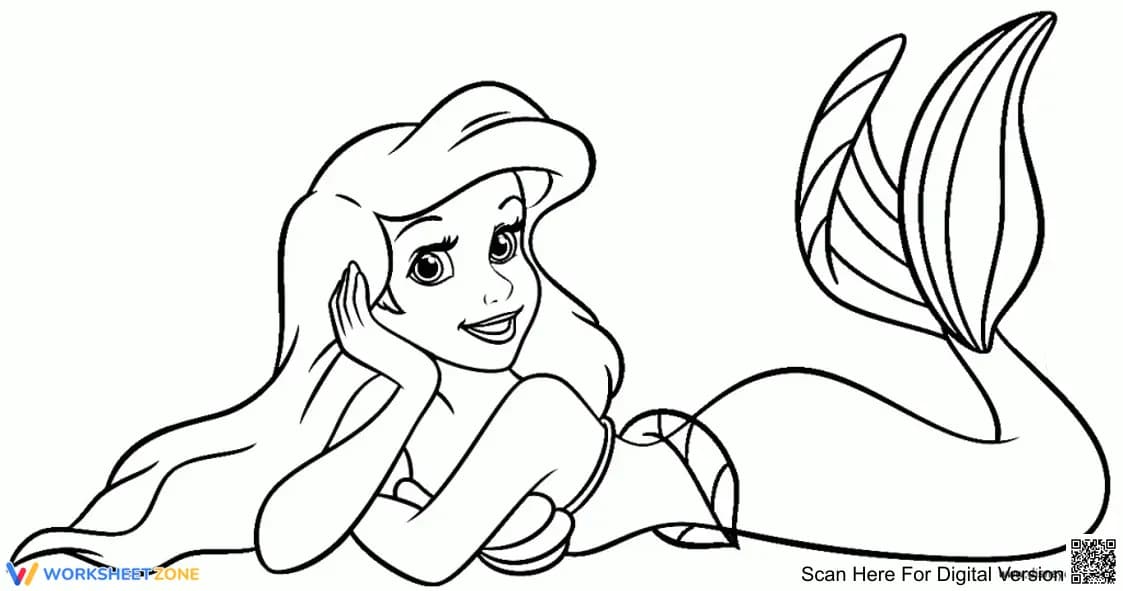

Ariel Coloring Page | Essential Grade K-2 Printable
Paste this activity's link or code into your existing LMS (Google Classroom, Canvas, Teams, Schoology, Moodle, etc.).
Students can open and work on the activity right away, with no student login required.
You'll still be able to track student progress and results from your teacher account.
This Ariel coloring worksheet provides Kindergarten and early elementary students with a focused opportunity to develop fine motor control and artistic expression. By engaging with a familiar character, learners practice grip stability and spatial awareness while completing a creative task. This activity serves as a foundational bridge between visual arts and descriptive communication in the primary classroom.
At a Glance
- Grade: Kindergarten · Subject: Arts & English
- Standard:
CCSS.ELA-LITERACY.SL.K.5— Add visual displays to descriptions to provide additional detail- Skill Focus: Fine Motor Development
- Format: 1 page · 1 task · No answer key · PDF
- Best For: Early finishers and morning work
- Time: 15–20 minutes
The worksheet features a high-resolution, single-page line drawing of Ariel from The Little Mermaid. The illustration uses clear, bold outlines to assist young learners in staying within boundaries, which is critical for developing the muscular control required for handwriting. There are no complex instructions, making it accessible for independent work during center rotations or quiet time.
The zero-prep workflow for this resource is designed for maximum efficiency in a busy classroom. First, print the single-page PDF (30 seconds). Second, distribute the sheets to students during transition periods or as part of a literacy center (1 minute). Third, review the completed work by asking students to describe the colors they chose, reinforcing descriptive vocabulary (1 minute). Total teacher preparation time is under 2 minutes, making it an ideal emergency sub plan component.
This resource aligns with CCSS.ELA-LITERACY.SL.K.5, which encourages students to "add drawings or other visual displays to descriptions as desired to provide additional detail." While primarily an artistic task, it supports the standard by providing the visual base for oral storytelling or descriptive writing exercises. Both standard codes can be copied directly into lesson plans, IEP goals, or district curriculum mapping tools.
Use this worksheet as a "hook" before a creative writing prompt about the ocean or as a calming activity following high-energy instruction. For a formative assessment, observe the student's pencil grip and their ability to control the coloring tool within the lines. Expected completion time ranges from 15 to 20 minutes depending on the student's detail level and artistic intent.
This printable is designed for Kindergarten through Grade 2 students, particularly those working on occupational therapy goals or fine motor precision. It pairs naturally with a read-aloud of "The Little Mermaid" or an anchor chart detailing descriptive adjectives for characters. It is also suitable for English Language Learners (ELL) to practice color naming and basic noun identification.
According to research from Fisher & Frey (2014), the integration of visual arts and fine motor tasks in early childhood education is a critical precursor to formal writing proficiency. The use of familiar character-based coloring activities, such as this CCSS.ELA-LITERACY.SL.K.5 aligned worksheet, increases student engagement and persistence in task completion. Studies analyzed by the RAND AIRS 2024 report suggest that structured coloring activities help develop the intrinsic hand muscles necessary for the "tripod grip" used in standard handwriting. By providing a low-stakes environment for creative expression, educators can monitor developmental milestones in spatial reasoning and color discrimination. This resource offers a practical application of these research-backed strategies, ensuring that students meet foundational standards while building the physical stamina required for more intensive academic writing tasks in later primary grades.


