


























Views
Downloads
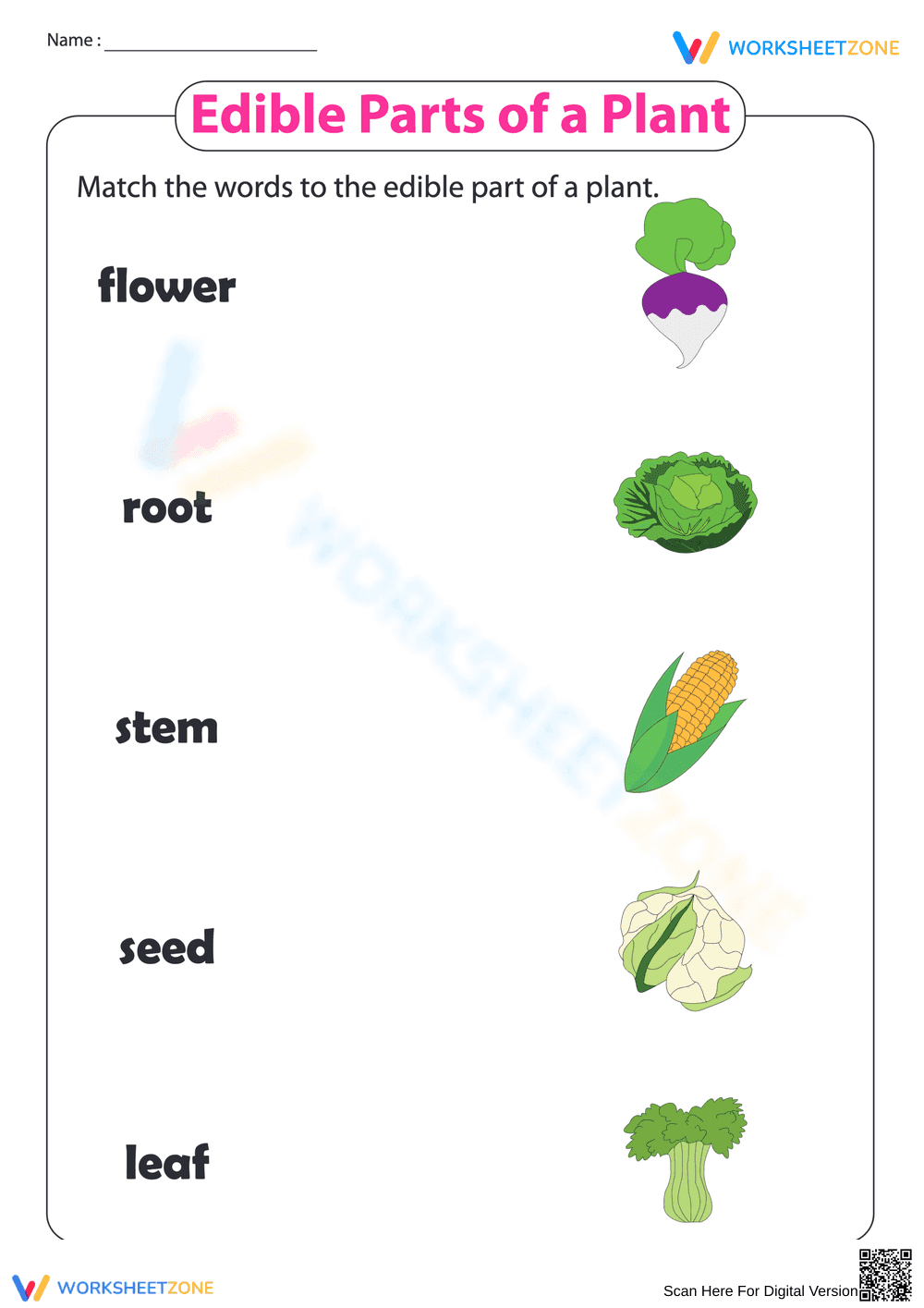

Printable Edible Plant Parts Worksheet | Grade 1 Science
Paste this activity's link or code into your existing LMS (Google Classroom, Canvas, Teams, Schoology, Moodle, etc.).
Students can open and work on the activity right away, with no student login required.
You'll still be able to track student progress and results from your teacher account.
This printable worksheet helps Grade 1 and Grade 2 students master the edible parts of a plant. Through a simple matching activity, learners connect key vocabulary—root, stem, leaf, flower, and seed—to familiar vegetables. This resource turns a foundational life science concept into an engaging, easy-to-understand activity for any elementary classroom.
At a Glance
- Grade: 1–2 · Subject: Science
- Standard:
1-LS1-1— Identify external plant parts and their roles in growth and survival.- Skill Focus: Identifying edible plant parts
- Format: 1 page · 5 problems · Answer key included · PDF
- Best For: Independent practice, science centers, or homework
- Time: 10–15 minutes
This resource consists of a single-page PDF worksheet and a complete answer key. The main activity features five clear vocabulary words (flower, root, stem, seed, leaf) and five corresponding illustrations of common foods. The clean layout and simple matching task are designed for young learners to complete independently with minimal instruction.
Skill Progression
The worksheet follows a gradual-release model to build student independence.
- Guided practice: The first two items act as a clear example, establishing the matching task.
- Supported practice: The next items allow students to apply their understanding with the support of the remaining options.
- Independent practice: The final item is completed autonomously, confirming the student's ability to identify the last plant part.
This "I Do, We Do, You Do" approach builds confidence and ensures mastery.
Standards Alignment
This worksheet directly aligns with 1-LS1-1, where students learn how plants use external parts to survive. Connecting plant parts to their function as food provides a perfect entry point into this standard. The standard code is ready to be copied directly into lesson plans or curriculum maps for easy documentation.
How to Use It
Use this for independent practice after a lesson on plants, as a quick formative assessment, or in a science center. Observe which parts students struggle with to identify misconceptions (e.g., is corn a stem or seed?). The activity should take 10-15 minutes.
Who It's For
Designed for first and second graders, this resource's clear visuals also support English Language Learners. For deeper learning, pair this worksheet with a hands-on activity like a "plant part salad" or a related read-aloud to connect the concepts to the real world.
This worksheet supports standard 1-LS1-1 by helping students identify the external parts of plants and understand their function as a food source for humans. This foundational skill is critical for developing early scientific literacy. According to the NAEP science framework, hands-on and observational activities are essential in early elementary grades for building a robust understanding of life science concepts. By connecting abstract botanical vocabulary to tangible, everyday foods, this resource makes learning concrete and accessible. Research from Fisher & Frey (2014) on gradual release of responsibility highlights the importance of moving students from guided to independent practice, a model this worksheet follows. This focused, single-page activity provides the structured practice needed for mastery and serves as an efficient tool for teachers to reinforce core science objectives with minimal preparation time.


