


























Views
Downloads
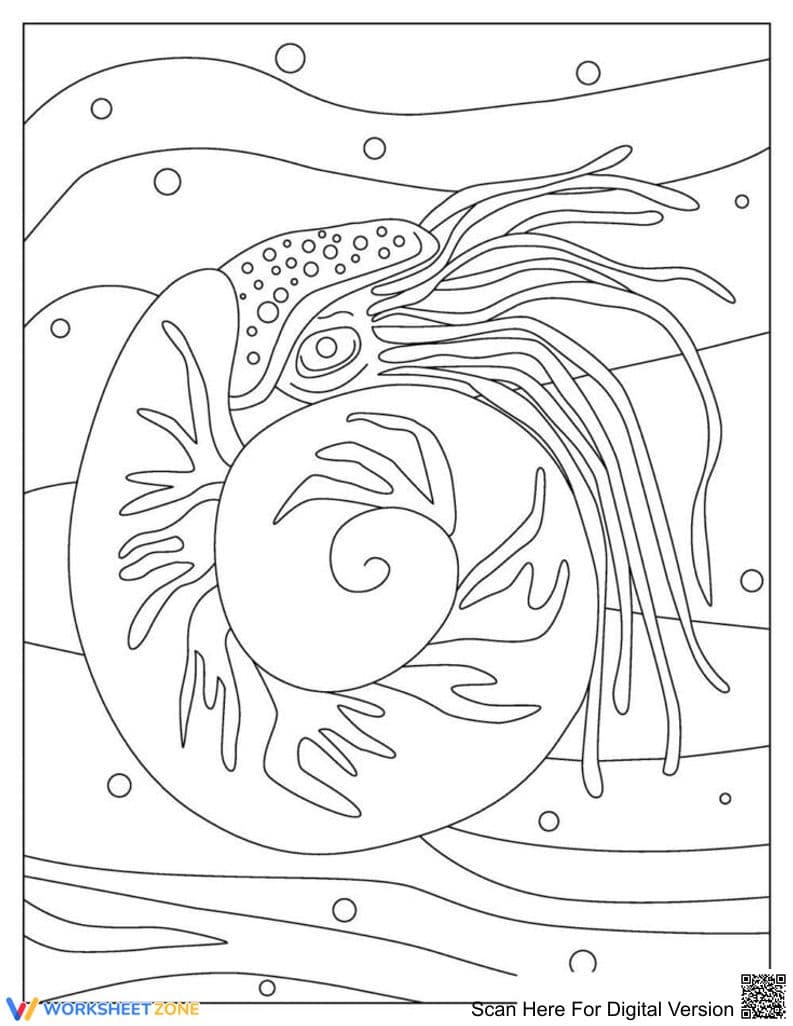

Ocean Life Coloring Page | Essential Grade K-5 Ready
Paste this activity's link or code into your existing LMS (Google Classroom, Canvas, Teams, Schoology, Moodle, etc.).
Students can open and work on the activity right away, with no student login required.
You'll still be able to track student progress and results from your teacher account.
This printable ocean life coloring worksheet helps students develop fine motor control and artistic expression while identifying marine organisms. By engaging with the intricate lines of the nautilus, learners strengthen the hand muscles necessary for writing and pencil grip. It serves as a creative bridge between science observation and language development.
At a Glance
- Grade: K-5 · Subject: Arts & English
- Standard:
CCSS.ELA-LITERACY.L.K.6— Use words and phrases acquired through conversations, reading and being read to- Skill Focus: Fine motor skills & vocabulary
- Format: 1 page · 1 task · No answer key · PDF
- Best For: Early finishers or science centers
- Time: 15–20 minutes
The worksheet features a high-quality line-art illustration of a nautilus in its natural habitat, complete with bubbles and wave patterns. This single-page PDF is designed for high-contrast printing, ensuring that every detail is clear for young artists. There are no complex instructions, making it immediately accessible for independent work or quiet time.
The zero-prep workflow for this resource is designed for maximum efficiency. First, print the single-page PDF (30 seconds). Second, distribute the sheets to students with crayons (1 minute). Third, review the finished work or display it on a bulletin board (30 seconds). Total teacher preparation time is under two minutes, making it an ideal emergency sub plan or transition activity.
This resource aligns with `CCSS.ELA-LITERACY.L.K.6` by providing a visual prompt for students to use newly acquired vocabulary related to the ocean and marine biology. While primarily an artistic task, it supports the acquisition of domain-specific words like "tentacles," "shell," and "nautilus." This standard code can be copied directly into lesson plans, IEP goals, or district curriculum mapping tools to document creative expression and vocabulary integration.
Use this worksheet during a science unit on "Life Under the Sea" to reinforce the physical characteristics of mollusks. It is best assigned after direct instruction about ocean habitats to allow students to process information through a tactile medium. Teachers can use this as a formative assessment by observing a student's ability to follow boundaries and their choice of realistic versus imaginative colors.
This activity is designed for Kindergarten through 5th-grade students, with a primary focus on early elementary learners developing grip strength. It is particularly effective for English Language Learners (ELLs) who benefit from visual aids when learning new nouns. Pair this worksheet with a non-fiction picture book about deep-sea creatures or an anchor chart detailing different types of shells.
Research from Fisher & Frey (2014) emphasizes the importance of visual literacy and creative tasks in reinforcing academic vocabulary. This worksheet, aligned with CCSS.ELA-LITERACY.L.K.6, provides a low-stakes environment for students to practice fine motor skills while engaging with scientific concepts. By focusing on a specific marine organism like the nautilus, the activity encourages students to use words and phrases acquired through reading. Studies in the RAND AIRS 2024 report suggest that integrating arts into core subjects improves student engagement and retention of terminology. This resource serves as a practical tool for teachers to bridge the gap between abstract concepts and hands-on learning, ensuring that students remain focused during independent practice sessions.


