


























Views
Downloads


Printable Lines and Segments Worksheet — Grade 4 Math
Paste this activity's link or code into your existing LMS (Google Classroom, Canvas, Teams, Schoology, Moodle, etc.).
Students can open and work on the activity right away, with no student login required.
You'll still be able to track student progress and results from your teacher account.
Mastering geometry requires students to move beyond simple identification to active construction and vocabulary fluency. This Grade 4 Lines and Segments worksheet provides a comprehensive bridge between recognizing geometric terms and drawing them accurately. By combining a vocabulary-rich word search with hands-on drawing tasks, students solidify their understanding of rays, segments, and intersecting lines.
At a Glance
- Grade: 4 · Subject: Math
- Standard:
CCSS.MATH.CONTENT.4.G.A.1— Draw and identify points, lines, line segments, rays, and angles in figures- Skill Focus: Geometric Terminology & Construction
- Format: 2 pages · 15 tasks · Answer key included · PDF
- Best For: Vocabulary reinforcement and introductory drawing practice
- Time: 20–30 minutes
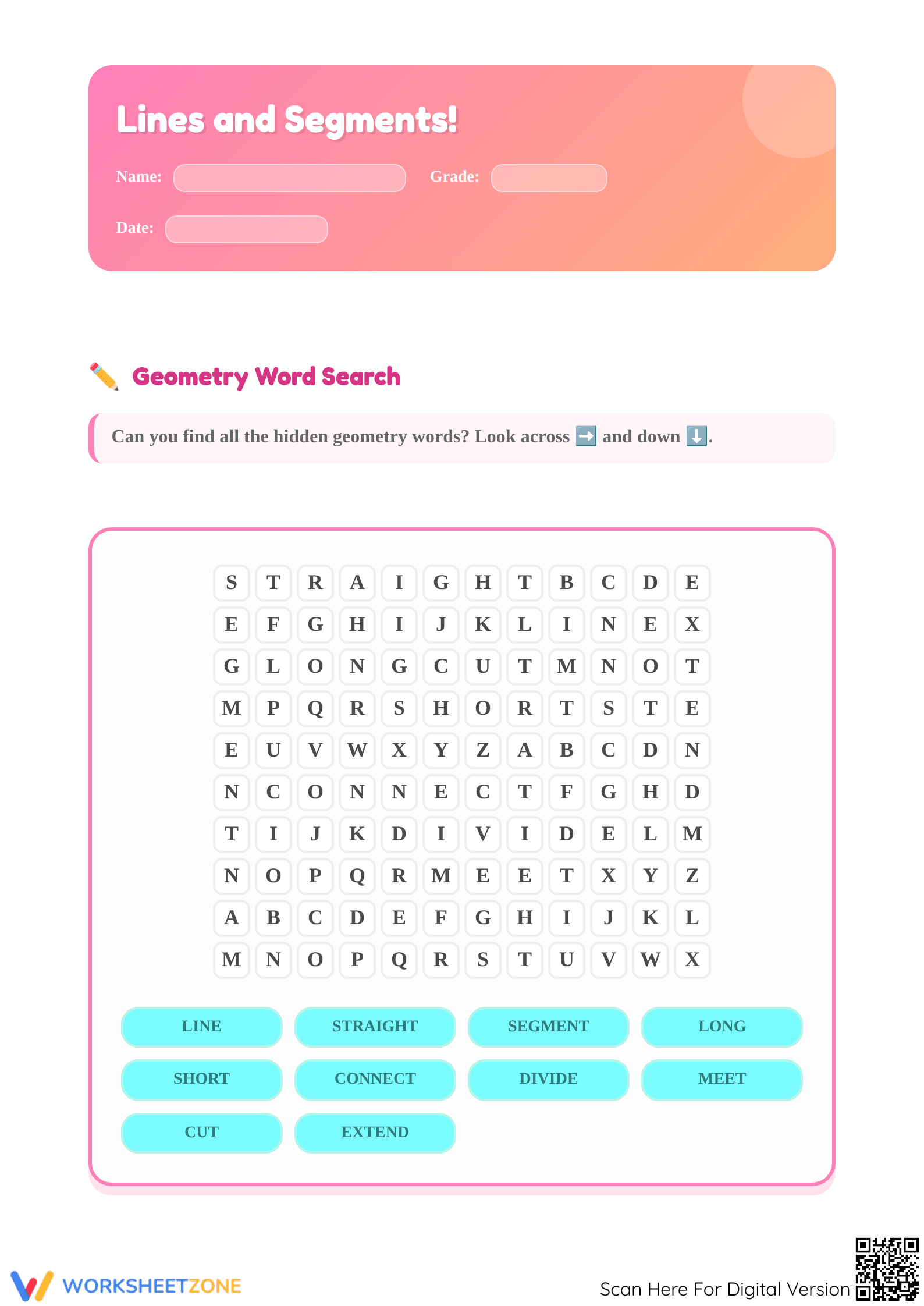
This two-page resource is designed for maximum student engagement and conceptual clarity. The first page features a geometry-themed word search that reinforces ten essential terms, such as segment, ray, and intersect. The second page transitions to the Geometry Artist section, providing four dedicated workspaces for students to use a ruler and construct specific figures based on technical definitions. A final challenge question applies these concepts to real-world polygons.
The zero-prep workflow is optimized for busy educators needing high-quality materials without administrative burden. First, print the two-page PDF (approx. 30 seconds). Second, distribute the worksheets and ensure students have access to a ruler and pencil (approx. 1 minute). Finally, use the included answer key to facilitate a quick group review or peer-grading session at the end of the lesson (approx. 5 minutes).
This worksheet is directly aligned to CCSS.MATH.CONTENT.4.G.A.1, which requires students to draw points, lines, line segments, rays, and various types of angles. The tasks explicitly guide students to differentiate between these structures by providing clear textual definitions alongside the drawing prompts. This standard code can be copied directly into lesson plans, IEP goals, or district curriculum mapping tools to ensure vertical alignment.
Use this worksheet as a mid-lesson check for understanding after introducing the definitions of lines and rays. As students work through the Geometry Artist section, move around the room to observe their ruler usage and ensure they are distinguishing between the arrows on a line and the endpoints on a segment. Alternatively, assign the word search as a morning warm-up to activate prior knowledge before a full geometry lecture.
This resource is primarily intended for fourth-grade students beginning their formal study of two-dimensional geometry. It also serves as an excellent remedial tool for fifth-grade students or an enrichment activity for advanced third graders. The inclusion of a word bank and clear definitions provides natural scaffolding for English Language Learners and students with processing needs, while the drawing tasks offer a tactile learning experience.
The successful integration of visual and textual information is a cornerstone of geometric literacy, as highlighted in the ScienceDirect TpT Analysis. This worksheet addresses CCSS.MATH.CONTENT.4.G.A.1 by requiring students to synthesize their knowledge of geometric vocabulary with the physical act of drawing lines, segments, and rays. Research indicates that word search activities, when paired with application tasks, help cement domain-specific language into long-term memory. By requiring students to draw from definitions—such as a ray starting at one point and going forever—the resource builds the mental models necessary for more complex spatial reasoning. The 15 included tasks provide sufficient repetition to achieve mastery without causing cognitive fatigue. This printable PDF is an essential tool for educators looking to provide a structured, high-signal practice environment that yields observable data on student construction skills.


