


























Views
Downloads

Printable Path of Light Worksheet | Grade 1 Science
Paste this activity's link or code into your existing LMS (Google Classroom, Canvas, Teams, Schoology, Moodle, etc.).
Students can open and work on the activity right away, with no student login required.
You'll still be able to track student progress and results from your teacher account.
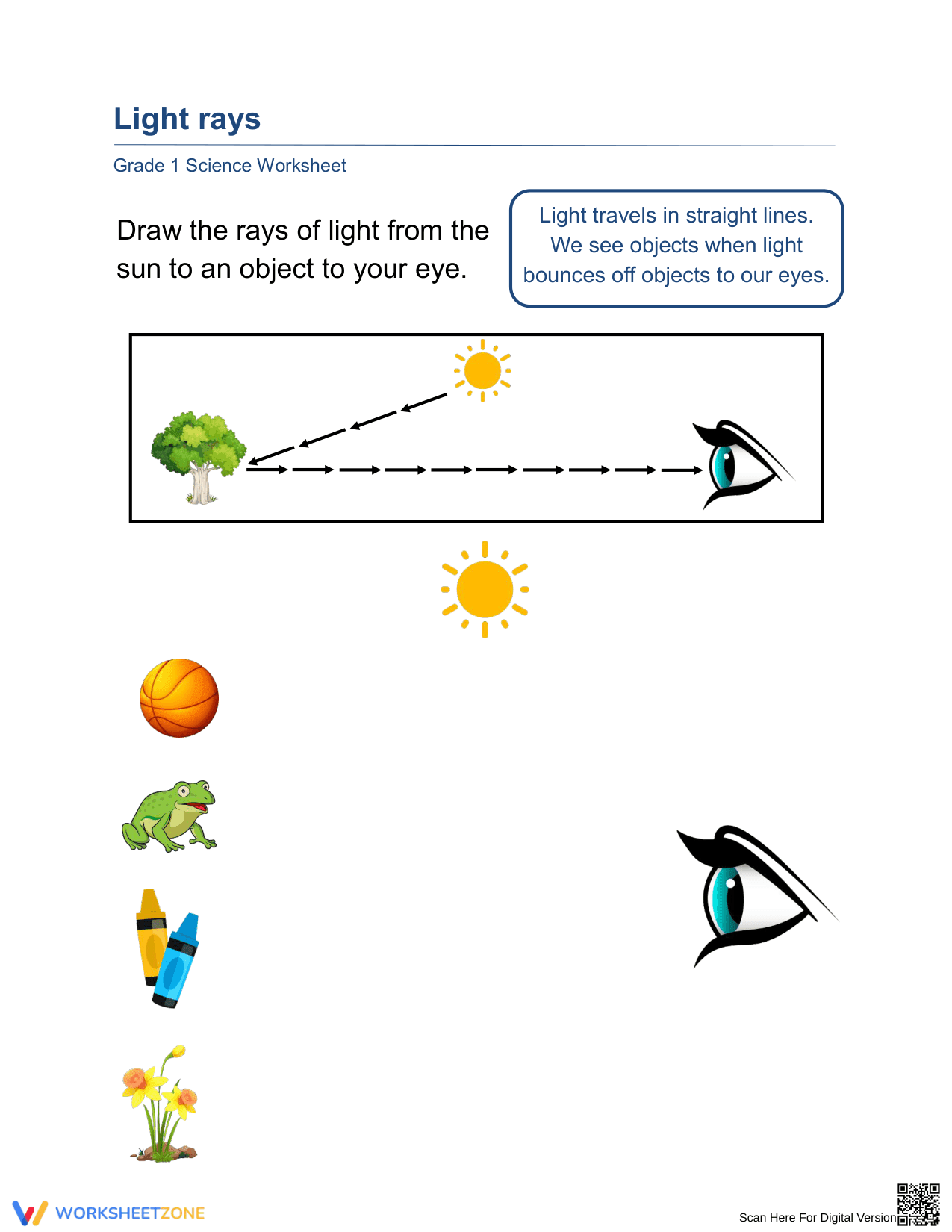
This worksheet provides targeted practice for first graders on the foundational physics concept of light. Students will draw the path light takes from a source (the sun), reflecting off an object, and traveling to the eye. This simple but powerful exercise helps solidify their understanding of how vision works.
At a Glance
- Grade: 1 · Subject: Science
- Standard:
1-PS4-2— Explain with evidence that objects must be illuminated to be seen.- Skill Focus: Modeling the path of light
- Format: 1 page · 4 problems · Answer key included · PDF
- Best For: Concept reinforcement, science centers
- Time: 10–15 minutes
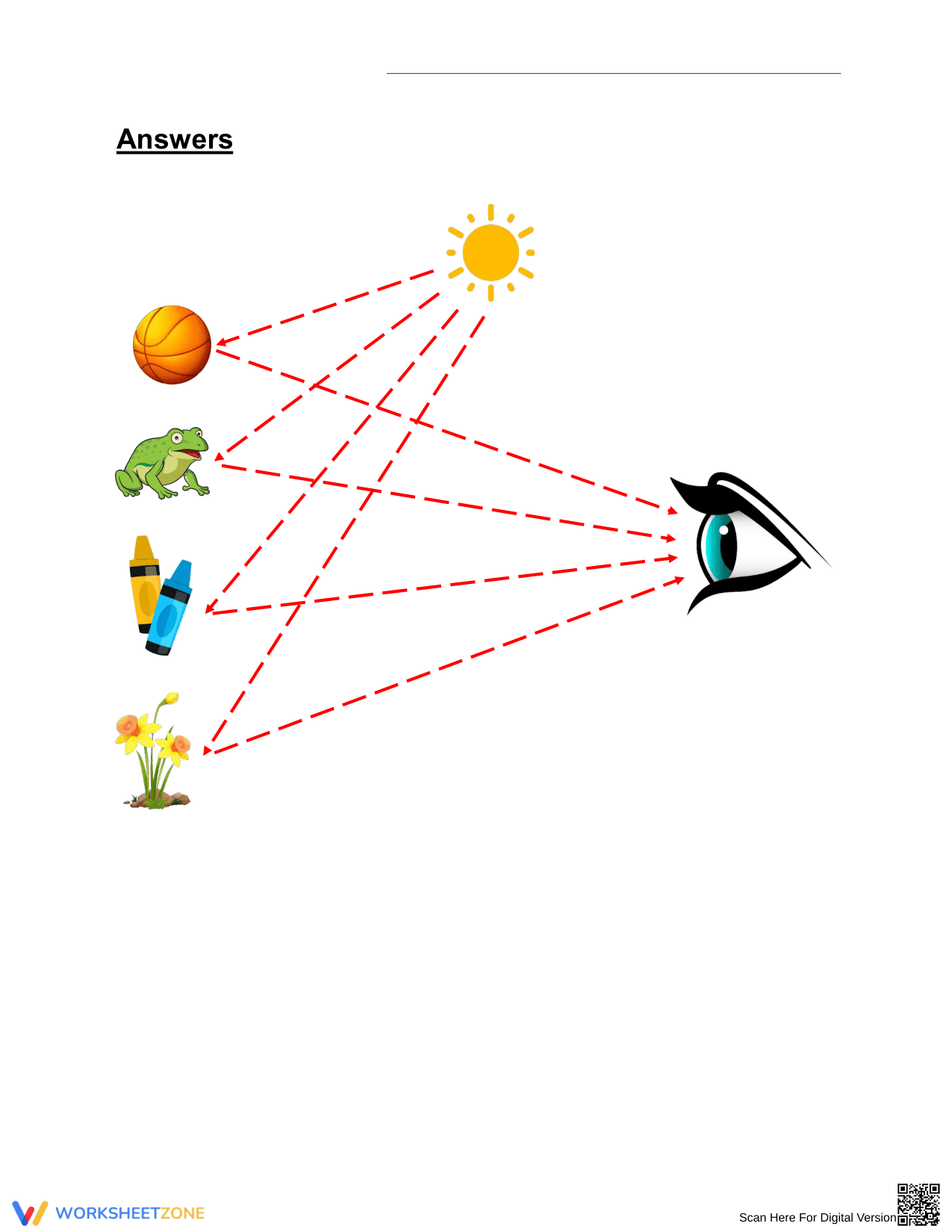
This single-page PDF worksheet includes a clear, worked example demonstrating how to trace the path of light. Following the example, students will find four distinct problems featuring different objects (a ball, a frog, crayons, and flowers). The layout is clean and provides ample space for students to draw. A complete answer key is included on a separate page, showing the correct light paths for easy grading.
This resource supports a gradual-release model, moving students toward independent application.
- Guided Practice: The worksheet begins with a clear, labeled diagram showing light's path, serving as an "I Do" example.
- Supported Practice: The first problem can be a "We Do" activity. Teachers can check that students draw two distinct, straight-line rays with directional arrows.
- Independent Practice: Students then apply their understanding to the remaining problems. The repetition solidifies the core concept, making this an effective "You Do" task.
This worksheet aligns with NGSS 1-PS4-2, which requires students to provide an evidence-based account that objects need illumination to be seen. By drawing the path of light from a source to an object and then to the eye, students create a model that serves as this evidence. It also lays groundwork for understanding 1-PS4-3 (shadows). Both standard codes can be copied directly into lesson plans or curriculum maps.
Use this worksheet after a direct lesson on light for reinforcement. It takes about 10-15 minutes. For a formative assessment tip, check if students draw two separate lines (sun-to-object, object-to-eye), which shows they understand reflection is key. It also works well as morning work or a science station activity.
Designed for first-graders, the visuals support all learners, including ELLs. The simple drawing task is developmentally appropriate. For an extension, pair this with a hands-on activity using flashlights and mirrors to demonstrate reflection.
This Grade 1 science resource provides focused practice on NGSS standard 1-PS4-2, helping students build a model for how illumination allows objects to be seen. The task—drawing the path of light from a source, reflecting off an object, and entering the eye—directly visualizes this principle. Such foundational, model-based reasoning in early grades is critical for developing scientific literacy. Research on effective science instruction highlights the importance of connecting concepts to observable phenomena, a connection this worksheet makes explicit. According to Fisher & Frey (2014), a gradual release of responsibility, where students move from guided to independent practice, strengthens skill acquisition. This worksheet’s structure, with its clear example followed by four practice problems, embodies that proven instructional sequence, making it a reliable tool for ensuring students grasp how light enables sight before moving on to more complex topics like shadows or refraction.


