


























Views
Downloads
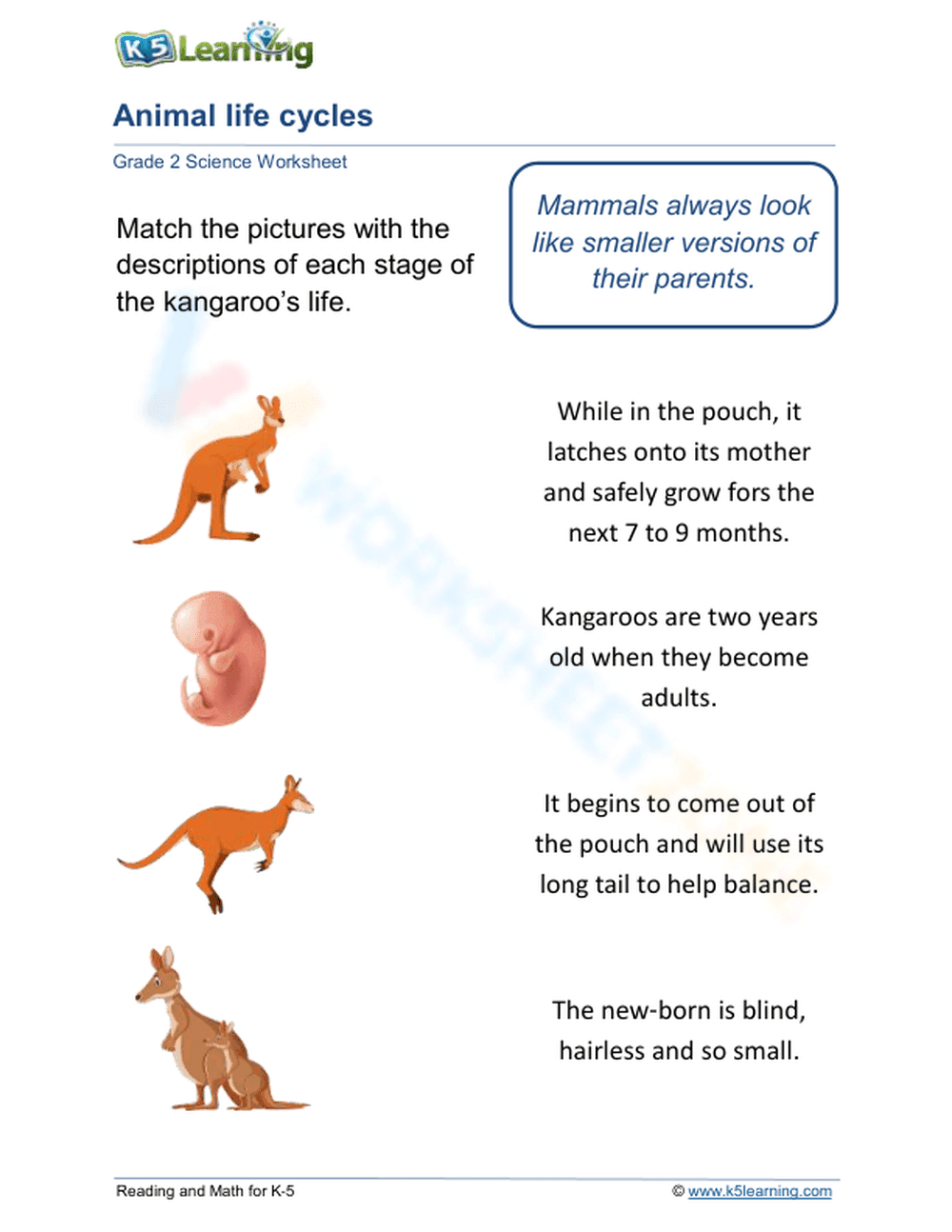

Essential Grade 2 Kangaroo Life Cycle Worksheet
Paste this activity's link or code into your existing LMS (Google Classroom, Canvas, Teams, Schoology, Moodle, etc.).
Students can open and work on the activity right away, with no student login required.
You'll still be able to track student progress and results from your teacher account.
This Grade 2 Science worksheet helps students understand the unique growth stages of a marsupial through the life cycle of a kangaroo. By matching vivid illustrations with descriptive text, learners identify how mammals grow and change from birth to adulthood. This activity reinforces observational skills and biological sequencing in a clear, structured format.
At a Glance
- Grade: 2 · Subject: Living Things
- Standard:
2-LS1-1— Describe how animals use their external parts to survive and grow- Skill Focus: Mammal life cycle sequencing
- Format: 1 page · 4 problems · Answer key included · PDF
- Best For: Individual practice or science center rotations
- Time: 10–15 minutes
Students encounter four distinct stages of the kangaroo's life: the blind newborn, the joey in the pouch, the developing juvenile, and the mature adult. The worksheet includes 1 printable page featuring high-quality images and four descriptive captions. A complete answer key is included to facilitate quick grading or student self-correction during independent work time.
Zero-Prep Workflow: 1. Print the single-page PDF (30 seconds). 2. Distribute to students for a warm-up or independent practice (1 minute). 3. Review the matches as a whole class or using the provided answer key (5 minutes). Total teacher preparation time is under 2 minutes, making this an ideal resource for substitute plans or last-minute science blocks.
The worksheet aligns with 2-LS1-1, which focuses on observing how animals grow and meet their needs. By identifying stages like the joey's development in the pouch, students see how marsupials utilize specific physical structures for protection and growth. This standard code can be copied directly into lesson plans, IEP goals, or district curriculum mapping tools.
Assign this worksheet after an introductory lesson on mammals or marsupials to solidify the concept of growth stages. It also serves as an effective formative-assessment tool; observe if students can differentiate between the joey's reliance on the pouch versus its independent movement to gauge their understanding of developmental milestones. Completion usually takes 10 to 15 minutes.
This resource is designed for Grade 2 students but is also suitable for Grade 1 enrichment or Grade 3 review. It supports visual learners through clear illustration-to-text matching. It pairs naturally with a classroom read-aloud about Australian wildlife or an anchor chart detailing different animal life cycles across the animal kingdom.
This Grade 2 life science resource utilizes a structured matching format to help students sequence the developmental milestones of marsupials. Research from Fisher & Frey (2014) emphasizes that combining visual representations with descriptive text supports the gradual release of responsibility, allowing students to build conceptual models of biological processes independently. The focus on the life cycle of a kangaroo provides a concrete example of how animals grow and survive, aligning with national standards for life science inquiry. By isolating the four key stages—from the hairless newborn to the independent adult—the worksheet reduces cognitive load while ensuring students master the essential vocabulary associated with mammal development. Educational analysis from ScienceDirect TpT Analysis suggests that high-interest animal topics increase student engagement during independent practice, leading to higher retention of scientific facts. This printable PDF ensures that Grade 2 learners meet the 2-LS1-1 requirements through active observation and evidence-based matching.


