


























Views
Downloads

Honey Bee Life Cycle Worksheet | Essential Grade 3-5 Science
Paste this activity's link or code into your existing LMS (Google Classroom, Canvas, Teams, Schoology, Moodle, etc.).
Students can open and work on the activity right away, with no student login required.
You'll still be able to track student progress and results from your teacher account.
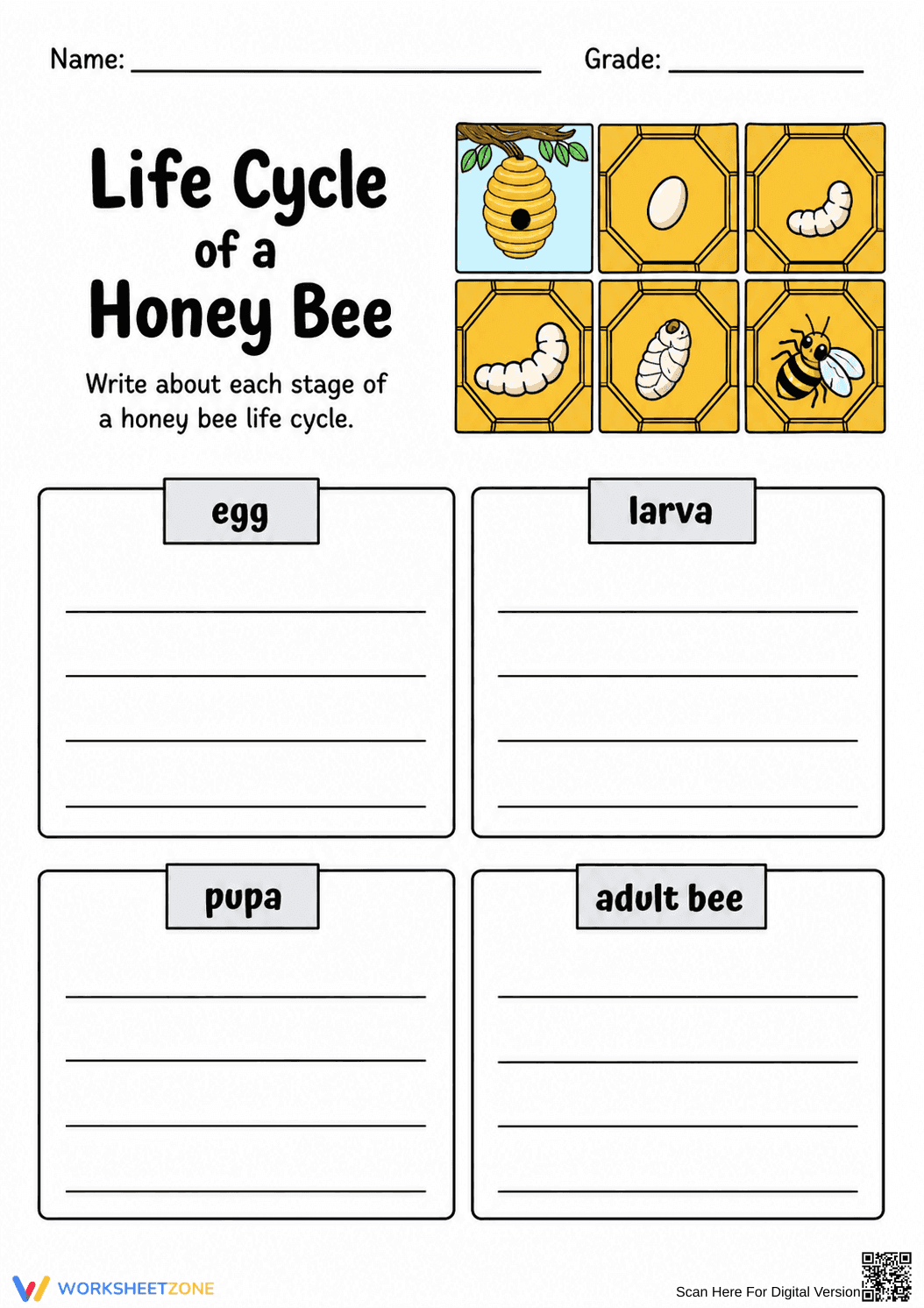
This Grade 3-5 science worksheet provides a structured framework for students to document the metamorphosis of a honey bee. By synthesizing research into descriptive writing, learners demonstrate a clear understanding of biological growth and development. This resource ensures students can identify and explain the distinct characteristics of each developmental phase through evidence-based observation.
At a Glance
- Grade: 3-5 · Subject: Science
- Standard:
3-LS1-1— Describe how organisms have unique and diverse life cycles- Skill Focus: Life cycle sequencing and descriptive writing
- Format: 1 page · 4 tasks · Answer key included · PDF
- Best For: Independent research or science centers
- Time: 20–30 minutes
What's Inside
The worksheet features a clean, organized layout with four dedicated writing sections for the egg, larva, pupa, and adult bee stages. Each section is paired with a high-quality visual icon representing the specific stage of the honey bee's life. The package includes a comprehensive answer key to facilitate quick grading or student self-correction, ensuring that scientific accuracy is maintained throughout the activity.
Zero-Prep Workflow
- Print: Generate the single-page PDF in less than 30 seconds for your entire class.
- Distribute: Hand out the sheets with zero additional setup; the instructions are self-explanatory for upper elementary students.
- Review: Evaluate student responses using the provided answer key in under five minutes, making it an ideal choice for substitute folders or busy instructional days.
Standards Alignment
This activity is directly aligned with `3-LS1-1`, which requires students to develop models to describe that organisms have unique and diverse life cycles but all have in common birth, growth, reproduction, and death. By documenting the specific transitions of the honey bee, students provide evidence of biological change over time. Both standard codes can be copied directly into lesson plans, IEP goals, or district curriculum mapping tools.
How to Use It
Use this worksheet as a formative assessment after a direct instruction lesson on insects. Alternatively, assign it as a guided research task where students use library books or approved websites to find specific details about what happens during the pupa stage. Observe if students can distinguish between the physical appearance of the larva and the pupa to gauge their attention to scientific detail. The expected completion time is 20 to 30 minutes depending on research depth.
Who It's For
This resource is tailored for Grade 3, 4, and 5 students exploring life science and entomology. It provides enough scaffolding for struggling writers while allowing advanced students to include complex vocabulary. It pairs perfectly with a classroom observation hive or a non-fiction text about pollinators and their role in the ecosystem, making it a versatile addition to any life science unit.
The Honey Bee Life Cycle Worksheet leverages the 3-LS1-1 standard to bridge the gap between scientific observation and technical writing. According to Fisher & Frey (2014), the use of graphic organizers and structured writing prompts in science helps students internalize complex biological processes through the gradual release of responsibility. This worksheet provides the necessary visual cues and organizational structure to support that transition. By focusing on the four distinct stages—egg, larva, pupa, and adult—students build a mental model of metamorphosis that is foundational for later studies in genetics and ecology. Research from the NAEP indicates that students who engage in regular descriptive writing within the science curriculum show higher retention of technical vocabulary. This printable resource serves as a reliable tool for documenting student mastery of life cycle concepts in a clear, assessable format suitable for any elementary science curriculum.


