


























Views
Downloads

Printable Lexile Level Chart Guide for Grades 2-7
Paste this activity's link or code into your existing LMS (Google Classroom, Canvas, Teams, Schoology, Moodle, etc.).
Students can open and work on the activity right away, with no student login required.
You'll still be able to track student progress and results from your teacher account.
This printable Lexile Framework reading level chart helps educators match young readers with appropriate books. By aligning student reading ability with text complexity, this visual guide supports literacy growth across grades 2 through 7. Use this reference tool to select books that offer the right amount of challenge.
At a Glance
- Grade: Grades 2, 3, 4, 5, 6, and 7 · Subject: Reading and English Language Arts
- Standard:
CCSS.ELA-LITERACY.RI.5.10— Match readers to appropriate text complexity levels for independent reading.- Skill Focus: Text complexity matching and Lexile level tracking
- Format: 1 printable page · 1 visual reference chart · PDF format
- Best For: Guided reading book selection and classroom library organization
- Time: 5–10 minutes
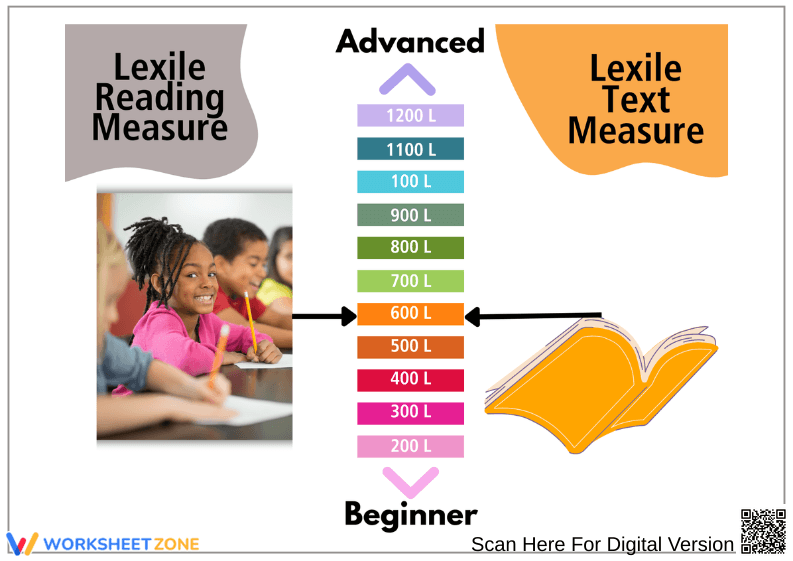
This resource features a color-coded visual scale representing Lexile measures from 200L to 1200L. It illustrates the relationship between the Lexile Reading Measure and the Lexile Text Measure. The chart uses a central alignment point at 600L to demonstrate how these measures correspond, making it easy to understand the matching process.
Implement this resource with a simple three-step workflow. First, print the single-page PDF in color (under 1 minute). Second, display the chart in your classroom library to guide book selection. Third, review the chart with students for 2 minutes to teach them how to locate books in their target range. This zero-prep tool requires under 2 minutes of teacher preparation.
Standards Alignment
This chart aligns with CCSS.ELA-LITERACY.RI.5.10, which requires students to read and comprehend complex informational texts independently. By representing Lexile measures visually, this tool helps educators monitor text complexity. Both standard codes can be copied directly into lesson plans, IEP goals, or district curriculum mapping tools.
How to Use It
Use this chart during independent reading selection to help students choose books. Introduce the chart before library navigation, showing students how to locate their reading level. For a quick formative assessment, observe students as they select books and ask them to explain if their choice falls within their target Lexile band. This takes 5 to 10 minutes.
Who It's For
This guide is designed for students in grades 2 through 7, reading specialists, and classroom teachers. It helps differentiate instruction for struggling readers who need lower-complexity texts, or advanced readers who require challenges. Pair this chart with a guided reading lesson or an anchor chart about book selection strategies.
This Lexile Framework level chart provides a visual representation of text complexity matching, supporting the structured literacy practices highlighted in the EdReports 2024 analysis. By aligning the Lexile Reading Measure of the student with the Lexile Text Measure of the book, educators can systematically scaffold reading instruction to prevent frustration and promote comprehension. Research indicates that matching readers to texts within their targeted Lexile range—typically 100L below to 50L above their measure—fosters optimal reading growth. This chart serves as a practical tool for implementing these research-backed strategies in daily classroom routines. It helps teachers translate complex assessment data into actionable book selection decisions, ensuring that every student accesses texts that support their individual learning trajectory. Use this resource to bridge the gap between formal reading assessments and daily independent reading practice.


