


























Views
Downloads

Preschool Reading Matching Worksheet | Essential
Paste this activity's link or code into your existing LMS (Google Classroom, Canvas, Teams, Schoology, Moodle, etc.).
Students can open and work on the activity right away, with no student login required.
You'll still be able to track student progress and results from your teacher account.
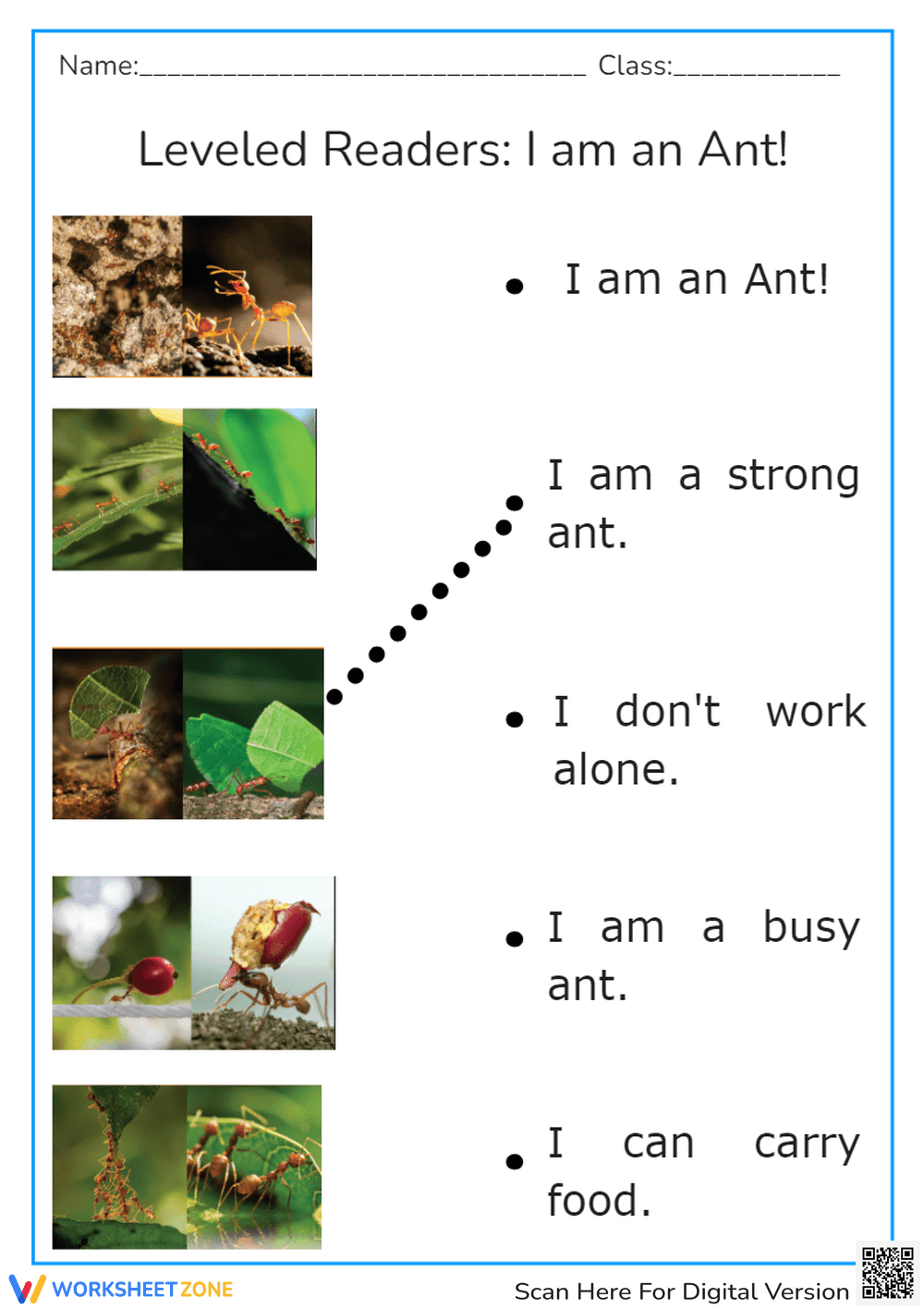
This Preschool Leveled Readers matching worksheet helps early learners connect simple sentences to descriptive imagery. By identifying key details in photos of ants, students build foundational literacy skills and reading confidence. This activity provides a structured way for young children to practice word recognition and visual comprehension in a single, engaging session.
At a Glance
- Grade: Preschool · Subject: ELA
- Standard:
CCSS.ELA-LITERACY.RI.K.7— Use illustrations and details in a text to describe its key ideas- Skill Focus: Sentence-picture matching
- Format: 1 page · 5 problems · Answer key included · PDF
- Best For: Early literacy centers and morning work
- Time: 10–15 minutes
The worksheet features five high-quality color photographs of ants performing various actions, paired with five simple "I am" or "I can" sentences. This one-page PDF includes a clear matching task where students draw lines from the text to the corresponding image. A complete answer key is provided to ensure quick checking by teachers or parents.
Teachers can implement this resource in under 2 minutes. First, print the single-page PDF for your class or small group. Second, distribute the sheets along with pencils or crayons. Third, review the completed matches as a group to reinforce the connection between the written word and visual evidence. This streamlined process makes it an ideal sub plan or transition activity.
This resource aligns with CCSS.ELA-LITERACY.RI.K.7, focusing on the relationship between illustrations and the text in which they appear. By matching the sentence "I can carry food" to the image of an ant with a berry, students demonstrate an understanding of how visuals support textual meaning. Both standard codes can be copied directly into lesson plans, IEP goals, or district curriculum mapping tools.
Use this worksheet during small-group guided reading to assess a student's ability to track print and recognize high-frequency words. It also serves as an excellent formative assessment tool; observe if students are looking for specific visual cues (like the leaf or the food) to make their matches. Expect completion within 10 to 15 minutes.
This activity is designed for preschool and early kindergarten students who are beginning to decode simple sentences. It is particularly effective for English Language Learners (ELLs) who benefit from the direct visual support of the photographs. Pair this with a non-fiction picture book about insects for a complete science-integrated literacy lesson.
According to the RAND AIRS 2024 report on early childhood literacy, the integration of high-quality visual aids with simplified text is critical for developing print awareness in pre-readers. This worksheet utilizes the CCSS.ELA-LITERACY.RI.K.7 framework to bridge the gap between visual observation and textual decoding. By engaging with 5 distinct matching tasks, students practice the cognitive shift from looking at a picture to reading a descriptive sentence. Research from Fisher & Frey (2014) emphasizes that such multimodal tasks are essential for scaffolding comprehension in the early years. This resource provides a structured, evidence-based approach to early reading that can be easily integrated into any preschool curriculum. The use of real-world photography rather than illustrations further supports vocabulary acquisition by providing concrete examples of the subject matter, ensuring that students remain engaged while meeting foundational literacy benchmarks.


