


























Views
Downloads
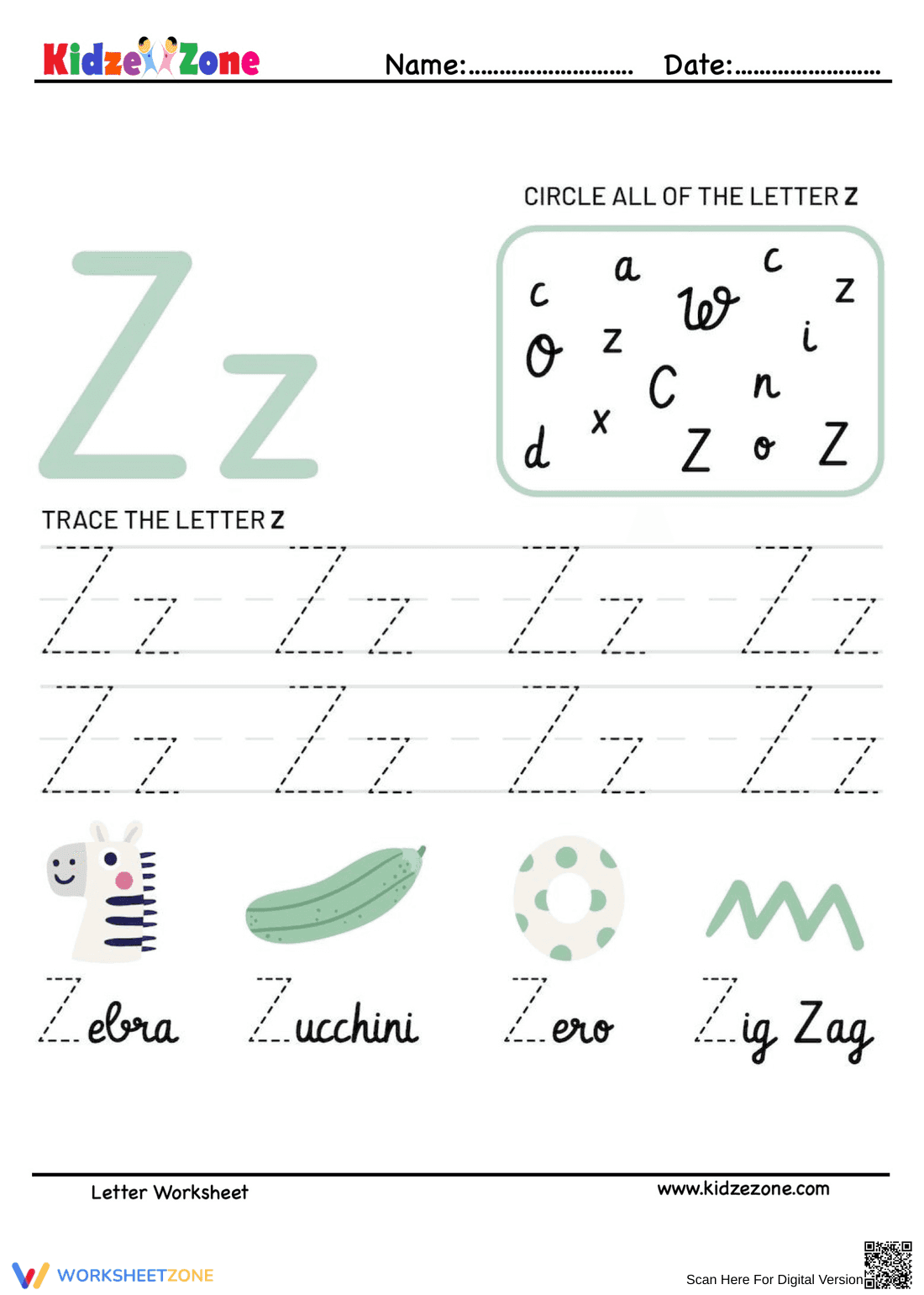

Letter Z Tracing Worksheet | Essential Grade K-1 Ready
Paste this activity's link or code into your existing LMS (Google Classroom, Canvas, Teams, Schoology, Moodle, etc.).
Students can open and work on the activity right away, with no student login required.
You'll still be able to track student progress and results from your teacher account.
This Grade Kindergarten and Grade 1 English worksheet provides a comprehensive approach to mastering the letter Z. Students engage in visual discrimination and fine motor practice to solidify their understanding of both uppercase and lowercase forms. By combining tracing with vocabulary association, the resource ensures students build a strong foundation for early literacy and handwriting success.
At a Glance
- Grade: Kindergarten · Subject: English
- Standard:
CCSS.ELA-LITERACY.L.K.1.A— Print many upper- and lowercase letters accurately- Skill Focus: Letter Z formation and recognition
- Format: 1 page · 13 tasks · Answer key included · PDF
- Best For: Independent morning work or literacy centers
- Time: 10–15 minutes
What's Inside: The worksheet features a dedicated "Circle all of the Letter Z" recognition box containing 15 mixed characters to sharpen visual scanning skills. Below, students find 8 sets of dashed-line tracing guides for "Zz" to practice proper stroke order. The bottom section includes four high-frequency vocabulary words—Zebra, Zucchini, Zero, and Zig Zag—paired with colorful illustrations and tracing opportunities to connect phonics with handwriting.
Zero-Prep Workflow
- Print: Generate the single-page PDF in less than 30 seconds for your entire class.
- Distribute: Hand out the sheets during transition periods or as students arrive for morning work.
- Review: Use the clear layout to provide immediate formative feedback on letter formation and recognition.
Total teacher preparation time is under 2 minutes, making it an ideal choice for emergency sub plans or busy daily routines.
Standards Alignment
The primary focus is `CCSS.ELA-LITERACY.L.K.1.A`, which requires students to print many upper- and lowercase letters. By providing structured paths for the letter Z, this worksheet supports the developmental transition from scribbling to intentional letter formation. Both standard codes can be copied directly into lesson plans, IEP goals, or district curriculum mapping tools.
How to Use It
Use this worksheet during the independent practice phase of a gradual release lesson on the alphabet. It serves as an excellent formative assessment tool; observe if students start their strokes from the top-left to ensure correct habits. The expected completion time is 10 to 15 minutes, fitting perfectly into a rotating literacy station or as a quiet-time activity after direct instruction.
Who It's For
This resource is tailored for Kindergarten students beginning their handwriting journey and Grade 1 students requiring remedial support. It is also highly effective for English Language Learners (ELL) who benefit from the visual cues of the zebra and zucchini. Pair this with an alphabet anchor chart or a tactile sand-tracing activity for a multi-sensory learning experience.
Effective handwriting instruction in early childhood is a predictor of later reading and writing fluency. According to Fisher & Frey (2014), the gradual release of responsibility—moving from guided tracing to independent recognition—is vital for motor memory. This worksheet implements these principles by providing 13 specific tasks that move the student from identification to production. By focusing on CCSS.ELA-LITERACY.L.K.1.A, the resource ensures that students meet national benchmarks for letter formation. Research from the NAEP suggests that early mastery of the alphabet, specifically the ability to print upper- and lowercase letters like the letter Z, correlates with higher literacy achievement in later elementary years. This printable resource provides the structured repetition necessary for students to internalize these shapes, making it a reliable tool for any early childhood classroom seeking to improve student outcomes in foundational English skills.


