


























Views
Downloads
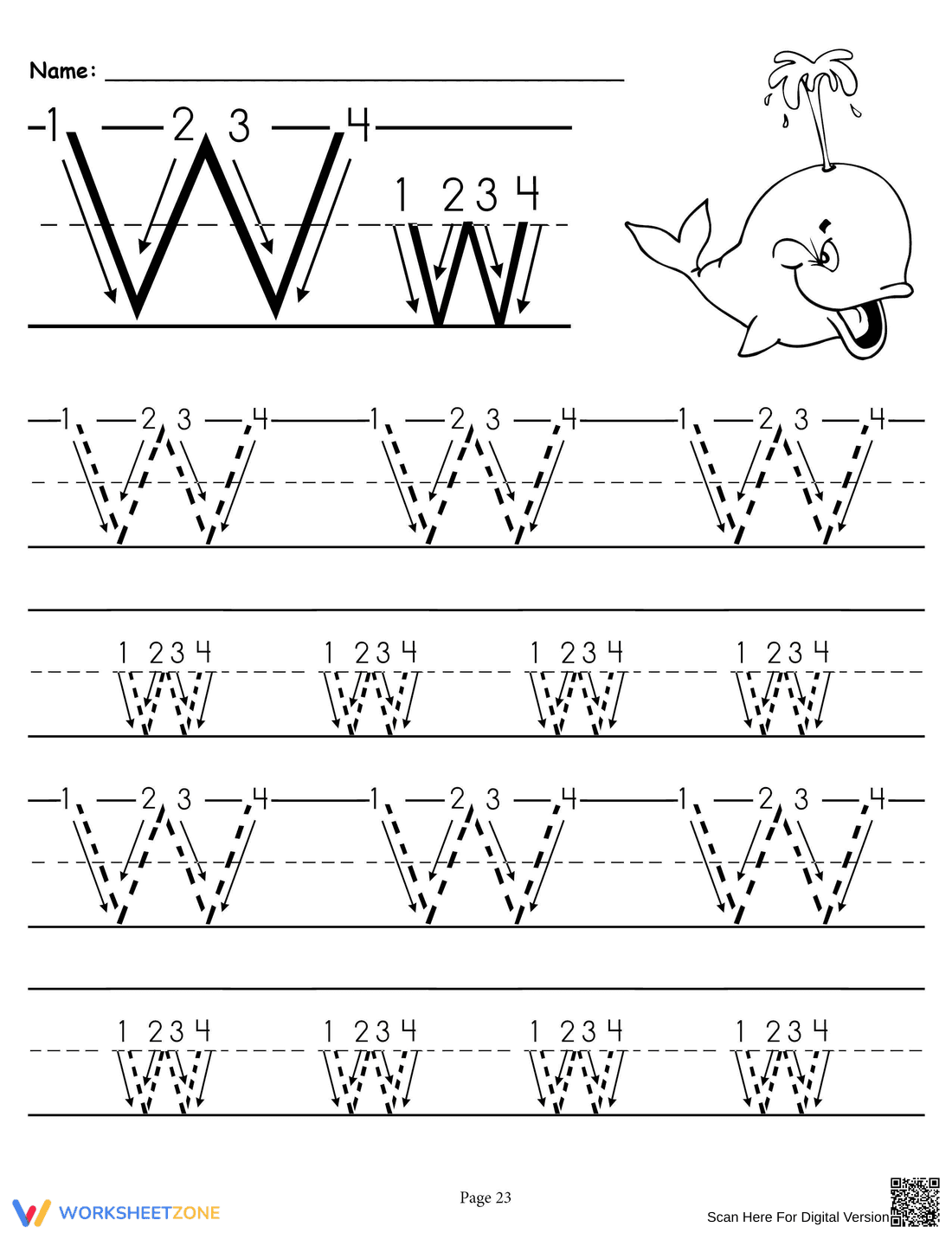

Letter W Tracing Worksheet | Essential Grade K-1 Practice
Paste this activity's link or code into your existing LMS (Google Classroom, Canvas, Teams, Schoology, Moodle, etc.).
Students can open and work on the activity right away, with no student login required.
You'll still be able to track student progress and results from your teacher account.
This Grade K-1 Letter W tracing worksheet provides young learners with structured practice to master uppercase and lowercase letter formation. By following numbered directional arrows, students develop the fine motor control necessary for legible handwriting. The inclusion of a whale graphic helps anchor phonemic awareness while making the writing process engaging for early childhood learners.
At a Glance
- Grade: Kindergarten · Subject: English
- Standard:
CCSS.ELA-LITERACY.L.K.1.A— Print many upper- and lowercase letters accurately using proper stroke order- Skill Focus: Letter W formation
- Format: 1 page · 14 problems · No answer key needed · PDF
- Best For: Morning work or handwriting centers
- Time: 10–15 minutes
Inside this single-page PDF, you will find a clear, large-scale model of the letter W with numbered stroke guides. The worksheet features two rows of uppercase W tracing and two rows of lowercase w tracing, totaling 14 individual practice opportunities. A friendly whale illustration at the top right provides a visual cue for the "W" sound and can be colored by students who finish early.
This resource is designed for a zero-prep classroom workflow. First, print the single-page PDF in less than 30 seconds. Second, distribute the sheets to students during your literacy block or as a transition activity. Finally, review student stroke order by circulating the room as they work for approximately 10 minutes. This layout is perfect for emergency sub plans or independent desk work.
This worksheet aligns with `CCSS.ELA-LITERACY.L.K.1.A`, which requires students to print many upper- and lowercase letters. It also supports `CCSS.ELA-LITERACY.RF.K.1.D` by helping students recognize and name all upper- and lowercase letters of the alphabet. Both standard codes can be copied directly into lesson plans, IEP goals, or district curriculum mapping tools.
Use this worksheet during the "You Do" phase of a gradual release handwriting lesson. After demonstrating the four-stroke formation on the board, assign this page for independent practice. It also serves as an excellent formative assessment tool; observe if students are following the numbered arrows or drawing the letter from the bottom up to identify who needs additional intervention.
This resource is ideal for Kindergarten students beginning their handwriting journey and Grade 1 students requiring remedial support in letter sizing. It pairs naturally with an alphabet anchor chart or a phonics lesson focused on the /w/ sound. The clear dashed lines provide the necessary scaffolding for students still developing spatial awareness on the page.
According to the RAND AIRS 2024 report, consistent tactile practice with letter formation is a foundational component of early literacy that directly correlates with later writing fluency. This worksheet addresses the specific requirements of CCSS.ELA-LITERACY.L.K.1.A by providing 14 distinct tracing tasks that emphasize proper stroke sequence. Research from Fisher & Frey (2014) suggests that guided tracing helps bridge the gap between letter recognition and independent production. By utilizing numbered directional cues, this resource ensures that students internalize the correct motor patterns rather than simply copying a shape. This systematic approach to handwriting instruction is essential for preventing the development of inefficient writing habits that can hinder speed and legibility in higher grades. Educators can use this printable as a reliable tool for building the muscle memory required for proficient alphabet mastery in early childhood settings.


