


























Views
Downloads
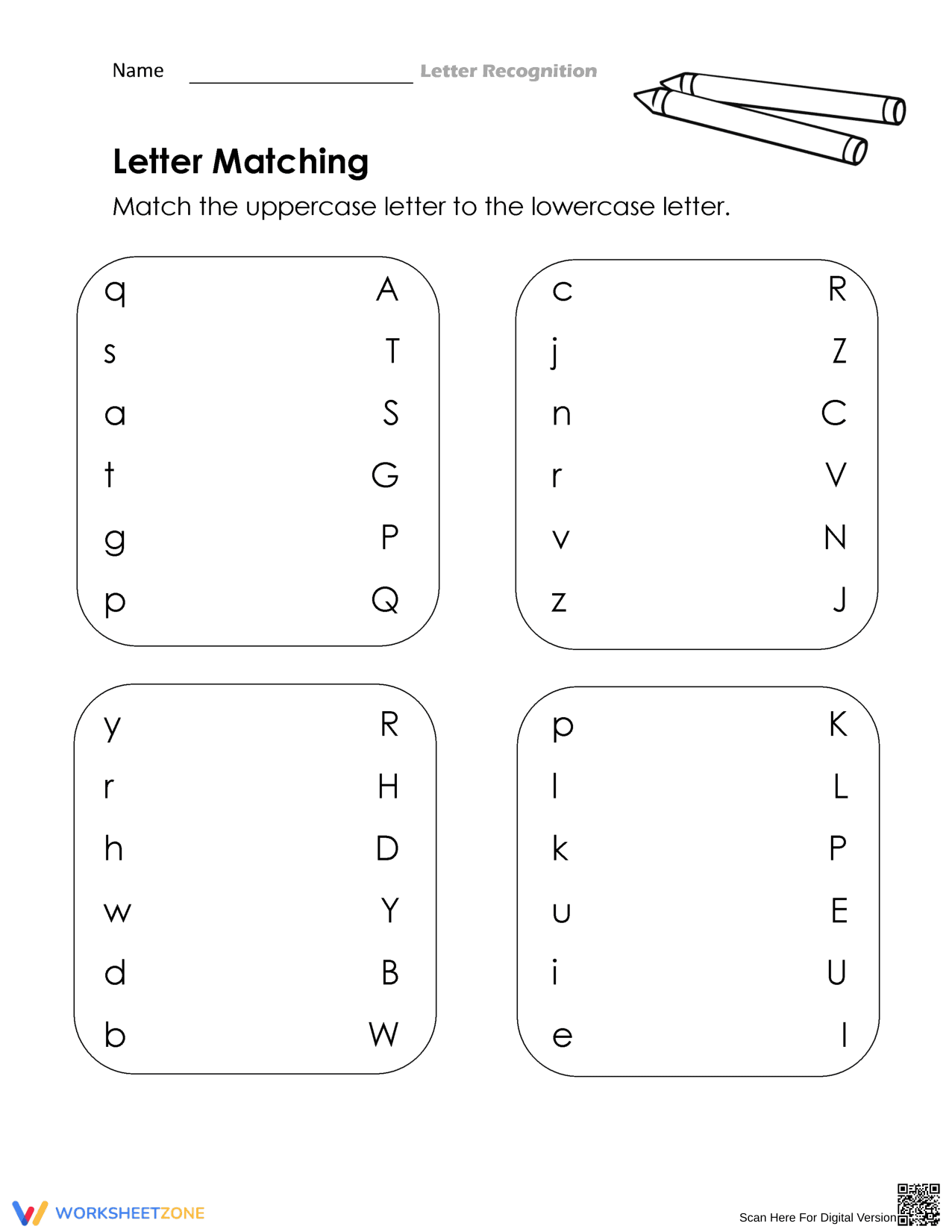

Printable Letter Matching Worksheet | Kindergarten English
Paste this activity's link or code into your existing LMS (Google Classroom, Canvas, Teams, Schoology, Moodle, etc.).
Students can open and work on the activity right away, with no student login required.
You'll still be able to track student progress and results from your teacher account.
Developing literacy begins with instant recognition of alphabet characters. This Letter Matching worksheet provides a focused environment for Kindergarten students to identify uppercase and lowercase pairs. By reinforcing these visual relationships, learners build the cognitive speed necessary for fluent reading and confident letter formation during early writing tasks.
At a Glance
- Grade: Kindergarten · Subject: English
- Standard:
CCSS.ELA-LITERACY.RF.K.1.D— Recognize and name all upper- and lowercase letters of the alphabet- Skill Focus: Alphabet Recognition & Case Matching
- Format: 1 page · 24 problems · Answer key included · PDF
- Best For: Daily morning work or phonics centers
- Time: 10–15 minutes
This resource features four matching zones, each containing six letter pairs. The clear layout minimizes distractions, allowing students to concentrate on character features. The clean font ensures shapes are easily distinguishable, supporting early learners. A full answer key is provided for rapid grading and immediate student feedback.
First, print copies in under one minute; the high-contrast design ensures clarity on any copier. Second, distribute the sheets for a 10-minute practice session. Finally, review work using the included key for immediate feedback. This zero-prep structure is ideal for emergency substitute plans, transition activities, or morning work routines.
This activity aligns with CCSS.ELA-LITERACY.RF.K.1.D, requiring students to recognize all upper- and lowercase letters. Practicing the mapping of lowercase letters to their uppercase forms helps master orthographic variations. This standard code can be copied directly into lesson plans or IEP goals to document mastery of foundational print concepts.
Use this as a formative assessment to observe which letter pairs cause confusion; watch for struggles with mirrored letters like "b" and "d." Alternatively, assign it to fast-finishers to reinforce naming speed. Students typically complete the 24 tasks within 12 minutes, providing a snapshot of recognition fluency before moving to phonics.
This is tailored for Kindergarten and Grade 1 learners requiring intervention. It is effective for English Language Learners familiarizing themselves with the Latin alphabet. Pair this worksheet with an alphabet anchor chart or tactile activity for a multi-sensory approach to letter recognition, ensuring students establish the prerequisite skills for decoding.
The RAND AIRS 2024 report confirms that rapid identification of uppercase and lowercase letters is a primary predictor of reading success. This worksheet addresses CCSS.ELA-LITERACY.RF.K.1.D through 24 targeted opportunities to practice this essential skill. Visual mapping of lowercase to uppercase forms bridges the gap between recognition and decoding. Research indicates that students achieving alphabet mastery by Kindergarten's end are more likely to meet future literacy benchmarks. This printable resource offers an evidence-based method for delivering the repeated exposure necessary for letter fluency. By integrating these focused tasks into the curriculum, educators ensure learners establish the prerequisite skills for beginning sound identification and pronunciation. This focused practice supports the development of automaticity, allowing students to allocate more cognitive resources to comprehension as they progress to more complex texts and writing assignments.


