


























Views
Plays
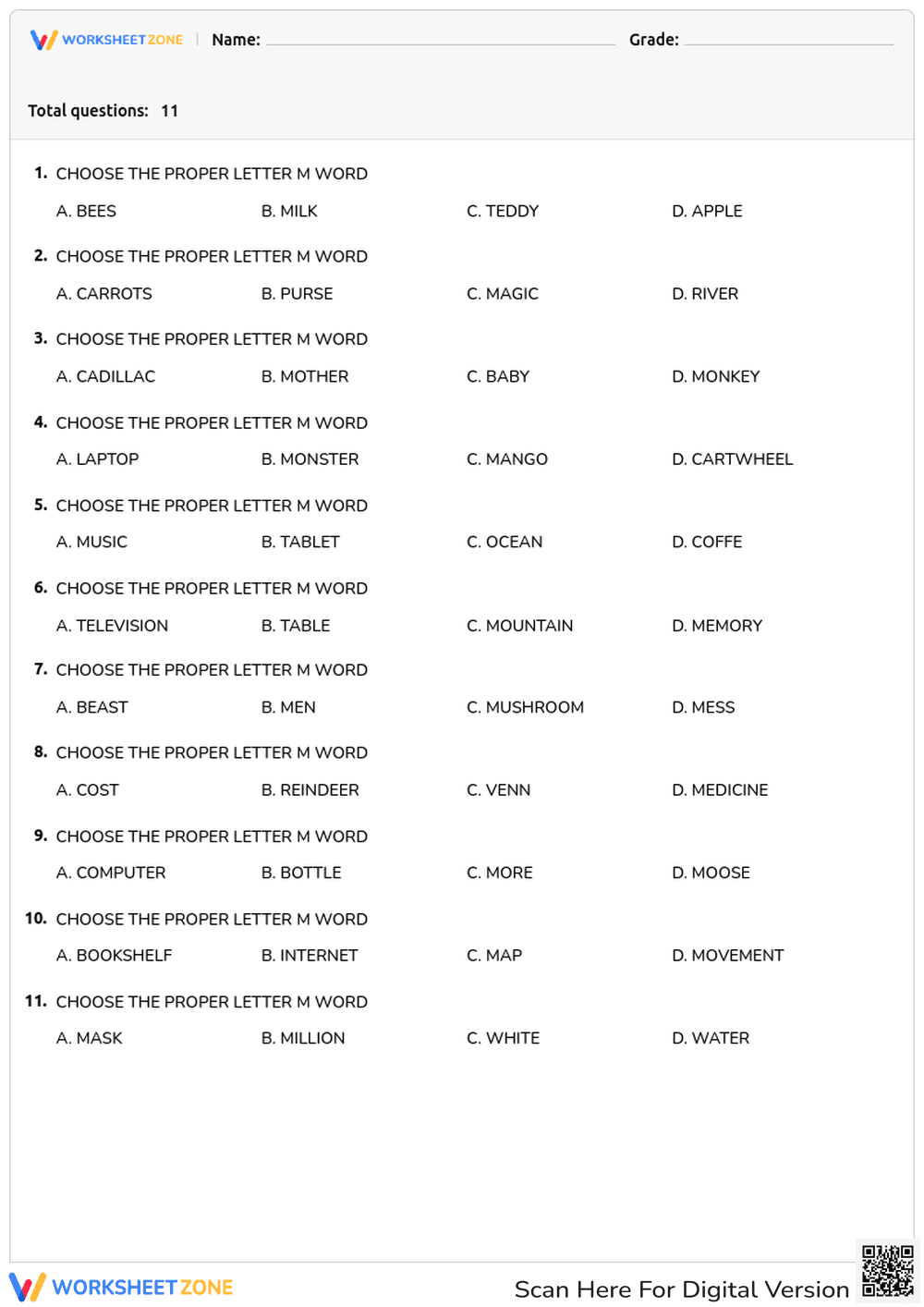

Letter M Recognition Worksheet | Kindergarten Essential
Paste this activity's link or code into your existing LMS (Google Classroom, Canvas, Teams, Schoology, Moodle, etc.).
Students can open and work on the activity right away, with no student login required.
You'll still be able to track student progress and results from your teacher account.
This Kindergarten Letter M worksheet helps students master initial letter recognition and phonics through 11 targeted multiple-choice questions. By identifying words that begin with the "m" sound, learners strengthen their phonological awareness and letter-sound correspondence. This resource provides immediate practice in distinguishing the target letter from other common alphabet sounds in a clear, structured format.
At a Glance
- Grade: Kindergarten · Subject: ELA Phonics
- Standard:
CCSS.ELA-LITERACY.RF.K.3.A— Demonstrate basic knowledge of one-to-one letter-sound correspondences for consonants- Skill Focus: Initial Letter M Identification
- Format: 1 page · 11 problems · Answer key included · PDF
- Best For: Independent phonics practice and morning work
- Time: 10–15 minutes
This single-page PDF contains 11 distinct multiple-choice items. Each question presents four word options, requiring the student to select the one that begins with the letter M. The vocabulary includes high-frequency words like "milk," "mother," and "map," as well as more complex nouns like "mountain" and "medicine." The layout is clean and distraction-free, featuring a dedicated space for the student's name and grade at the top.
The zero-prep design allows for an efficient classroom workflow. First, print the single-page document (30 seconds). Next, distribute the sheets to students during your literacy block or as a transition activity (1 minute). Finally, review the answers using the included key or through a quick whole-class check (2 minutes). Total teacher preparation time is under two minutes, making this an ideal resource for substitute folders or unexpected schedule changes.
The primary focus is `CCSS.ELA-LITERACY.RF.K.3.A`, which requires students to demonstrate basic knowledge of one-to-one letter-sound correspondences. By isolating the letter M, students practice the foundational skill of mapping sounds to graphemes. This standard code can be copied directly into lesson plans, IEP goals, or district curriculum mapping tools to ensure instructional compliance.
Use this worksheet as a formative assessment after introducing the letter M sound. It works exceptionally well during small-group literacy centers where the teacher can observe a student's ability to scan options and recognize the target initial consonant. Alternatively, assign it as a quick exit ticket to gauge mastery before moving to the next letter in the alphabet sequence. Completion typically takes 10 to 15 minutes.
This resource is designed for Kindergarten students beginning their phonics journey. It is also highly effective for English Language Learners (ELL) who need to build basic English vocabulary while practicing letter sounds. Pair this worksheet with a Letter M anchor chart or a short reading passage featuring "m" words to provide a comprehensive instructional experience.
Systematic phonics instruction, specifically focusing on letter-sound correspondence like the tasks in this CCSS.ELA-LITERACY.RF.K.3.A worksheet, is a cornerstone of early literacy development. According to the RAND AIRS 2024 report, explicit practice in identifying initial consonants significantly correlates with later reading fluency and decoding proficiency. By isolating the letter M across 11 distinct tasks, students engage in the repetitive exposure necessary to move from letter recognition to automaticity. Research from Fisher & Frey (2014) emphasizes that structured, independent practice following direct instruction helps solidify the gradual release of responsibility model. This worksheet provides the independent practice phase, allowing educators to collect evidence of student mastery in a standardized format. The use of multiple-choice options further supports cognitive development by requiring students to discriminate between the target phoneme and distractors, a key skill identified in NAEP literacy frameworks.


