


























Views
Downloads
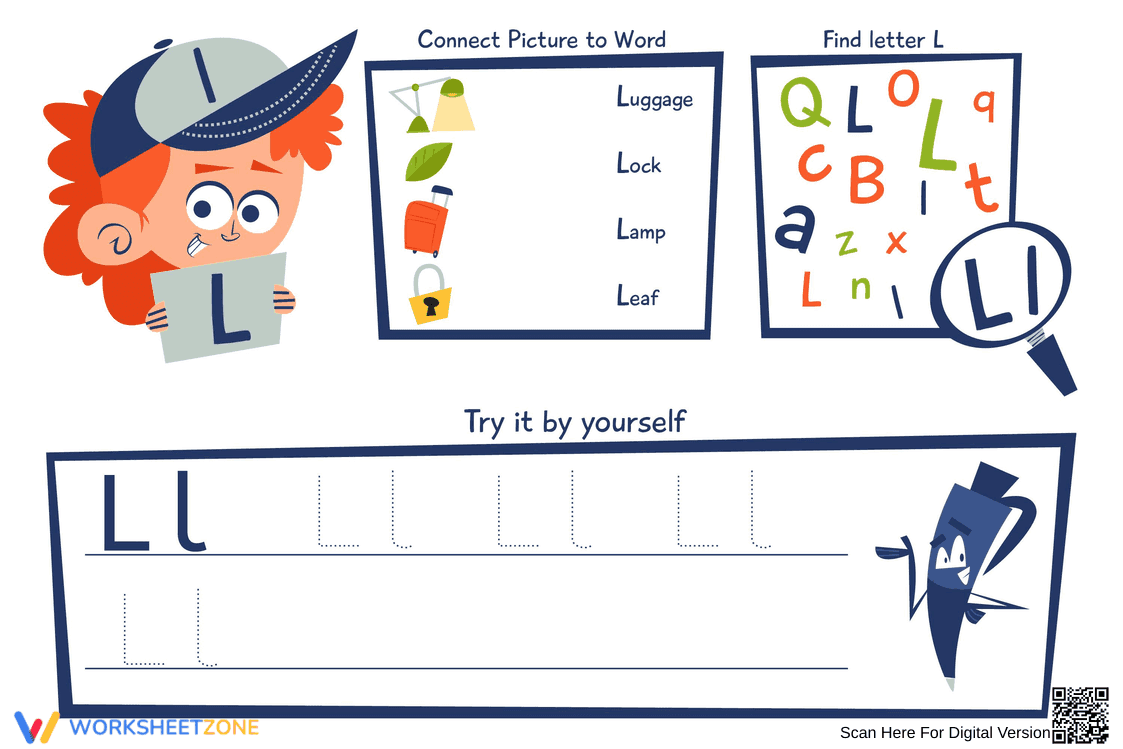

Grade 1 Letter L — Printable No-Prep Worksheet
Paste this activity's link or code into your existing LMS (Google Classroom, Canvas, Teams, Schoology, Moodle, etc.).
Students can open and work on the activity right away, with no student login required.
You'll still be able to track student progress and results from your teacher account.
This Grade 1 English worksheet provides focused practice on the letter L, helping students develop essential handwriting and phonics skills. By completing these activities, young learners will confidently recognize, trace, and write uppercase and lowercase forms while connecting the initial sound to familiar vocabulary words.
At a Glance
- Grade: 1 · Subject: English
- Standard:
CCSS.ELA-LITERACY.L.1.1.A— Print all upper- and lowercase letters- Skill Focus: Letter L recognition and tracing
- Format: 1 page · 3 tasks · No answer key · PDF
- Best For: Independent practice or morning work
- Time: 10–15 minutes
Inside this single-page resource, educators will find three distinct tasks designed to reinforce letter mastery. The first section features a vocabulary matching activity where students connect pictures like a lamp to their corresponding words. Next, a visual discrimination task asks children to find the letter L among mixed letters. Finally, the bottom section provides guided tracing lines for students to practice writing independently.
This resource is designed for a highly efficient, zero-prep workflow:
- Print (1 minute): Simply download the PDF and print.
- Distribute (1 minute): Hand out the sheets during morning work or literacy centers.
- Review (3 minutes): The intuitive layout means students can begin immediately, requiring less than two minutes of total teacher prep time. It is an excellent addition to any emergency sub plan.
This worksheet is tightly aligned to CCSS.ELA-LITERACY.L.1.1.A, which requires students to print all upper- and lowercase letters. It also supports foundational phonics skills by having students associate the initial sound with specific images. Both standard codes can be copied directly into lesson plans, IEP goals, or district curriculum mapping tools.
Teachers can deploy this worksheet during morning arrival to establish a focused routine before direct instruction begins. Alternatively, it serves as an effective literacy center station. As a formative assessment tip, observe students during the tracing section to ensure correct pencil grip and stroke order. The activity typically takes 10 to 15 minutes to complete.
This resource is primarily designed for first-grade students solidifying their alphabet knowledge and handwriting fluency. It is also beneficial for kindergarteners needing a challenge or second-graders requiring targeted intervention. For differentiation, teachers can provide a tactile alphabet card. This worksheet pairs perfectly with a classroom alphabet anchor chart.
Developing automaticity in letter formation is a critical stepping stone for early literacy success in the primary classroom. According to Fisher & Frey (2014), providing students with structured, repetitive practice in foundational skills significantly reduces cognitive load during more complex reading and writing tasks later on. This worksheet directly supports CCSS.ELA-LITERACY.L.1.1.A by requiring students to print all upper- and lowercase letters accurately. By combining handwriting practice with visual discrimination and phonics-based vocabulary matching, the activity ensures that learners are not just copying shapes, but actively connecting the letter L to its phonetic function in everyday words. Mastery of these basic transcription skills allows young writers to eventually focus their mental energy on idea generation and sentence composition rather than the mechanics of forming individual letters. This targeted, multimodal practice is essential for building confident, fluent readers and writers.


