


























Views
Downloads
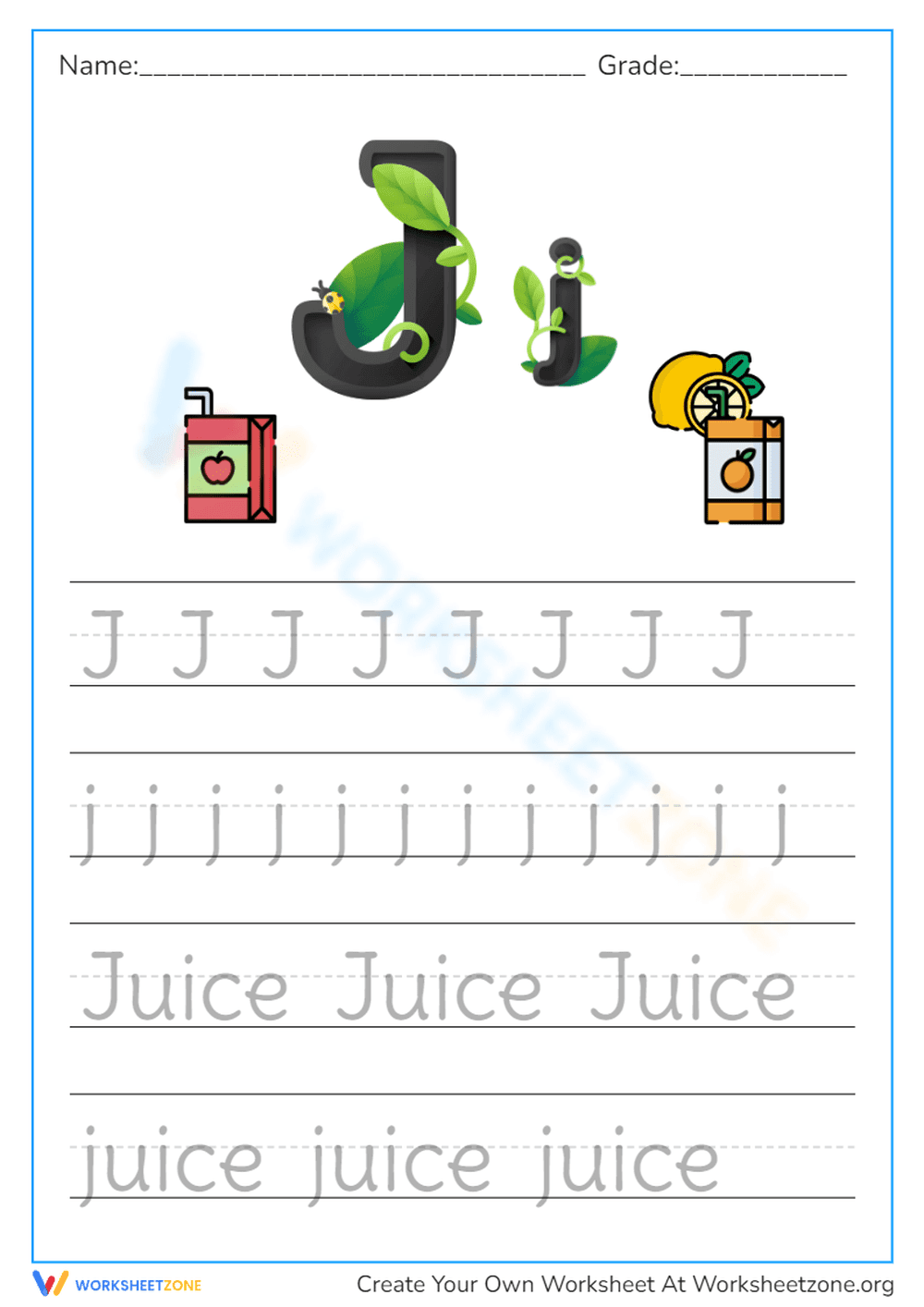

Letter J Tracing Worksheet | Grade K-1 Printable
Paste this activity's link or code into your existing LMS (Google Classroom, Canvas, Teams, Schoology, Moodle, etc.).
Students can open and work on the activity right away, with no student login required.
You'll still be able to track student progress and results from your teacher account.
This Grade K-1 Letter J tracing worksheet provides students with structured handwriting practice to master the formation of uppercase and lowercase letters. By tracing both individual characters and the word juice, learners build the muscle memory required for legible writing. This resource ensures students develop the fine motor control necessary for early literacy success.
At a Glance
- Grade: K-1 · Subject: English
- Standard:
CCSS.ELA-LITERACY.L.K.1.A— Print many upper- and lowercase letters accurately- Skill Focus: Letter J formation
- Format: 1 page · 26 tasks · No-prep · PDF
- Best For: Morning work or handwriting centers
- Time: 10–15 minutes
This single-page PDF features four distinct tracing rows. The first two rows focus on isolated character practice with 8 uppercase J and 12 lowercase j characters. The bottom half of the page transitions to word-level application, providing 3 instances of Juice and 3 instances of juice. Visual cues include colorful juice box illustrations to reinforce letter-sound association and engagement.
Zero-Prep Workflow
Teachers can integrate this resource into their daily routine in under 2 minutes. Simply print the required number of copies (30 seconds), distribute them to students during morning arrival or literacy centers (30 seconds), and conduct a quick visual review of stroke order as students work (1 minute). This worksheet is an ideal grab-and-go option for substitute folders or unexpected schedule changes.
Standards Alignment
The primary focus is `CCSS.ELA-LITERACY.L.K.1.A`, which requires students to print many upper- and lowercase letters. By providing specific paths for the letter J, the worksheet supports the foundational mechanics of writing. Both standard codes can be copied directly into lesson plans, IEP goals, or district curriculum mapping tools.
How to Use It
Use this worksheet during the independent practice phase of a handwriting lesson after demonstrating the hook stroke of the letter J on the board. It also serves as an effective formative assessment tool; observe if students start their strokes from the top line or bottom line to identify those needing additional intervention. Completion typically takes 10 to 15 minutes.
Who It's For
This resource is designed for Kindergarten and first-grade students beginning their handwriting journey. It is particularly helpful for learners requiring extra fine motor support. Pair this worksheet with a physical alphabet anchor chart or a Letter J phonics reader to create a comprehensive literacy experience for early childhood classrooms.
According to Fisher & Frey (2014), the gradual release of responsibility begins with clear modeling followed by guided practice like the 26 tracing tasks found in this worksheet. Research indicates that repetitive tracing of the letter J helps solidify the neural pathways required for automaticity in writing. By aligning with CCSS.ELA-LITERACY.L.K.1.A, this resource ensures that students are meeting national benchmarks for letter formation. The inclusion of the word juice provides a semantic context that aids in letter-sound recognition, a critical component of early decoding skills. This worksheet offers a structured environment where students can move from isolated letter production to word-level writing without the cognitive load of generating their own content. Such scaffolds are essential for building confidence in emerging writers during the Kindergarten and Grade 1 years.


