


























Views
Downloads
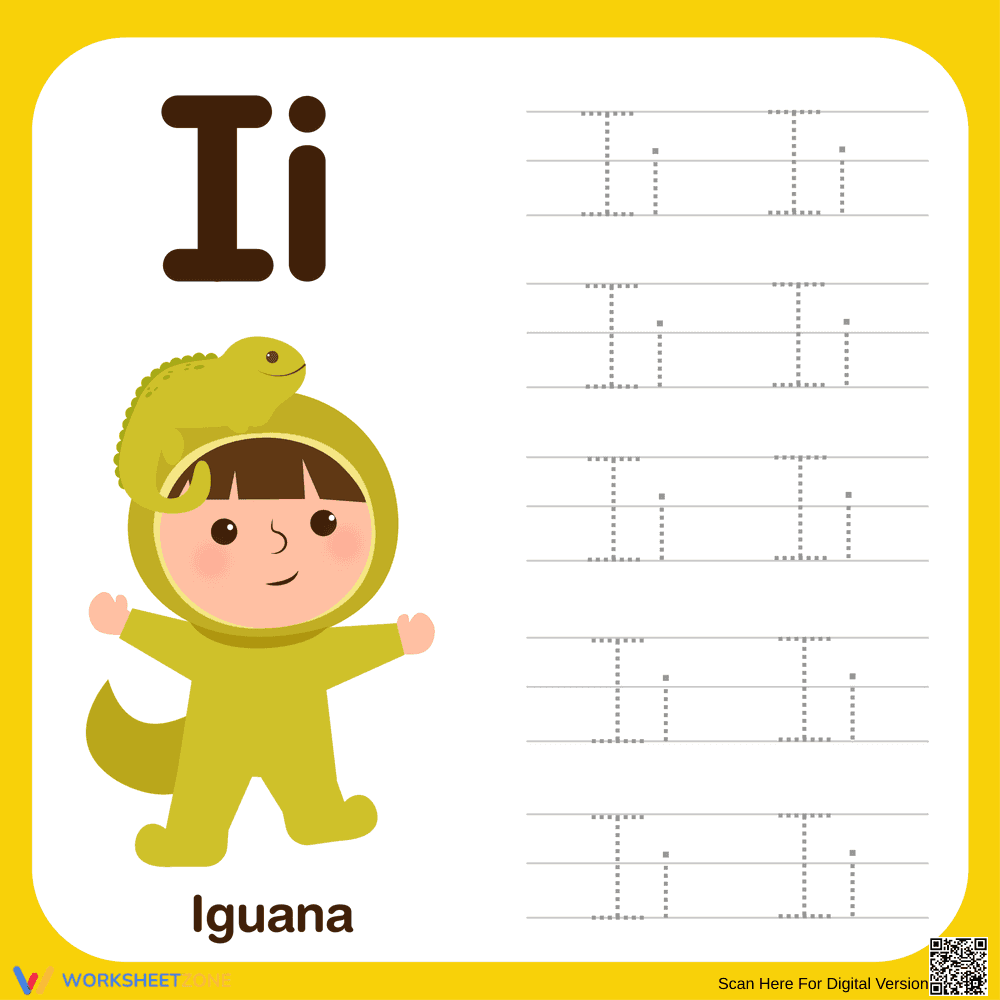

Letter I Tracing Worksheet | Essential Kindergarten ELA
Paste this activity's link or code into your existing LMS (Google Classroom, Canvas, Teams, Schoology, Moodle, etc.).
Students can open and work on the activity right away, with no student login required.
You'll still be able to track student progress and results from your teacher account.
This Letter I tracing worksheet helps early learners master uppercase and lowercase letter formation through repetitive practice. By focusing on the "I is for Iguana" theme, students connect phonemic awareness with fine motor development. This resource ensures students build the muscle memory required for fluent handwriting and alphabet recognition.
At a Glance
- Grade: Kindergarten · Subject: ELA
- Standard:
CCSS.ELA-LITERACY.RF.K.1.D— Recognize and name all upper- and lowercase letters of the alphabet- Skill Focus: Letter I Formation
- Format: 1 page · 10 tasks · No answer key needed · PDF
- Best For: Morning work or literacy centers
- Time: 10–15 minutes
Inside this single-page PDF, you will find a large visual anchor featuring an iguana character to reinforce the letter sound. The right side of the page contains five rows of guided tracing lines. Each row provides two sets of uppercase "I" and lowercase "i" pairs, totaling 10 practice opportunities for the student.
The worksheet follows a structured progression to build confidence. First, students observe the large "Ii" model and the iguana illustration. Next, they engage in guided practice by tracing the dotted lines for both letter cases. Finally, the repetitive layout encourages independent practice as students move down the page, refining their stroke order and letter sizing. This gradual-release approach supports early writing success through a simple I Do, We Do, You Do framework.
This resource aligns with `CCSS.ELA-LITERACY.RF.K.1.D`, which requires students to recognize and name all upper- and lowercase letters. It also supports foundational writing skills by emphasizing correct letter orientation and vertical stroke consistency. Both standard codes can be copied directly into lesson plans, IEP goals, or district curriculum mapping tools.
Use this worksheet during your initial introduction of the letter "I" to provide immediate tactile reinforcement. It works exceptionally well as a formative assessment tool; observe students to ensure they start their strokes from the top down. Expect completion within 10 to 15 minutes depending on the student's fine motor proficiency and previous exposure to the alphabet.
This activity is designed for preschool, kindergarten, and first-grade students who are developing foundational literacy skills. It is particularly helpful for English Language Learners (ELLs) who benefit from the visual animal association. Pair this with an alphabet anchor chart or a letter-sound song for a comprehensive lesson that targets multiple learning modalities.
According to the RAND AIRS 2024 report, repetitive tracing exercises are fundamental for developing the graphomotor skills necessary for early literacy. This Letter I worksheet addresses CCSS.ELA-LITERACY.RF.K.1.D by providing 10 specific tracing tasks that bridge the gap between letter recognition and production. Research from Fisher & Frey (2014) emphasizes that visual anchors, such as the iguana theme used here, help young learners retain phonemic information more effectively. By integrating uppercase and lowercase practice on a single page, this resource provides a high-density learning opportunity that fits easily into a standard 15-minute literacy block. Educators can use this tool to track progress in letter formation, ensuring that students meet developmental milestones for handwriting and alphabet mastery before transitioning to word-level writing tasks.


