


























Views
Downloads
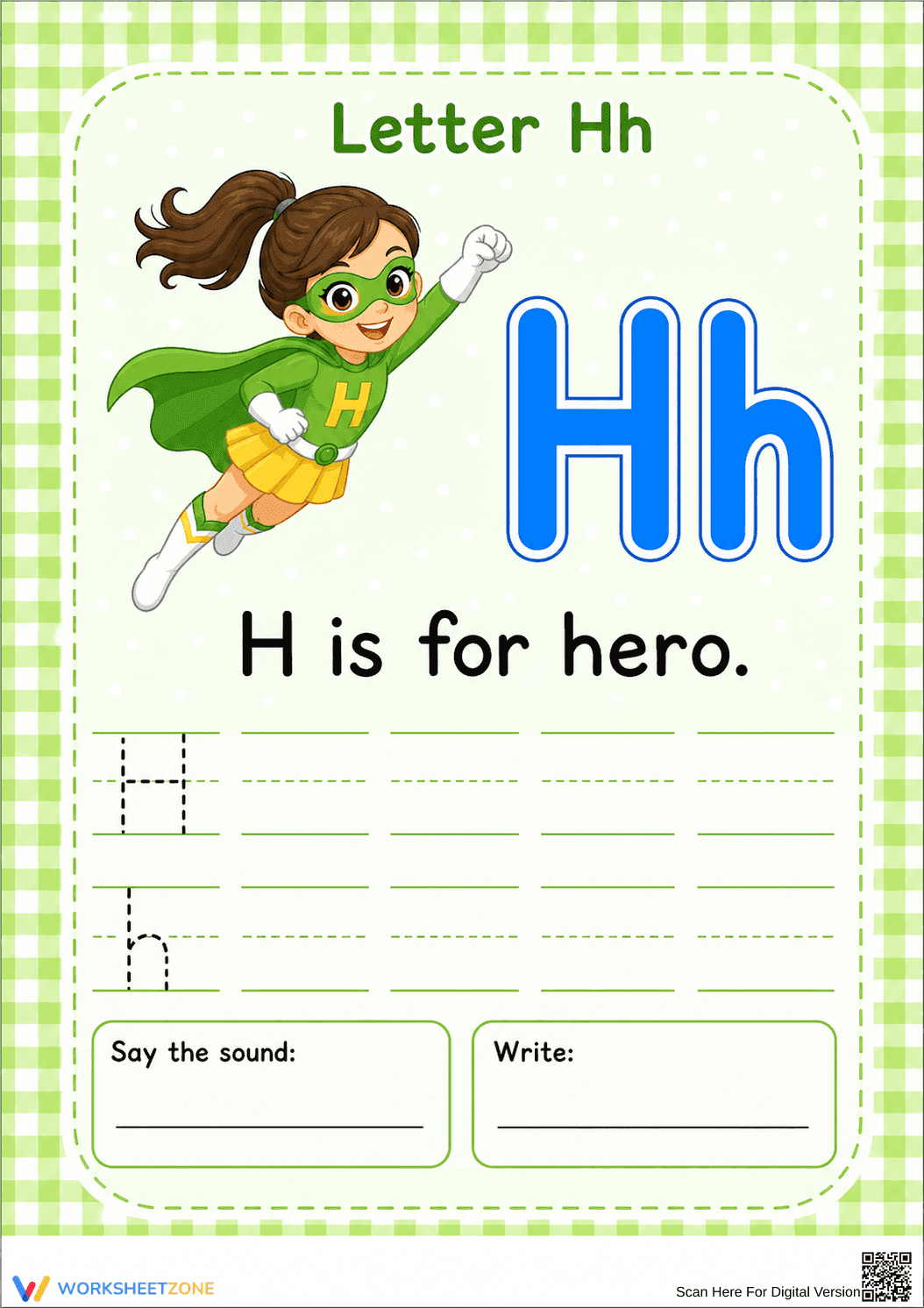

Letter H Beginning Sound Worksheet | Printable Grade K
Paste this activity's link or code into your existing LMS (Google Classroom, Canvas, Teams, Schoology, Moodle, etc.).
Students can open and work on the activity right away, with no student login required.
You'll still be able to track student progress and results from your teacher account.
This essential Letter H beginning sound worksheet helps early learners connect the letter H to its phoneme through visual cues and motor practice. Students identify the "H is for hero" anchor, trace letter forms, and practice vocalizing the sound. It provides a clear path toward phonemic awareness and foundational literacy for Kindergarten students.
At a Glance
- Grade: Kindergarten · Subject: ELA Phonics
- Standard:
CCSS.ELA-LITERACY.RF.K.3.A— Demonstrate basic knowledge of one-to-one letter-sound correspondences by producing the primary sound- Skill Focus: Letter H Beginning Sound
- Format: 1 page · 4 tasks · Answer key included · PDF
- Best For: Initial phonics instruction and handwriting practice
- Time: 10–15 minutes
What's Inside
This single-page PDF includes a vibrant "Hero" anchor image to reinforce the /h/ sound. It features two dedicated tracing rows for uppercase 'H' and lowercase 'h', a vocalization prompt to "Say the sound," and a free-writing box for independent letter formation. The layout is clean and distraction-free, perfect for young learners developing fine motor skills.
Skill Progression
- Guided Practice: Students trace 6 uppercase and 6 lowercase letters to establish correct stroke order and muscle memory.
- Supported Practice: Learners vocalize the /h/ sound while referencing the "Hero" visual anchor to strengthen phonemic associations.
- Independent Practice: The final writing box requires students to produce the letter H without dotted guides or scaffolding.
This sequence follows the gradual-release model, moving from high-support tracing to independent letter production.
Standards Alignment
This resource aligns with `CCSS.ELA-LITERACY.RF.K.3.A`, focusing on letter-sound correspondence. It also supports `CCSS.ELA-LITERACY.L.K.1.A` regarding printing many upper- and lowercase letters. Both standard codes can be copied directly into lesson plans, IEP goals, or district curriculum mapping tools.
How to Use It
- Instructional Moment: Assign this during the "You Do" portion of a phonics lesson after introducing the letter H with a physical anchor chart.
- Formative Assessment: Observe students as they complete the "Say the sound" box; check if they can produce the /h/ sound without adding a schwa.
Expected completion time is 10 to 15 minutes depending on the student's fine motor development.
Who It's For
This is designed for Kindergarten students beginning their phonics journey, but it also serves Grade 1 students needing remedial support. It pairs naturally with a letter-of-the-week curriculum or a "Hero" themed reading unit for early English Language Arts.
Research from Fisher & Frey (2014) emphasizes the importance of the gradual release of responsibility in early literacy, moving from modeled tracing to independent production. This worksheet applies that framework by providing 4 distinct tasks that bridge the gap between letter recognition and phonemic production. According to the NAEP, early mastery of letter-sound correspondence is one of the strongest predictors of later reading success. By focusing on the specific /h/ sound through the `CCSS.ELA-LITERACY.RF.K.3.A` standard, this resource ensures students develop the necessary decoding skills required for Grade 1 fluency. The inclusion of both uppercase and lowercase tracing helps solidify orthographic mapping, a critical component of the Science of Reading. Educators can use this 1-page tool to provide targeted intervention or as a standard part of a comprehensive phonics curriculum, ensuring every student meets foundational benchmarks for early English Language Arts.


