


























Views
Downloads
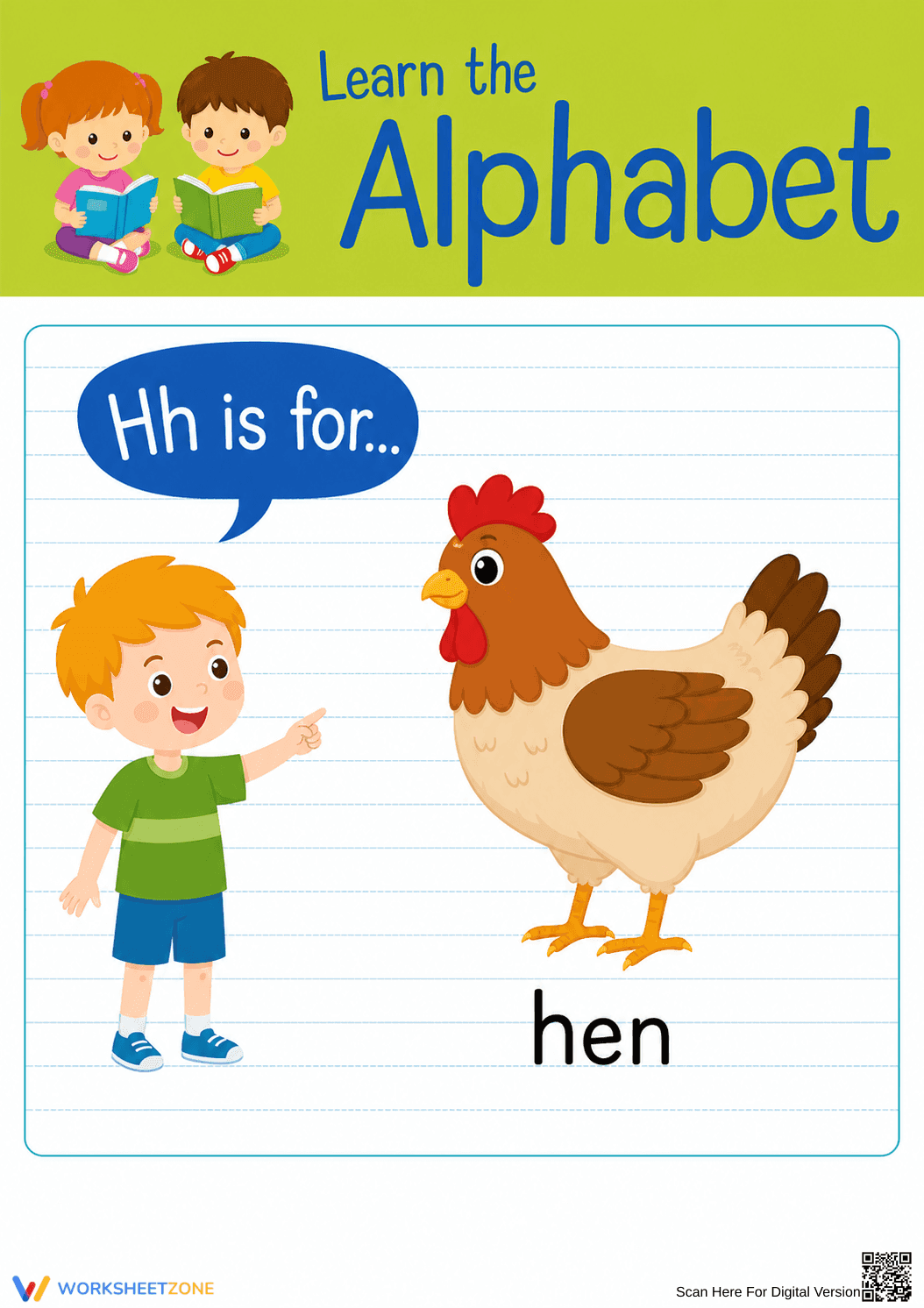

Printable Letter H Beginning Sound Worksheet | Grade K ELA
Paste this activity's link or code into your existing LMS (Google Classroom, Canvas, Teams, Schoology, Moodle, etc.).
Students can open and work on the activity right away, with no student login required.
You'll still be able to track student progress and results from your teacher account.
This foundational phonics resource helps early learners master the beginning sound of the letter H. By connecting the visual letter with a familiar vocabulary word, students build essential letter-sound correspondence skills. This single-page tool provides clear reinforcement for early reading success.
At a Glance
- Grade: K · Subject: ELA
- Standard:
CCSS.ELA-LITERACY.RF.K.3.A— Produce primary sounds for consonants- Skill Focus: Letter H Beginning Sound
- Format: 1 page · 1 visual task · No answer key needed · PDF
- Best For: Whole group instruction
- Time: 5–10 minutes
Inside this resource, educators will find a single anchor page designed to introduce the letter H. The page features an engaging illustration of a hen alongside a character demonstrating the target sound. The text explicitly links the letter forms to the target word, providing a complete phonetic package. No separate answer key is required.
This resource supports a structured approach to phonics acquisition:
- Guided practice: Teachers use the visual anchor to introduce the letter H, modeling the /h/ sound.
- Supported practice: Students repeat the sound and the word "hen," connecting the spoken phoneme to the printed grapheme.
- Independent practice: Learners reference this chart independently during reading centers to recall the primary sound.
This progression aligns with the gradual-release model of I Do, We Do, You Do.
This material is directly aligned to CCSS.ELA-LITERACY.RF.K.3.A: "Demonstrate basic knowledge of one-to-one letter-sound correspondences by producing the primary sound or many of the most frequent sounds for each consonant." It also supports early vocabulary development by pairing the target letter with a concrete noun. Both standard codes can be copied directly into lesson plans, IEP goals, or district curriculum mapping tools.
This visual anchor is highly versatile for early childhood classrooms. Use it during morning meeting or whole-group phonics instruction to introduce the letter of the week. Alternatively, display it in a literacy center as a reference tool for students working on beginning sound sorts. As a formative assessment tip, observe whether students can independently produce the /h/ sound when pointing to the poster before moving on to other activities. Expected completion time for the initial introduction is 5 to 10 minutes.
This resource is primarily designed for Kindergarten students beginning their formal phonics instruction, though it is also appropriate for Pre-K learners or first-grade students needing foundational review. For differentiation, teachers can challenge advanced students to brainstorm additional words starting with the same sound. It pairs excellently with tactile letter-tracing activities or a direct instruction lesson on consonant sounds.
Mastering the letter H beginning sound is a critical step in early literacy development. According to a recent RAND AIRS 2024 report, explicit instruction in letter-sound correspondence significantly accelerates decoding proficiency in early readers. When students practice how to produce primary sounds for consonants, as outlined in CCSS.ELA-LITERACY.RF.K.3.A, they build the necessary neural pathways for fluent reading. Visual anchors that pair a target grapheme with a highly recognizable image, such as a hen, reduce cognitive load and provide a concrete reference point for abstract phonetic concepts. This targeted approach ensures that foundational phonics skills are firmly established before students transition to more complex blending and segmenting tasks. Consistent exposure to these clear, focused visual tools supports long-term retention and reading confidence across diverse learning profiles in the early childhood classroom.


