


























Views
Downloads

Letter G Handwriting Practice | Essential Grade K-1
Paste this activity's link or code into your existing LMS (Google Classroom, Canvas, Teams, Schoology, Moodle, etc.).
Students can open and work on the activity right away, with no student login required.
You'll still be able to track student progress and results from your teacher account.
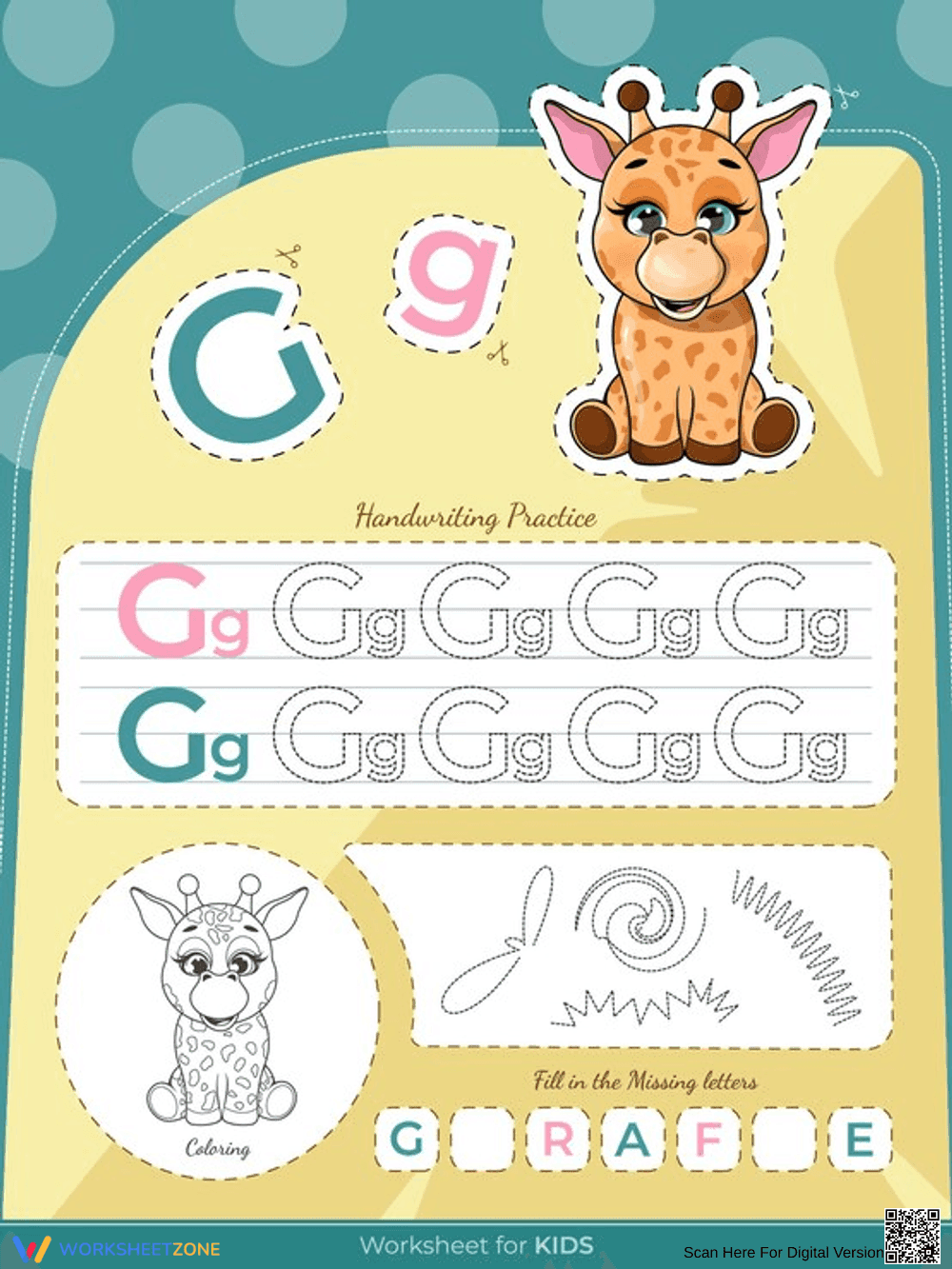
This Letter G handwriting practice worksheet provides a comprehensive approach to early literacy by combining tactile tracing with visual recognition. Students master the formation of both uppercase 'G' and lowercase 'g' while engaging with a friendly giraffe theme that maintains interest throughout the lesson. By integrating coloring and spelling, the resource ensures that young learners develop the necessary dexterity for legible penmanship.
At a Glance
- Grade: Kindergarten · Subject: English
- Standard:
CCSS.ELA-LITERACY.L.K.1.A— Print many upper- and lowercase letters accurately- Skill Focus: Letter G formation
- Format: 1 page · 15 tasks · Answer key included · PDF
- Best For: Morning work or literacy centers
- Time: 15–20 minutes
What's Inside: The single-page PDF features 8 sets of guided tracing for the "Gg" pair, three distinct line-tracing paths to build hand-eye coordination, a giraffe coloring illustration, and a "Fill in the Missing Letters" activity for the word "GIRAFFE." The layout is designed to be visually stimulating without being overwhelming for five- and six-year-old students.
Zero-Prep Workflow
- Print: Generate copies for your entire class in under 30 seconds.
- Distribute: Hand out the sheets during your phonics block or as a quiet transition activity.
- Review: Quickly check for proper stroke order and letter orientation as students complete the spelling puzzle.
Total teacher preparation time is under 2 minutes, making this an ideal resource for sub plans or unexpected schedule changes.
Standards Alignment
The primary standard addressed is `CCSS.ELA-LITERACY.L.K.1.A`, which focuses on the student's ability to print many upper- and lowercase letters. This worksheet ensures students can distinguish between case types and apply them to a specific vocabulary word. Both standard codes can be copied directly into lesson plans, IEP goals, or district curriculum mapping tools.
How to Use It
Use this worksheet as a formative assessment during the "G" week of your alphabet curriculum. It is best assigned after direct instruction on letter formation so students can practice the specific motor movements independently. Teachers should circulate during the activity to observe pencil grip and ensure students are following the dashed lines from top to bottom. Expected completion time ranges from 15 to 20 minutes depending on the student's coloring speed.
Who It's For
This resource is designed for Kindergarteners and early Grade 1 students who are developing foundational writing skills. It serves as an excellent intervention tool for students needing extra fine motor support. Pair this worksheet with a giraffe-themed picture book or an anchor chart showing the letter G to reinforce the phonetic connection.
According to Fisher & Frey (2014), the gradual release of responsibility begins with clear modeling of foundational skills like letter formation. This worksheet supports that model by providing dashed-line scaffolds that transition into independent letter placement. Research from the RAND AIRS 2024 report emphasizes that multisensory engagement—combining coloring, tracing, and spelling—increases retention of phonemic awareness in early childhood settings. By focusing on a single letter within a thematic context, students are more likely to internalize the specific motor patterns required for legible handwriting. The inclusion of a spelling component further bridges the gap between simple penmanship and functional literacy, ensuring that the standard CCSS.ELA-LITERACY.L.K.1.A is met through diverse instructional modalities.


