




























Views
Downloads
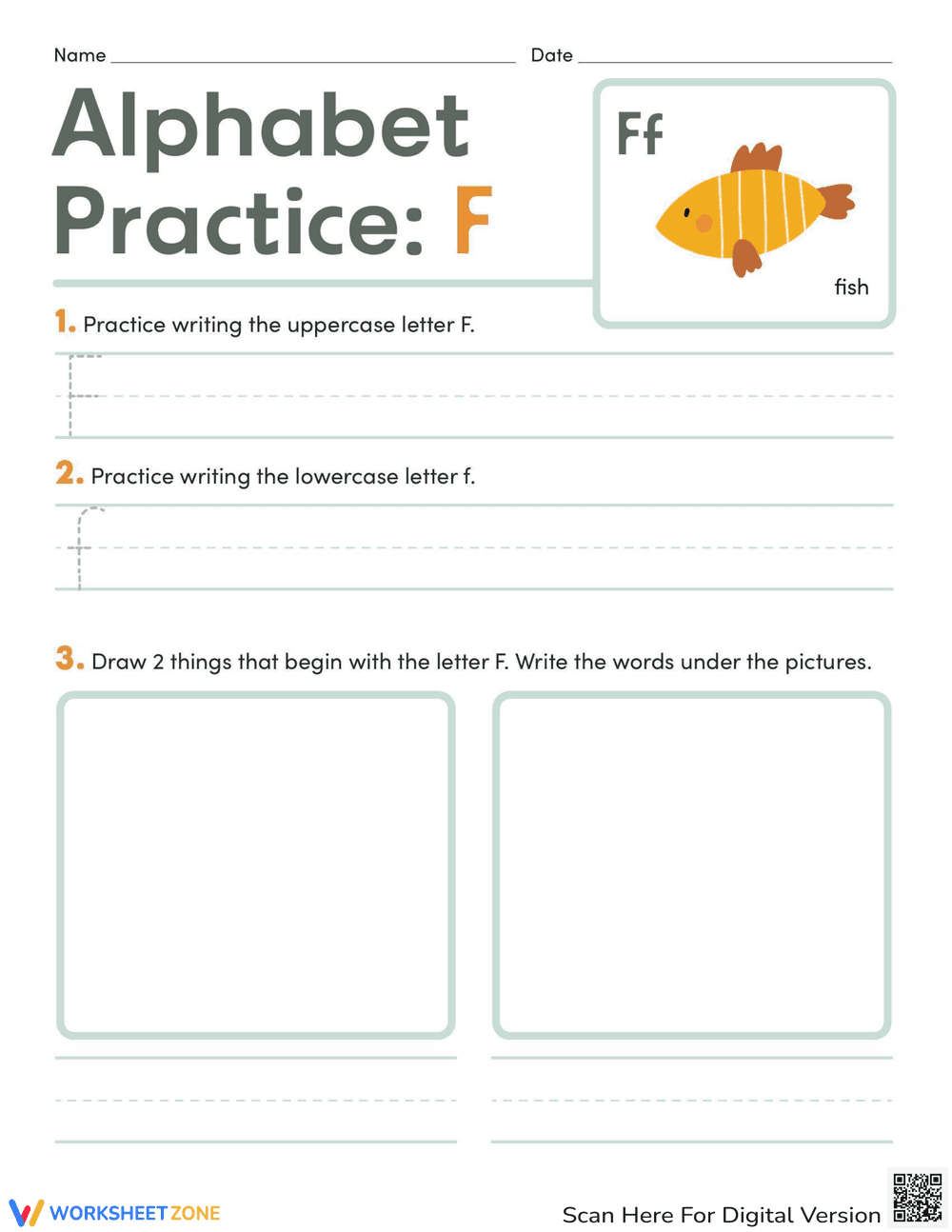

Grade K Letter F Practice — Printable No-Prep Worksheet

Paste this activity's link or code into your existing LMS (Google Classroom, Canvas, Teams, Schoology, Moodle, etc.).
Students can open and work on the activity right away, with no student login required.
You'll still be able to track student progress and results from your teacher account.
This foundational handwriting and phonics worksheet develops essential letter recognition and formation skills for the letter F. Students establish proper motor memory by practicing uppercase and lowercase strokes before connecting symbols to initial phonemes through vocabulary drawing. This structured practice builds early literacy confidence and reinforces sound-symbol correspondence.
At a Glance
- Grade: Kindergarten · Subject: ELA
- Standard:
CCSS.ELA-LITERACY.L.K.1.A— Print many upper- and lowercase letters correctly- Skill Focus: Letter F formation and beginning phonics
- Format: 1 page · 3 problems · Answer key included · PDF
- Best For: Independent practice and morning work
- Time: 15–20 minutes
This 1-page worksheet features three tasks designed to reinforce letter mastery. The first two sections provide guided tracing lines for uppercase F and lowercase f, followed by independent writing space. The third section offers two illustration boxes where students draw objects beginning with the /f/ sound and write corresponding words below. A complete answer key with sample vocabulary is included.
Zero-Prep Workflow
This worksheet is engineered for immediate classroom deployment, requiring zero advanced teacher preparation or specialized materials:
- Print (30 seconds): Generate clean PDF copies directly. The single-page layout minimizes paper usage and prints perfectly in grayscale.
- Distribute (30 seconds): Hand out sheets during morning transitions. The clear visual layout allows young learners to understand expectations immediately.
- Review (45 seconds): Use the included answer key to quickly verify proper letter formation and accurate initial sound identification.
With total teacher preparation time under two minutes, this resource serves as an ideal emergency substitute plan or morning work activity.
Standards Alignment
This resource aligns to primary standard CCSS.ELA-LITERACY.L.K.1.A, requiring students to print many upper- and lowercase letters. Additionally, the vocabulary illustration exercise supports CCSS.ELA-LITERACY.RF.K.3.A by asking students to demonstrate basic knowledge of one-to-one letter-sound correspondences through identifying words with the initial /f/ sound. Both standard codes can be copied directly into lesson plans, IEP goals, or district curriculum mapping tools.
How to Use It
This worksheet functions effectively across multiple settings. Teachers can deploy it immediately after direct instruction in phonics lessons to solidify letter formation mechanics. Alternatively, it serves as an independent literacy center station. As a formative-assessment observation tip, educators should monitor pencil grip and stroke directionality during tracing to correct improper habits early. Expected completion time ranges from 15 to 20 minutes.
Who It's For
This worksheet is designed for kindergarten students and early first graders needing foundational review. For differentiation, teachers can support developing writers by providing an anchor chart of familiar 'F' words to assist with the drawing section. Advanced students can write complete sentences rather than single words. This activity pairs naturally with a direct instruction lesson on consonant sounds.
Effective early literacy instruction requires explicit practice connecting motor skills with phonemic awareness. This worksheet addresses CCSS.ELA-LITERACY.L.K.1.A by providing structured opportunities for young learners to print uppercase and lowercase letters correctly while identifying initial consonant sounds. According to research highlighted in EdReports 2024, foundational skills materials that integrate direct handwriting instruction with phonics application significantly improve letter automaticity and reading readiness in early grades. By combining tactile letter tracing with generative vocabulary illustration, this resource reinforces the neural pathways necessary for fluent reading and writing. The clear, single-page format ensures cognitive focus remains entirely on skill acquisition rather than complex task navigation. Providing immediate, high-quality practice aligned to rigorous academic standards supports long-term literacy development and ensures students establish the essential building blocks for future academic success.


