


























Views
Downloads

Essential Letter C Beginning Sound Worksheet | Grade K
Paste this activity's link or code into your existing LMS (Google Classroom, Canvas, Teams, Schoology, Moodle, etc.).
Students can open and work on the activity right away, with no student login required.
You'll still be able to track student progress and results from your teacher account.
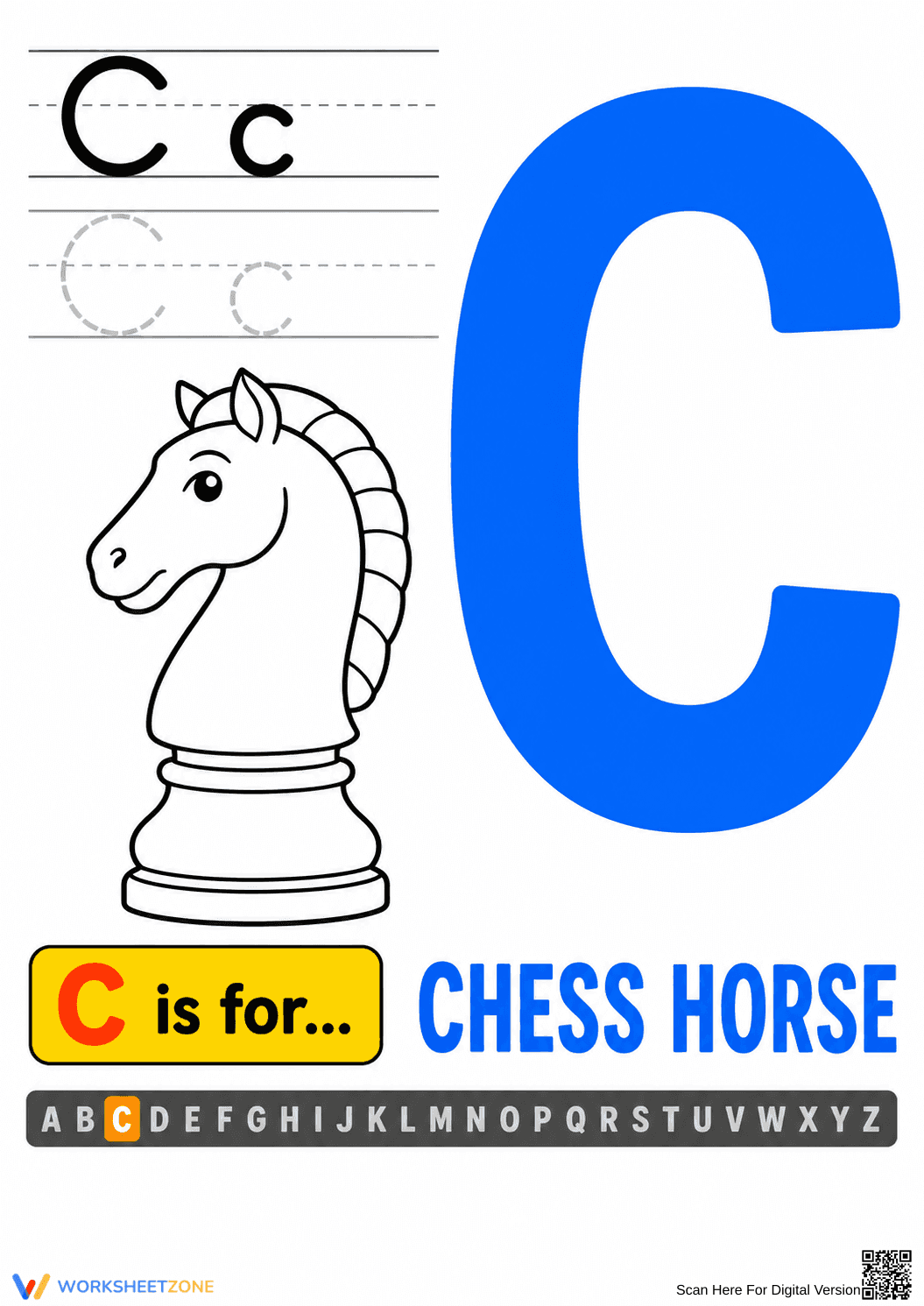
This Essential Letter C Beginning Sound worksheet helps early learners identify and produce the /k/ sound through visual association and tactile tracing. Students connect the letterform to a concrete object, reinforcing phonemic awareness and letter-sound correspondence. This foundational resource ensures students recognize the letter C in both uppercase and lowercase formats while building fine motor skills.
At a Glance
- Grade: Kindergarten · Subject: ELA Phonics & Reading
- Standard:
CCSS.ELA-LITERACY.RF.K.3.A— Produce the primary sound for the letter C in isolation- Skill Focus: Letter C recognition, tracing, and beginning sounds
- Format: 1 page · 3 tasks · Answer key included · PDF
- Best For: Initial phonics instruction and letter recognition
- Time: 10–15 minutes
What's Inside
Inside this single-page PDF, you will find a clear, high-contrast layout designed for young learners. It features large uppercase and lowercase tracing guides with dashed lines to support proper letter formation. The worksheet includes a prominent "Chess Horse" illustration to anchor the beginning sound, alongside a full alphabet strip that highlights the letter's position in the sequence.
Skill Progression
The worksheet follows a structured skill progression to ensure student success. First, **Guided practice** involves tracing the uppercase and lowercase C on provided lines to establish muscle memory. Next, **Supported practice** uses the large visual anchor of the "Chess Horse" to link the visual letter to its phoneme. Finally, **Independent practice** allows students to identify the letter's position within the alphabet bar. This gradual-release model moves from mechanical tracing to conceptual sound association.
Standards Alignment
This resource is aligned with `CCSS.ELA-LITERACY.RF.K.3.A`, which requires students to demonstrate basic knowledge of one-to-one letter-sound correspondences. It also supports `CCSS.ELA-LITERACY.RF.K.1.D` by helping students recognize and name all upper- and lowercase letters of the alphabet. Both standard codes can be copied directly into lesson plans, IEP goals, or district curriculum mapping tools.
How to Use It
Use this worksheet during the "You Do" portion of a phonics lesson after introducing the letter C. It works well as a morning work activity or a literacy center rotation. For a formative assessment, observe if students can correctly name the "Chess Horse" and emphasize the initial /k/ sound. Completion typically takes 10 to 15 minutes depending on fine motor proficiency.
Who It's For
This worksheet is designed for Kindergarten students, but it is also suitable for Grade 1 students requiring RTI support or English Language Learners (ELLs) building basic vocabulary. It pairs naturally with a letter C anchor chart or a phonics reader focusing on hard 'C' sounds. The high-contrast design is particularly helpful for students with visual processing needs.
According to Fisher & Frey (2014), the integration of visual anchors with tactile tracing is a fundamental component of the gradual release of responsibility in early literacy. This worksheet applies those principles by providing a clear "Chess Horse" visual to ground the abstract letter C in a concrete noun. By focusing on CCSS.ELA-LITERACY.RF.K.3.A, the resource targets the primary sound-symbol relationship necessary for decoding. Research indicates that consistent exposure to letter-sound correspondence in isolation, followed by word-level application, significantly improves reading readiness scores. This 1-page tool provides the 3 specific tasks required to move a student from simple recognition to phonemic production. Educators can utilize this structured approach to ensure that 100% of students meet the foundational benchmarks for alphabetic principle mastery before progressing to complex blending.


