


























Views
Downloads
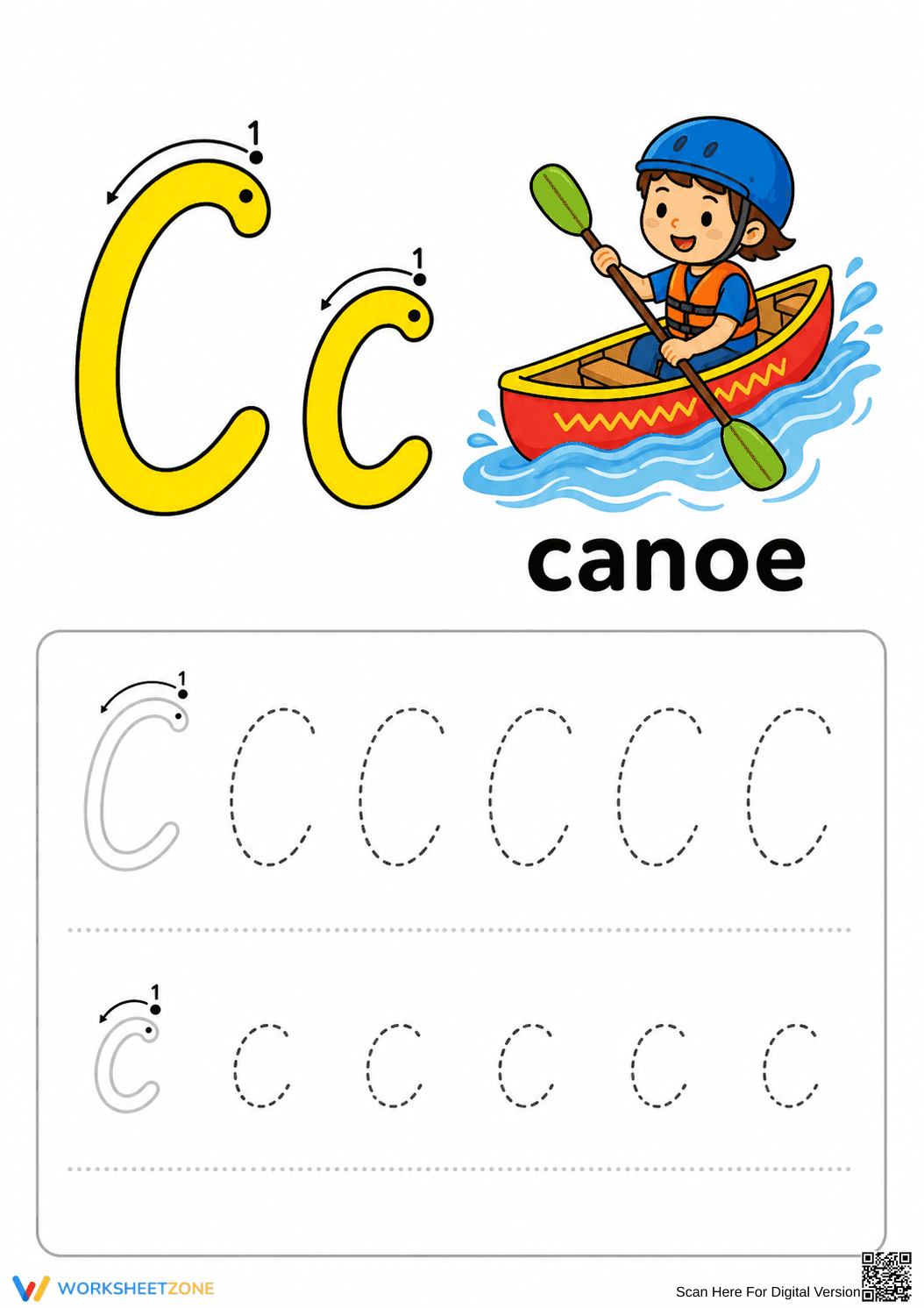

Printable Letter C Tracing Worksheet | Grade K ELA
Paste this activity's link or code into your existing LMS (Google Classroom, Canvas, Teams, Schoology, Moodle, etc.).
Students can open and work on the activity right away, with no student login required.
You'll still be able to track student progress and results from your teacher account.
This printable Kindergarten phonics worksheet helps students master the letter C through guided tracing and beginning sound recognition. By practicing both uppercase and lowercase letter formation alongside a visual cue for the word "canoe," early learners build essential fine motor skills and foundational literacy capabilities.
At a Glance
- Grade: K · Subject: ELA
- Standard:
CCSS.ELA-LITERACY.L.K.1.A— Print many upper- and lowercase letters- Skill Focus: Letter C Tracing and Sound
- Format: 1 page · 12 problems · No answer key · PDF
- Best For: Independent practice
- Time: 5–10 minutes
Inside this single-page resource, educators will find a clear layout designed for early writers. The top section features large models of the uppercase and lowercase letter C, with numbered arrows guiding proper stroke order. An illustration of a canoe reinforces the beginning sound. Below, students complete 12 tracing tasks across two rows—one for uppercase and one for lowercase—using dashed lines to support accurate formation.
Zero-Prep Workflow
This resource is designed for immediate classroom implementation.
- Print (1 minute): Simply download the PDF and print the required number of copies. The black-and-white tracing sections ensure crisp reproduction.
- Distribute (1 minute): Hand out the worksheets along with pencils or crayons. The visual instructions make the task immediately clear to young learners.
- Review (1 minute): Quickly check student grip and stroke direction as they work. Total teacher prep time is under two minutes, making this an excellent option for morning work or emergency sub plans.
Standards Alignment
This worksheet is directly aligned to CCSS.ELA-LITERACY.L.K.1.A, requiring students to print many upper- and lowercase letters. It also supports foundational phonics skills by connecting the visual letter symbol to its corresponding beginning sound. Both standard codes can be copied directly into lesson plans, IEP goals, or district curriculum mapping tools.
How to Use It
Integrate this tracing activity into your morning routine as a focused starter task before direct instruction. Alternatively, use it during small group literacy centers where you can closely monitor pencil grip and stroke sequence. As a formative assessment tip, watch to see if students start their letters at the top line as indicated by the arrows, rather than pushing the pencil up from the bottom. Most students will complete this activity within a 5 to 10-minute timeframe.
Who It's For
This worksheet is primarily designed for Kindergarten students developing basic handwriting and phonics skills. It is also highly effective for preschool students ready for structured letter practice, or first-grade students requiring targeted remediation in letter formation. For differentiation, provide textured surfaces underneath the paper for students who need tactile feedback. Pair this resource with a read-aloud book featuring words that start with the letter C to reinforce the sound-symbol connection.
Mastering early handwriting skills like those aligned to CCSS.ELA-LITERACY.L.K.1.A, where students print many upper- and lowercase letters, is a critical step in early literacy development. According to a comprehensive EdReports 2024 review of foundational reading materials, explicit instruction in letter formation combined with phonemic awareness activities significantly improves long-term reading fluency and writing stamina. When young learners practice tracing the letter C while simultaneously associating it with a familiar word like canoe, they build robust neural pathways connecting motor memory to phonetic decoding. This dual-coding approach ensures that students do not just memorize shapes, but actively understand the functional role of letters in written communication. Consistent, guided practice with directional arrows reduces letter reversals and establishes the automaticity required for more complex writing tasks in later grades.


