


























Views
Downloads
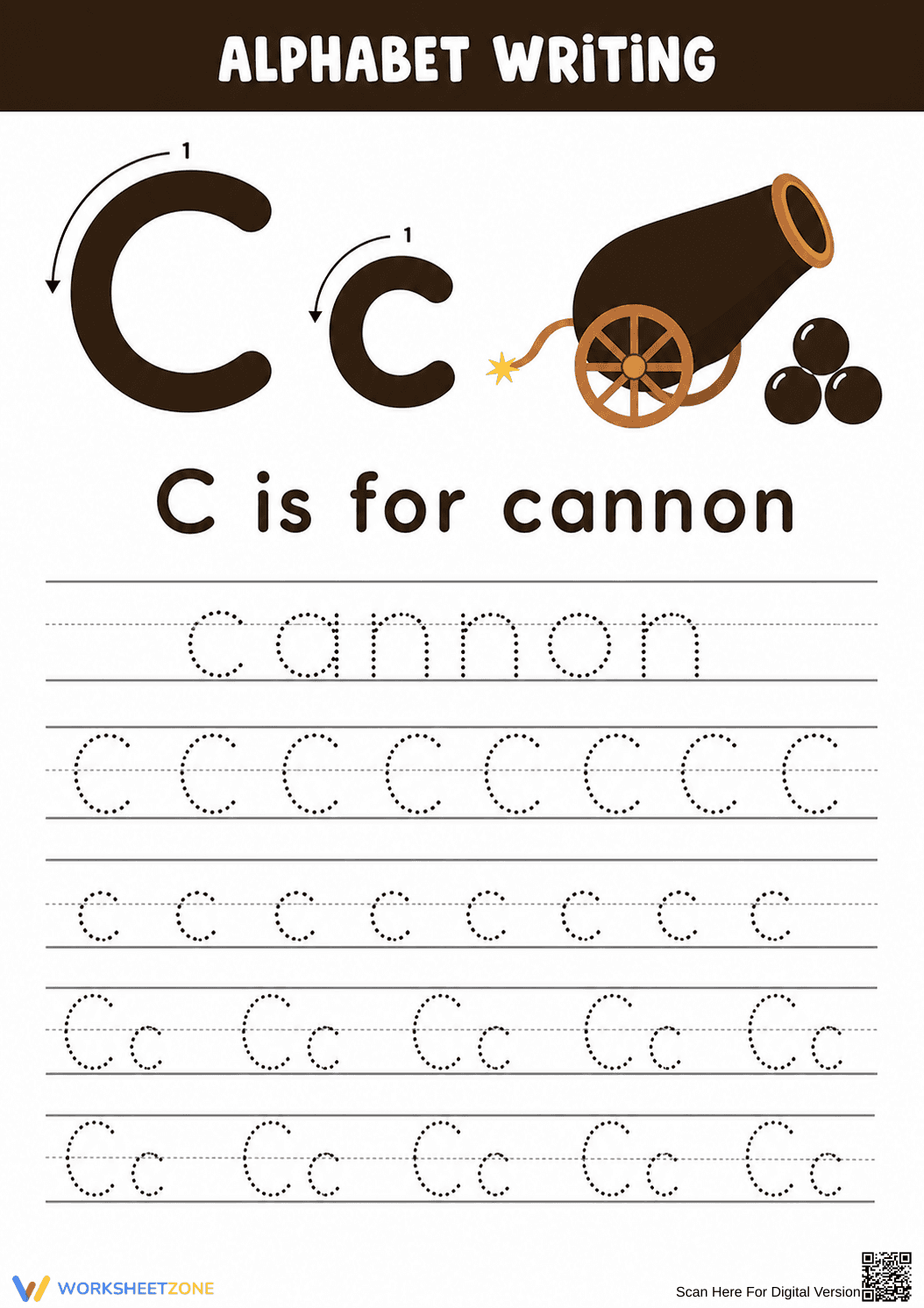

Printable Letter C Tracing Worksheet | Grade K Ready
Paste this activity's link or code into your existing LMS (Google Classroom, Canvas, Teams, Schoology, Moodle, etc.).
Students can open and work on the activity right away, with no student login required.
You'll still be able to track student progress and results from your teacher account.
This foundational Kindergarten handwriting worksheet helps early learners master the formation of the letter C. By combining visual cues with structured tracing exercises, students develop essential fine motor skills and reinforce beginning phonics sounds. The clear layout ensures young writers can confidently practice both uppercase and lowercase letters.
At a Glance
- Grade: Kindergarten · Subject: ELA
- Standard:
CCSS.ELA-LITERACY.L.K.1.A— Print many upper- and lowercase letters- Skill Focus: Letter C formation and tracing
- Format: 1 page · 5 tracing rows · No answer key needed · PDF
- Best For: Independent morning work
- Time: 10–15 minutes
This single-page printable features a guided example of uppercase and lowercase C with directional arrows. An illustration of a cannon connects the letter to its beginning sound. Students complete five rows of dashed-line tracing practice. The progression starts with the word "cannon," moves to isolated uppercase letters, transitions to lowercase, and finishes with alternating pairs to solidify spatial awareness.
This resource offers a zero-prep workflow:
- Print (1 minute): Generate copies directly from the PDF file.
- Distribute (1 minute): Hand out during morning arrival; the intuitive layout requires minimal instruction.
- Review (1 minute): Quickly scan student work for proper stroke direction.
With under two minutes of total teacher preparation, this activity is excellent for emergency sub plans or daily literacy centers.
This handwriting practice is directly aligned to CCSS.ELA-LITERACY.L.K.1.A, requiring students to print many upper- and lowercase letters. It also supports foundational phonics skills by associating the letter C with its primary consonant sound. Both standard codes can be copied directly into lesson plans, IEP goals, or district curriculum mapping tools.
Deploy this worksheet as morning work following a whole-group phonics lesson on the letter C. Students can independently trace while the teacher handles morning routines. Alternatively, use it in a small-group literacy center. Observe students to ensure they start pencil strokes at the top line, following the arrows. Expected completion time is 10 to 15 minutes.
This resource is primarily designed for Kindergarten students developing basic print concepts and fine motor control. It is also highly effective for pre-K students who are ready for early handwriting exposure, or first-grade students requiring targeted intervention for letter reversals. For a comprehensive literacy block, pair this tracing sheet with a read-aloud book that heavily features the hard C sound, or an interactive anchor chart displaying other C-word vocabulary.
Mastering letter formation is a critical stepping stone in early childhood literacy. According to research from Fisher & Frey (2014), explicit instruction in handwriting and letter recognition significantly impacts a student's subsequent reading fluency and written expression capabilities. When young learners practice printing upper- and lowercase letters, as outlined in CCSS.ELA-LITERACY.L.K.1.A, they build the necessary automaticity to free up cognitive resources for higher-level composition tasks later on. This specific worksheet facilitates that automaticity by providing structured, repetitive tracing exercises that reinforce correct stroke pathways. By integrating the visual cue of the cannon, the activity simultaneously strengthens the phoneme-grapheme connection, ensuring students not only know how to write the letter but also understand its phonetic function within words. This dual-purpose approach maximizes instructional efficiency during foundational literacy blocks.


