


























Views
Downloads
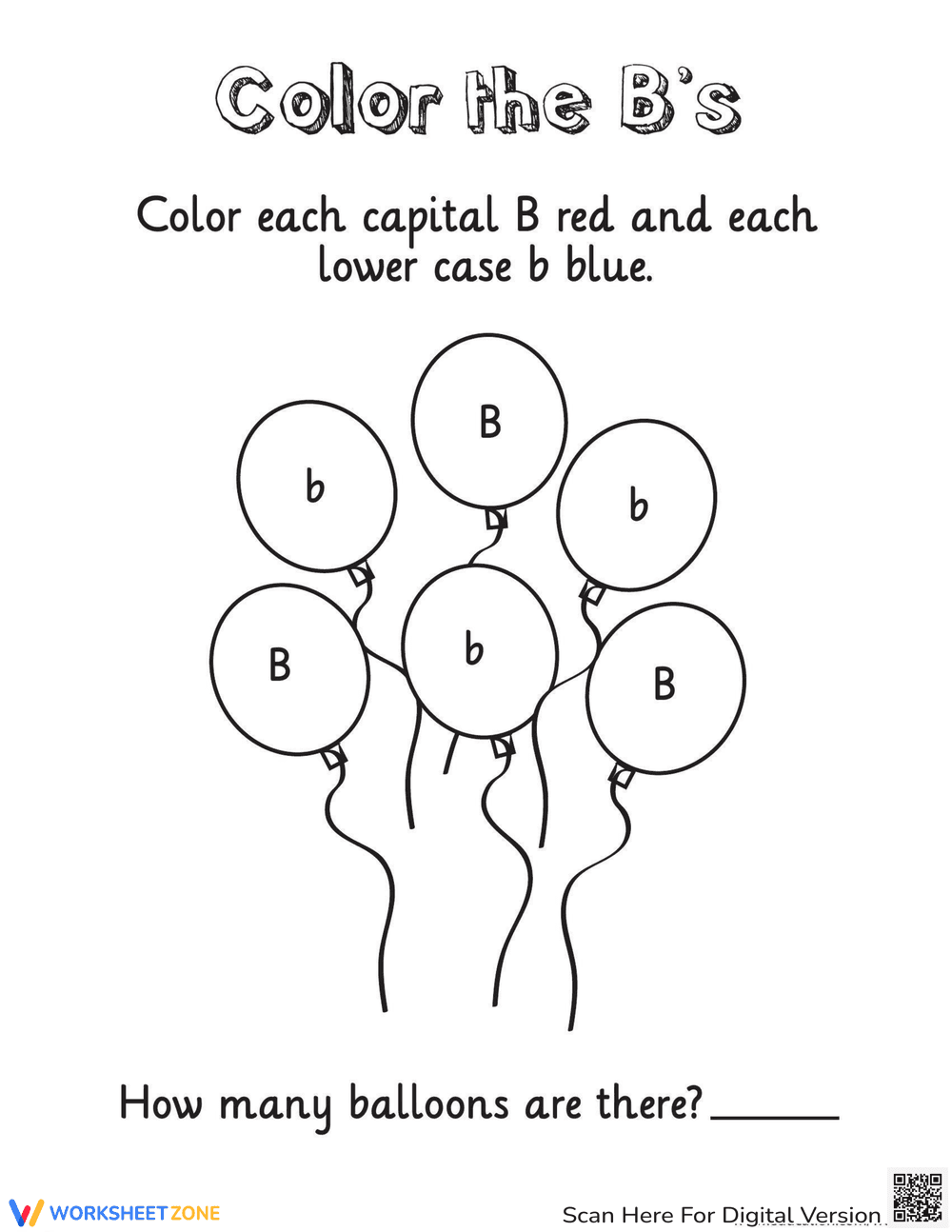

Printable Letter B Recognition Worksheet for Kindergarten
Paste this activity's link or code into your existing LMS (Google Classroom, Canvas, Teams, Schoology, Moodle, etc.).
Students can open and work on the activity right away, with no student login required.
You'll still be able to track student progress and results from your teacher account.
This printable Kindergarten ELA worksheet helps young learners master letter recognition by distinguishing between uppercase and lowercase letter B. Students color balloons based on letter case and practice basic counting. This activity builds foundational reading readiness and fine motor skills.
At a Glance
- Grade: Kindergarten · Subject: English Language Arts
- Standard:
RF.K.1.D— Recognize and name all uppercase and lowercase letters- Skill Focus: Letter B identification and counting
- Format: 1 page · 7 tasks · No answer key · PDF
- Best For: Morning work and letter introduction
- Time: 10–15 minutes
This single-page PDF contains 7 total tasks designed for early childhood learners. The main activity features 6 balloons containing either capital "B" or lowercase "b". Clear instructions direct students to color uppercase letters red and lowercase letters blue. At the bottom of the page, a simple fill-in-the-blank question prompts students to count the total number of balloons, integrating basic math practice.
This resource offers a zero-prep workflow that fits into any busy classroom schedule. First, print the single-page PDF for your class, taking less than 1 minute. Second, distribute the sheet along with red and blue crayons, which takes about 1 minute. Finally, review the completed coloring sheets visually to check for accuracy in under 2 minutes. This efficient setup makes the activity ideal for emergency sub plans or transition periods.
Standards Alignment
This activity aligns directly with the Common Core State Standard `RF.K.1.D`, which requires students to recognize and name all uppercase and lowercase letters of the alphabet. By focusing specifically on the letter B, students build the visual discrimination skills necessary for reading fluency. Both standard codes can be copied directly into lesson plans, IEP goals, or district curriculum mapping tools.
How to Use It
Use this worksheet during direct instruction as a guided practice activity immediately after introducing the letter B. Alternatively, assign it as an independent center activity to reinforce letter shapes. During the activity, walk around and observe if students confuse the lowercase "b" with other letters like "d" or "p". The worksheet takes approximately 10 to 15 minutes to complete.
Who It's For
This worksheet is designed for Kindergarten students, preschool learners transitioning to kindergarten, or older students requiring targeted intervention. It supports diverse learners through visual color-coding cues. Pair this worksheet with a read-aloud book focused on the letter B or an anchor chart displaying uppercase and lowercase letter forms to reinforce the lesson.
Early literacy development relies heavily on letter recognition, a key predictor of reading success. According to research from EdReports 2024, structured practice in letter identification helps build the orthographic mapping skills necessary for decoding. This worksheet targets standard `RF.K.1.D` by prompting students to distinguish between uppercase and lowercase forms of the letter B. By combining visual discrimination with fine motor coloring tasks, the activity reinforces letter shapes in memory. The addition of a counting task at the bottom integrates early numeracy, supporting cross-curricular learning. Educators can use this resource to assess student progress in letter recognition and plan targeted interventions for struggling readers. The simple layout ensures that young learners can focus entirely on the letter shapes without unnecessary cognitive load, making it a highly effective tool for early childhood classrooms.


