


























Views
Downloads
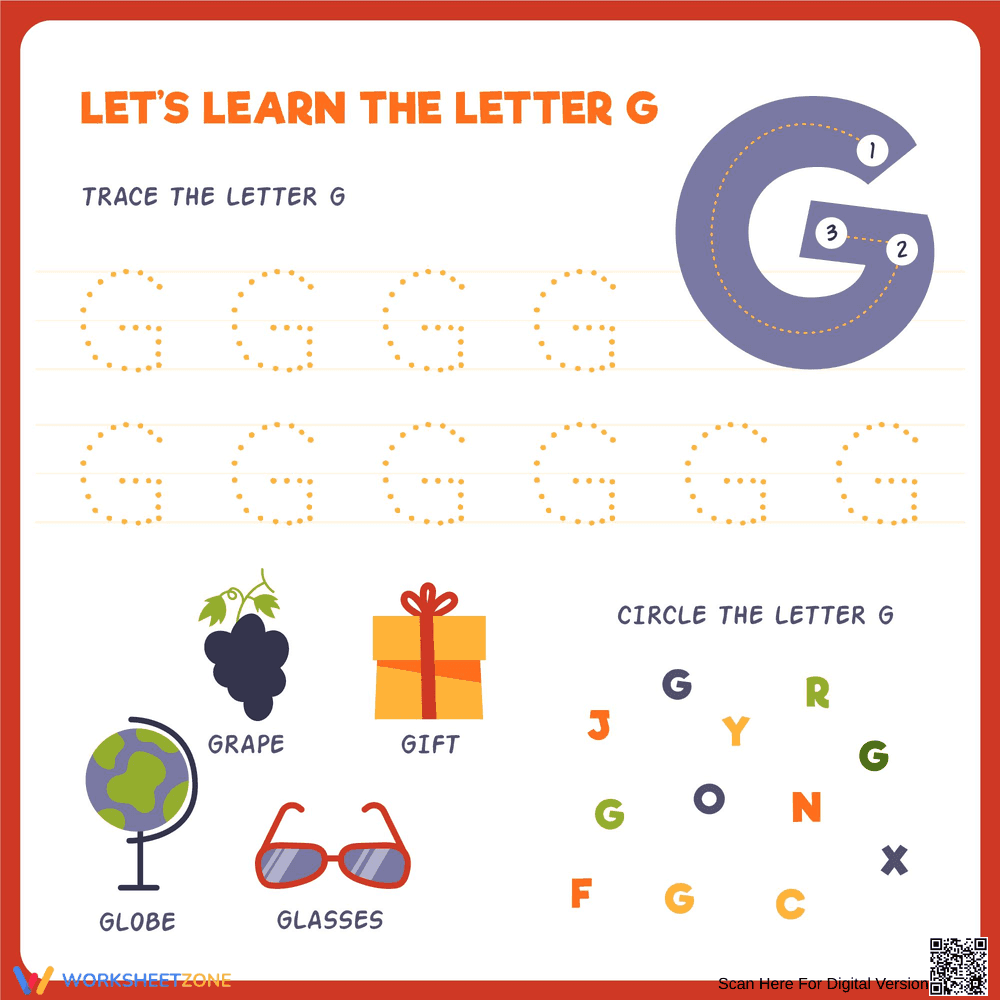

Letter G Handwriting Worksheet | Essential Kindergarten
Paste this activity's link or code into your existing LMS (Google Classroom, Canvas, Teams, Schoology, Moodle, etc.).
Students can open and work on the activity right away, with no student login required.
You'll still be able to track student progress and results from your teacher account.
This Kindergarten handwriting worksheet provides a comprehensive introduction to the letter G through tracing and visual identification. Students develop the fine motor control necessary for proper letter formation while reinforcing phonemic awareness with themed illustrations. By combining tactile tracing with a letter-search activity, the resource ensures students recognize the uppercase G in various contexts.
At a Glance
- Grade: Kindergarten · Subject: Handwriting
- Standard:
CCSS.ELA-LITERACY.L.K.1.A— Print many upper- and lowercase letters with proper form- Skill Focus: Letter G formation and recognition
- Format: 1 page · 15 problems · Answer key included · PDF
- Best For: Morning work or literacy centers
- Time: 10–15 minutes
The worksheet features a large guided letter G with numbered stroke arrows to model correct pencil movement. Below, students find 10 dashed-line tracing opportunities to practice consistency. The bottom half includes four vocabulary images (Grape, Gift, Globe, Glasses) to anchor the letter sound, alongside a "Circle the Letter G" discrimination grid containing 12 different characters to test visual accuracy.
This resource is designed for immediate classroom implementation with a total teacher prep time of under 2 minutes. First, print the single-page PDF for your entire cohort. Second, distribute the sheets during your phonics block or as a quiet transition activity. Finally, review the letter-search grid as a whole group to provide instant feedback on letter discrimination. This makes it an ideal choice for substitute plans.
This activity aligns directly with CCSS.ELA-LITERACY.L.K.1.A, which requires students to print letters accurately. It also supports foundational reading skills by connecting letter shapes to initial sounds in common nouns. Both standard codes can be copied directly into lesson plans, IEP goals, or district curriculum mapping tools to ensure compliance with state and national literacy frameworks.
Use this worksheet during the "You Do" phase of a gradual release model after demonstrating the letter G on a whiteboard. It serves as an excellent formative assessment; observe students' grip and stroke order as they work through the 10 tracing repetitions. Expect most Kindergarteners to complete the full page within 12 minutes, making it a perfect fit for fast-paced literacy rotations.
This resource is tailored for early learners, including English Language Learners who benefit from the visual cues provided by the labeled illustrations. It pairs perfectly with an alphabet anchor chart or a tactile sand-tray writing lesson to provide multi-sensory reinforcement for students struggling with letter reversals. The clear layout ensures that students with focus challenges can complete the tasks without distraction.
Effective handwriting instruction in early childhood is a critical predictor of later literacy success, as noted in the RAND AIRS 2024 report. This worksheet targets the specific mechanical requirements of CCSS.ELA-LITERACY.L.K.1.A by providing structured tracing paths that build muscle memory. Research from Fisher & Frey (2014) emphasizes that guided practice in letter formation allows students to transition from cognitive effort to automaticity, freeing up mental resources for higher-level composition tasks. By integrating 15 distinct tasks—including tracing, visual identification, and letter discrimination—this resource provides the high-frequency exposure necessary for mastery. The inclusion of numbered stroke guides ensures that students do not develop inefficient habits, which can be difficult to correct in later grades. This printable PDF serves as a foundational tool for developing the neat handwriting and letter recognition skills essential for Kindergarten readiness and beyond.


